
Introducing solids: Dos and Don'ts of feeding solid food to 6-month-old babies
Team ParentCircle
ParentCircle empowers parents to raise successful children through holistic parenting.
Are you looking for food options to introduce after exclusively breastfeeding your baby for six months? Here are some expert tips on introducing solid foods to your baby while you continue to breastfeed
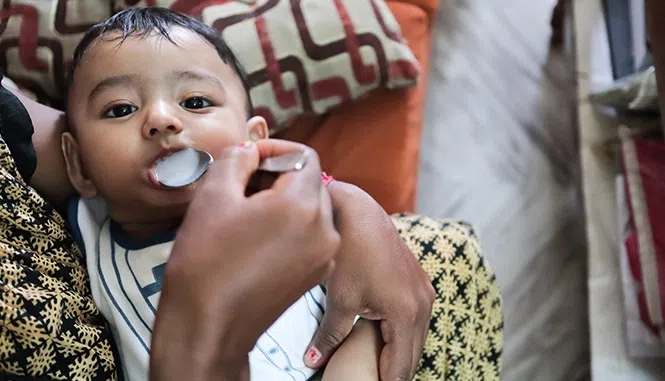
According to the guidelines of the World Health Organization (WHO) and UNICEF, the introduction of solid foods is recommended only when the baby is of 6 months together with continued breastfeeding up to 2 years of age or beyond.
Starting solid foods at 6 months of age
If you are a new parent and have been exclusively breastfeeding your baby until 6 months of age, it is time to introduce solid foods, along with continued breastfeeding. Remember that the initial foods introduced to 6-month-old babies are meant to supplement breastfeeding—these solid foods are not replacements for breast milk.
As nutritionist Dr Anjali V Bhatt says, “As you slowly add solid foods to your baby’s diet, continue to breastfeed them till the time they are at least 12 months. You can continue to breastfeed beyond that too if both you and your child are comfortable. About starting solids, when the baby is 6 months old, you can start by introducing 2–3 spoonfuls of soft foods into their diet, along with continued breastfeeding. Options like porridge, mashed fruits, or vegetables can be offered twice a day.”
Signs that your baby is ready for solids
How do you know if your baby is ready for solids along with breast milk or formula? Ms Bhatt says, “Babies show different signs when they are ready to start eating a little bit of solid foods.
Here are some common signs:
- Sitting up with support: When your baby can sit up well with support, it is time to introduce solid foods.
- Good head control: When your baby can hold their head steady, they are less likely to choke on food.
- Doubled birth weight: This is a good sign that your baby is getting ready for some solid foods along with breast milk or formula.
- Showing interest in food: The best cue to start solids is when your baby shows interest in food at family mealtimes."
Dos and don’ts while feeding solid foods
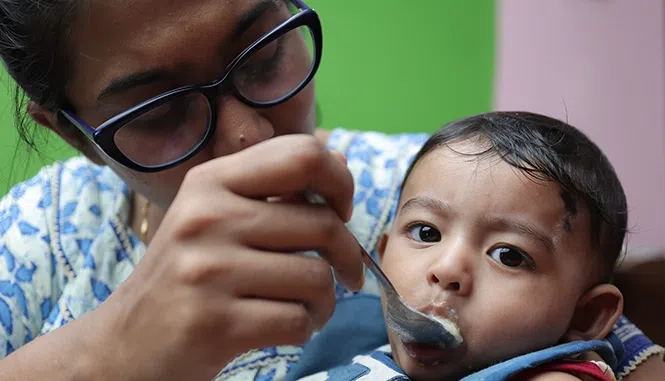
Here are some pointers from Ms Bhatt on introducing solids to your baby:
- Start with liquid and semiliquid foods and observe your baby. Only when your baby has taken the liquid foods well and is able to digest without any issues, introduce semisolid foods.
- You can also start with soft and easily digestible foods like rice, banana or boiled potato.
- Start with clear liquids like vegetable soup, or soup made from pulses. And slowly increase the consistency.
- Cooked foods are safest, as they get sterilized during cooking and pose minimal risk of stomach infections to babies. Cooking also increases digestibility. Once your baby’s gut has developed, a variety of uncooked foods can be given slowly.
- Before introducing fruits, feed your baby soft-boiled vegetables, cereals and pulses. Babies usually reject other foods once they get a taste of sweet fruits.
- You can mix small amounts of well-cooked soft foods with breast milk or regular milk to avoid digestive issues.
- Introduce new foods one at a time, waiting a few days between two new foods.
- Do not introduce finger foods initially; you can offer them when your baby starts teething.
- Avoid pulses with hard husk or large grain pulses like kidney beans and broad beans. Green gram or moong dal is the best pulse to introduce to babies.
- Once your baby is able to digest green gram (when your baby is around 8 to 9 months old), start them on solid foods by gradually mixing other pulses with green grams in small quantities. This prevents colic and indigestion.
- Inclusion of a variety of millets, pulses, vegetables, fruits and fats is important as your baby transitions to solid foods.
(Dr Anjali Bhatt is PhD in Food Science and Nutrition and a Yoga coach)























Comments
Edit
Comment Flag
Cancel Update