
Sponsored
Myopia in children: Possible causes, symptoms to look out for, and expert opinion
Kerina De Floras Felix
author parentcircle author parentcircle author parentcircle author parentcircle author parentcircle author parentcircle author parentcircle author parentcircle author parentcircle author parentcircle author parentcircle author parentcircle
Myopia or nearsightedness is a common eye condition in children, where close-up objects look clear but distant objects are blurry. Hear from the experts in the eyewear industry on its causes, symptoms, and treatment
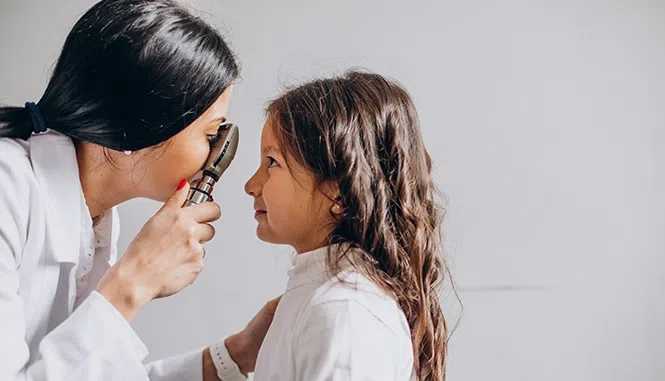
If your child has trouble seeing distant objects clearly, squints often, and comes closer to the objects to see clearly, or complains of eyestrains and headaches, chances are that they might be developing myopia or nearsightedness. What is this condition that is rapidly becoming common among children? In this article, we talk about myopia, its possible causes, and symptoms that parents can look out for to identify this eye condition in young children and take a close look at how Essilor® Stellest® lenses, a leading brand in vision correction and protection, can be used for children to slow down the progression of myopia.
What is myopia?
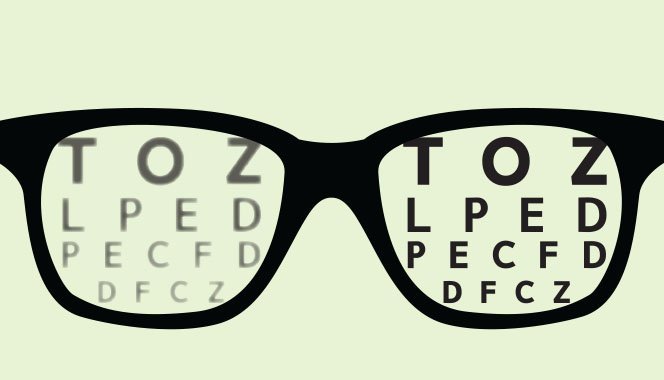
Myopia or nearsightedness is an eye condition that makes it difficult to see distant objects clearly.1 It is often diagnosed in school-going children and young adults. Children with myopia have slightly elongated eyeballs, or their cornea (the clear part in front of the eye) may be curved.2 This causes light to focus in front of the retina (inner part of the eye), rather than directly on it, making distant objects appear blurry.
Childhood myopia is often caused by rapid or extended eye development.2 Spending too much time on nearsighted activities like reading, coloring, or watching TV; genetics; and environmental factors can also cause this eye condition in children.3, 4
The rising cases of childhood myopia
According to a study that reviewed the increasing prevalence of myopia globally, about 50 percent of the world’s population will be affected by myopia by 2050.5
“In the last few years, we are seeing more children with big jumps in their refractive power, and myopia is progressing much faster than before. Extended near-eye activity combined with less time outdoors or genetics can cause myopia. The only solution is to have children come for an eye test as soon as possible and frequent eye checkups.” – Dr Pradeep Sharma, Centre For Sight group of hospitals
Early signs of myopia in children
Myopia symptoms are quite easy to spot and most of the cases that walk into the hospital are because a parent or teacher has identified that the child is having a problem seeing things at a distance.
“Post COVID-19, after almost two years of attending online classes on laptops and phones with reduced time spent outdoors playing, when children came back to school, teachers realized that quite a few could not see the words written on the blackboard from a distance.” – Ananthlakshmi S, Professional Services Head, Essilor® 6
Children with this eye condition (myopia or nearsightedness) may be able to see clearly up close, but they may:
- have blurry vision of objects that are far away
- squint or blink more than normal
- have trouble reading from the class blackboard
- hold books or toys closer to their eyes
- sit too close to the television
- rub their eyes frequently
- complain of headaches or eye pain.
If your child shows any of these signs, consult an ophthalmologist (eye doctor) or book an eye examination immediately.
How can myopia be treated?
Myopia can be controlled or slowed, but each solution has its own advantages and disadvantages.
- Myopia control spectacle lens designs, which work by changing how light falls on the retina
- Orthokeratology, the use of specially designed contact lenses to reshape the cornea
- Eye drops
- Changes in daily habits, like spending more time outdoors and less time on nearsighted activities.
For kids, a non-invasive, aesthetic, simple, and easy-to-use myopia control solution is the most preferred one. Any myopia control solution recommended by an eye care professional needs to have a consistent follow-up, which is the key to myopia management.
Essilor® Stellest™ Lenses to correct and control myopia
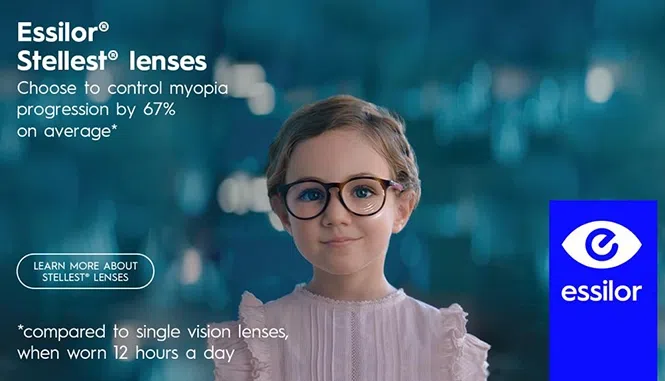
Compared to single-vision lenses, which are usually prescribed for myopia or other refractive eye conditions, Essilor® Stellest® lenses have been found to slow down the progression of myopia by 67% on average (when worn for 12 hours a day, every day).7 How? Essilor® Stellest® lenses correct myopia using a large single-vision zone that focuses light on the retina, providing clear vision. They also use the H.A.L.T. (Highly Aspherical Lenslet Target) technology, to slow down the myopia progression.7 In this method, a collection of 1,021 invisible lenslets positioned in 11 rings create a volume of non-focused light in front of the retina, acting as a shield against eye elongation and leading to slowing down the progression of myopia. Essilor® Stellest® lenses are recommended for myopic children between the ages of 6 to 16 years and can be prescribed as soon as myopia progression is detected.
Essilor® Stellest® lenses are Essilor®’s best solution to fight your child’s myopia and control myopia progression. Ask your eye care professional about Essilor® Stellest® lenses today, or visit www.essilorindia.com/stellest.
Is myopia curable?
While myopia cannot be cured or reversed, its rapid progression can be controlled or slowed. Here are a few things you can do to keep your child’s myopia progress in check.
- Get your child’s eyes checked regularly
- Make sure they wear the prescribed corrective lenses – remember, with regular single-vision glasses, vision is corrected, but myopia can still progress
- Let them take breaks when doing near-sighted activities
- Encourage at least two hours of playtime outdoors.
“Young kids may not be able to express that they cannot see objects at a distance clearly. In these cases, parents and teachers need to be sensitive towards children and watch out for symptoms of myopia – a lot of time parents might think or say the child is bluffing or making excuses. Children need frequent eye examinations and more often if the child is already wearing spectacles for myopia,” says Dr Vijaya Vasanthakumar, Medical & Professional Affairs Director, Essilor®
An eye test today can help your child’s developing vision. By focusing on helping children spend more time outdoors and less time on nearsighted activities that require them to be stationary, myopia and other eye conditions can be prevented or slowed down. Make small changes in your child’s routine to help them enjoy clear vision.
References:
- https://www.aao.org/eye-health/diseases/myopia-nearsightedness. Accessed & adapted from American Academy of Ophthalmology on 28 Sep 2023.
- Hou W, et al. Axial elongation in myopic children and its association with myopia progression in the Correction of Myopia Evaluation Trial (COMET). Eye Contact Lens. 2018 July; 44(4): 248–259.
- Flitcroft DI. The complex interactions of retinal, optical and environmental factors in myopia aetiology. Progress in retinal and eye research. 2012;31(6):622-60.
- Morgan IG, Ohno-Matsui K, Saw SM. Myopia. The Lancet. 2012;379(9827):1739-48.
- Holden BA, Fricke TR, Wilson DA, Jong M, Naidoo KS, Sankaridurg P, Wong TY, Naduvilath TJ, Resnikoff S. Global Prevalence of Myopia and High Myopia and Temporal Trends from 2000 through 2050. Ophthalmology. 2016 May;123(5):1036-42. doi: 10.1016/j.ophtha.2016.01.006. Epub 2016 Feb 11. PMID: 26875007.
- Saara K, Swetha S, Subhiksha R, Amirthaa M, Anuradha N. Steep increase in myopia among public school-going children in South India after COVID-19 home confinement. Indian Journal of Ophthalmology. 2022 Aug;70(8):3040.
- Bao J, Huang Y, Li X, Yang A, Zhou F, Wu J, et al. Spectacle Lenses With Aspherical Lenslets for Myopia Control vs Single-Vision Spectacle Lenses: A Randomized Clinical Trial. JAMA Ophthalmol. 2022;140(5):472-8.



















Comments
Edit
Comment Flag
Cancel Update