
Help! Why Does My Child Refuse To Take Medicine? Is There A Way Out?
Team ParentCircle
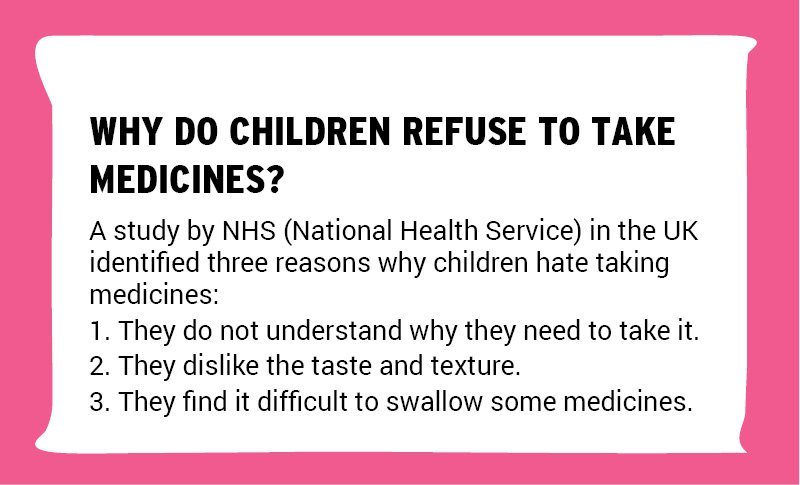
Does your child give you a point-blank NO every time you take a spoonful of medicine to them? It's time to outsmart your little smarty!
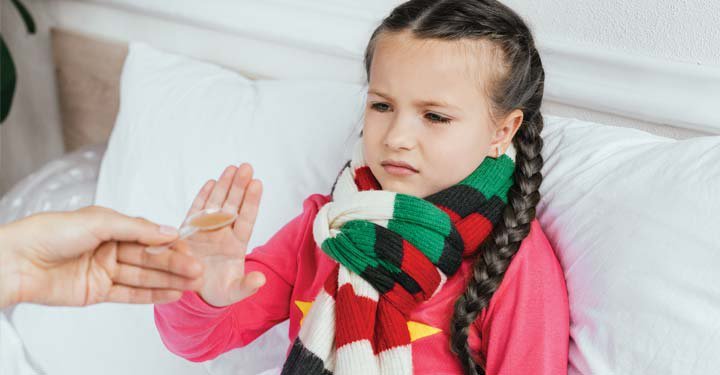
Four-year-old Arun is running around the cot, trying to escape from his mom, Aaravi. She has an antibiotic in her hand for Arun, who has been suffering from a mild bacterial infection. With great difficulty, Aaravi catches Arun and tries to convince him to have the medicine. But Arun is in no mood to listen. He extends his hands and, in a sweep, pushes the spoon away, spilling the syrup all over the cot. Aaravi lets out an exasperated grunt and is almost in tears.
Do you empathise with Aaravi? We get your anger and frustration. Handling a sick child is not easy, let alone handling a sick child who is refusing to cooperate. And we know you are worried about your child's health more than ever. How do you get those few precious drops of medicine into your child's mouth? We offer some tips and tricks:
Tips To Get Your Child To Take Medicines
- Offer a treat: This is one occasion when a bribe is acceptable. Tempt your child with a new story to read or a treat if they take the medicine.
- Let your child decide: If the medicine syrup comes in different flavors or colors, take your child to the store and let them choose their favorite. Valuing their choice will make them feel important. Hopefully, they won't resist taking the medicine now.
- Improve the taste: Try adding honey to the medicine or mix the syrup in milk or fruit juice (at room temperature). However, this method is not advisable for all medicines. It is best to check with your pediatrician before you do this.
- Display a sticker chart: Which child would say no to attractive stickers? Give your child an appreciative sticker each time they comply.
- Make the medicine delivery attractive: Try to make the medicine delivery as fun as you possibly can. A new spoon with a favorite cartoon character or a syringe with a ribbon can sometimes make all the difference.
- Keep calm: Easier said than done, you will argue, but try not to display your tension. Your child will pick up on your anxiety and react to it. Matter-of-factly talk about the medicine and let them know that everybody takes medicines now and then.
- Doctor play: Encourage your child to play doctor with their doll patients. Let them write out the medicine for their patients. In the process, encourage them to give the medicine to the patients. Get your child a children's doctor set, an attractive dropper, a tiny spoon, and a make-believe medicine bottle. Turn it into a game and sneak in the medicine at the right time. Smart strategy, ah!
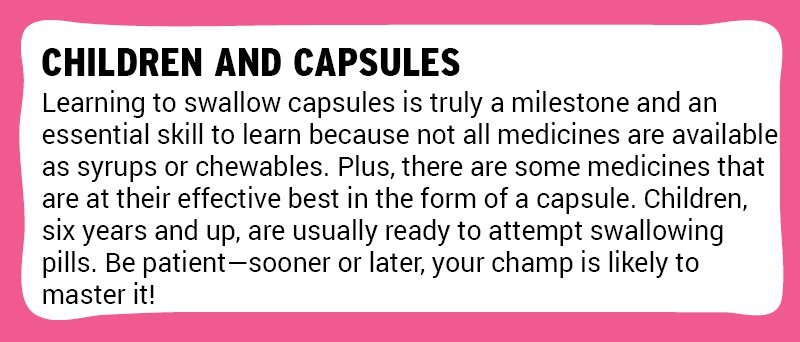
- Request your doctor for options: If your child's pediatrician has prescribed a tablet/medicine, make sure you enquire about all the other equivalent options available. There may be better-tasting ones or concentrated options available that will need to be taken fewer times. Chewables work better for some children.
- Numb the taste buds: Sometimes, when you consume something cold, your taste buds turn numb, and you can't taste anything immediately after. If you are comfortable trying this out with your child and confident she won't catch a cold, go ahead after checking with your child's doctor. Give her an ice pop and offer the medicine right after. But do not try this if your child is less than four years old.
- Sidestep the taste buds: Taste buds are focused on the front and center of the tongue. So, try using a dropper and let the medicine quickly drip into the back of your child's tongue. But you may need some practice to succeed at this. You may also need someone's help to keep your child still while you manage this laudable feat!
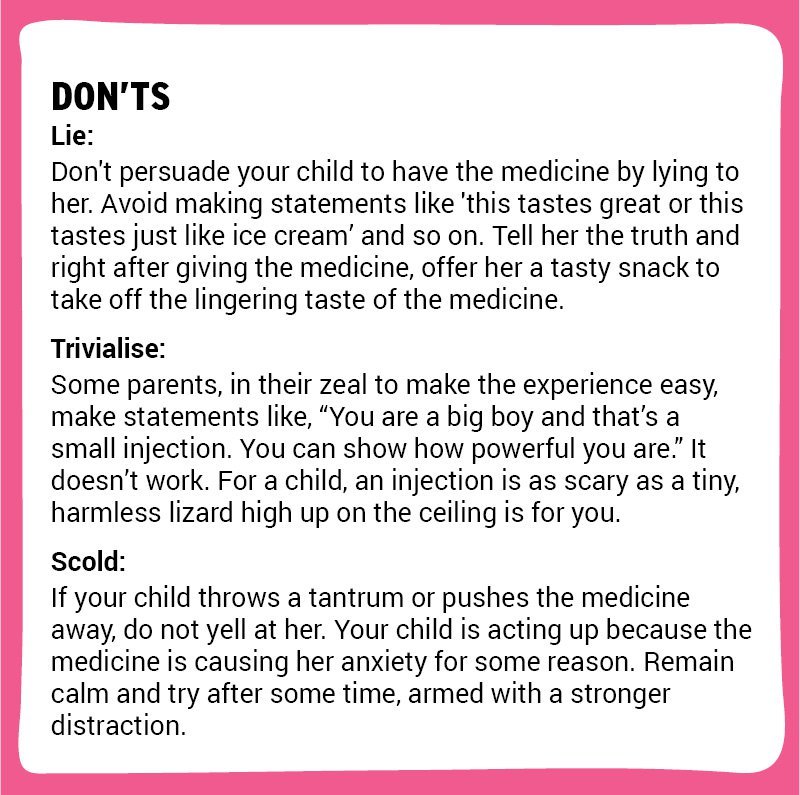
- Distract: Let your imagination run wild! Come up with creative ways to distract your toddler while you sneak in the medicine. Ravi, a father of a four-year-old, says, "When it is medicine time, the medicine becomes a plane that is landing straight into my child's mouth, and he becomes the pilot, totally focussed on applying the brakes! And in goes the medicine without any fuss.
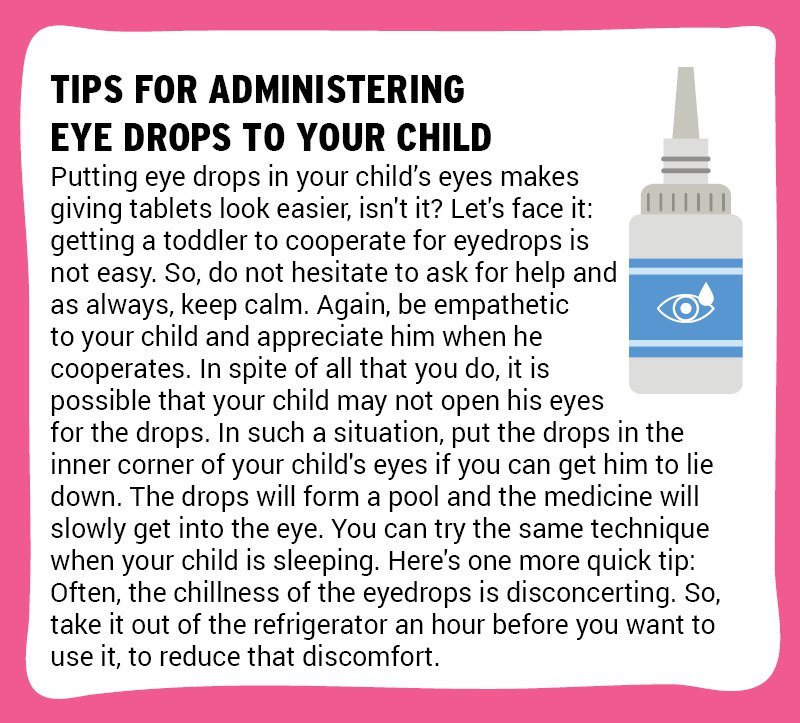
Often, the chillness of the eyedrops is disconcerting. So, take it out of the refrigerator an hour before you want to use it to reduce that discomfort.
We hope these tips help reduce your stress a little. While you appreciate and reward your child after every successful medicine gulp, remember to pat yourself, too! It's not easy. You need the cheers as much as your child does.
























Comments
Edit
Comment Flag
Cancel Update