
Early Puberty In Girls: Key Causes, Symptoms, And What You Need To Know
Shirley Johanna
Puberty is a natural process that every child goes through. But it can be worrisome if it occurs when your child is still playing with her dolls! Read on to know more about early puberty in girls.

"I got my first period when I was 7.5 years old. But the worst part is that it happened when I was at school. Clueless about menstruation, I got scared when I saw my skirt stained. I thought I had some disease and was going to die! Although this incident happened 12 years ago, I still remember my classmate's comments and how I ran to the staffroom crying! I calmed down only when I was sent home and saw my mom. I told her that I never wanted to go to school again," recalls Saranya, a college student.
Precocious puberty, also known as early puberty, can be quite distressing for a child. Early puberty is when a child's body begins to change into that of an adult too soon. Puberty, which usually begins in girls between 8 and 13 years of age, involves the rapid growth of bones and muscles, changes in body shape and size, and the development of the body's ability to reproduce. When the signs of puberty start to show in girls before the age of 8, it is considered precocious puberty.
What are the signs of early puberty in girls?
The signs of early puberty and puberty are the same, it's the timing that differs. The signs include:
- Rapid height growth
- Breast development
- Pubic or underarm hair growth
- First menstruation
- Acne
- Body odor
Two types of precocious puberty
Two types of early puberty may affect a young girl:
- Central precocious puberty: This is the most common type of early puberty. In central precocious puberty, the pituitary gland releases hormones called gonadotropins, which stimulate the ovaries to produce the sex hormone, estrogen. Estrogen causes the changes of puberty, such as breast development.
- Peripheral precocious puberty: In this type, which is less common, the pituitary gland is not involved. Instead, puberty is caused by estrogen because of problems with the ovaries, the adrenal glands, or the thyroid gland.
What causes early puberty?
Dr Akta Bajaj, senior consultant and head (gynecology), Ujala Cygnus Group of Hospitals, New Delhi, says, "Genetics is one of the main factors. If a mother had early puberty, the chances of her daughter hitting puberty early are also high. The pituitary gland in our brain helps in the secretion of hormones that play a key role in puberty. Any trauma to the brain due to an injury, infection, or tumor disrupts the hormones, causing early puberty. Other factors such as lifestyle changes and poor nutrition can also increase the risk of precocious puberty in girls."
Other possible causes of early onset of puberty in girls include:
- Consumption of poultry and meat treated with hormones and antibiotics.
- Tumors or growths on ovaries, adrenal glands, or the pituitary gland.
- Early childhood exposure to endocrine disruptors such as bisphenol A (BPA) in plastics and dichlorobenzene in mothballs and air deodorizers.
- Early childhood exposure to estrogen is found in over-the-counter creams, medications, and nutritional supplements.
Also, studies show that obesity in girls can lead to early onset of puberty. But don't let these factors worry you, as in the majority of cases, there's no known reason for early puberty.
What are the complications?
Early puberty may cause physical and emotional complications, though, in many children, it doesn't lead to any long-term health problems. Complications include shorter height (the children grow quickly and stop growing when puberty hits), low self-esteem, and stress. Also, studies have found a link between early puberty in girls and a significantly higher risk of developing breast cancer later in life.
How is early puberty treated?
Treatment depends on the cause of precocious puberty. Children who show signs of early puberty require treatment. Different types of treatments are available to reverse early puberty, depending on the cause. "Reversing early puberty helps prevent stunted growth in children," says Dr Bajaj.
Before starting the treatment, a pediatric endocrinologist will suggest a few tests—blood tests to detect hormone levels, an X-ray to evaluate growth and bone maturity, an ultrasound to check for ovarian cysts, and an MRI of the brain. After analyzing the test results, the doctor may prescribe medications to stop or slow the onset of early puberty. The treatment usually involves hormone therapy with a medication called LHRH analogs (synthetic hormones), which stop the production of sex hormones that cause early puberty. The other treatment for early puberty is surgery, which is rarely needed unless the cause is a tumor.
How to prevent early puberty
Early puberty that occurs due to genetic factors cannot be prevented. But you can take these steps to minimize the environmental causes of early puberty:
- Avoid exposing your child to external sources of estrogen, such as medications and nutritional supplements.
- Encourage her to maintain a healthy body weight.
- Offer free-range organic produce to your child to reduce exposure to hormones, pesticides, and fertilizers.
- Encourage her to eat fresh foods, as packaged and processed ones contain chemicals such as phthalates.
- Avoid storing food in plastic containers and plastic wraps.
Talking to your daughter about periods
Puberty can be extremely stressful for your child, especially if she isn't prepared for it. Talking to your child about periods need not be a stressful affair for you. All you need to do is give her a simple and honest explanation about what puberty is.
Here's what Arundhati Swamy, family counselor and head of the Parent Engagement Programme, ParentCircle, has to say about period talk. "There's no right time to talk about periods to your child. The earlier you prepare her, the better. Talk about periods whenever an opportunity presents itself, the first time your child sees a sanitary napkin at home, in a shop or an advertisement; or sees a stained garment. If her cousin has attained puberty or her friend talks to her about periods and she comes to you with questions, then have the period talk. If your child does not ask questions, you must initiate the conversation and explain to her what periods are, how and why they happen, and what to expect."
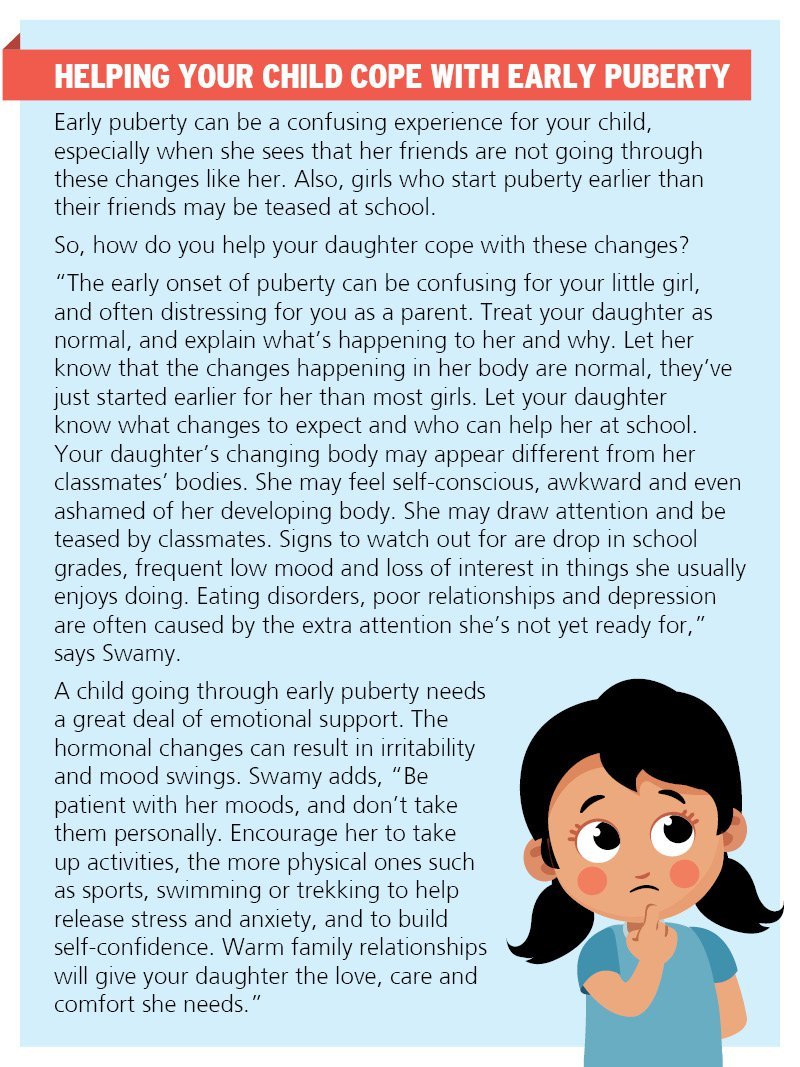
Early puberty is common among young girls these days. Although it usually doesn't lead to any long-term health problems, early puberty can be unsettling for your child and even you. Proper treatment and counseling can help your child stay happy and embrace the change.






















Comments
Edit
Comment Flag
Cancel Update