
Wondering how to talk to your child about periods? These tips will help you have the 'talk'
Team ParentCircle
ParentCircle empowers parents to raise successful children through holistic parenting.
As your child moves toward puberty, it is extremely important for you to have the period talk- with both your boy and your girl. In today’s world, the talk needs to start early, and boys need to be an integral part of this crucial phase of healthy discussions. Our expert perspective will help you along the way. Read on to find out more
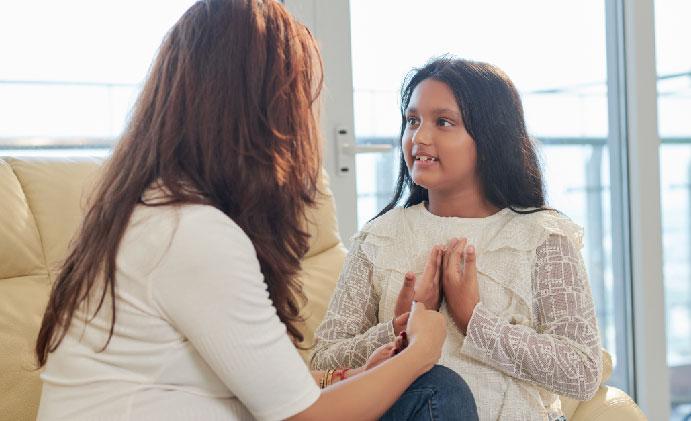
“I was 11 when I got my first period. Even though a few friends had got theirs before I did, I was totally unprepared. We were at the zoo that day and I saw my bloodstained panties when I took a loo break. I stuffed some very rough, not-so-high quality toilet paper in my panties and continued my day.” - Michelle, a marketing professional.
"I was in fifth grade when one day in school during the PE class, I saw my classmates giving me weird looks. A few of them were looking at me and sniggering. My friends came up to me and took me to the toilet, where, to my absolute horror, I saw my skirt stained with blood. I didn’t understand what was happening. One friend got me a pad from the school nurse and taught me how to stick it on. I was so embarrassed - I refused to go back to my class and phoned my mother to come and pick me up.” - Hannah, an IT specialist
Several years have passed since Michelle and Hannah experienced ‘those moments’ that every girl endures silently. Not much has changed. Even today, most parents just do not step forward when it comes to having that talk. And it is not a one-off event, it is a process. These stories highlight the importance of talking to your child about periods well before she gets her first period. ‘Period talk’ entails open, honest, and ongoing conversations with your prepubescent child. The idea is to give your child the message that she can come to you for reliable information and that you will answer all her questions and clarify her doubts without embarrassment.
Why having the period talk is important
Having the period talk with your girl is important for a number of reasons:
- It will help her be prepared for the changes ahead. She will not likely be embarrassed or confused but will know what to expect.
- It will educate her about how the human body works. Helping your child understand her body will positively influence her to make sound decisions about her health.
- It will send a key message to your child that you can be relied upon for providing accurate information about sensitive topics (that are ‘supposed’ to be embarrassing to discuss and seen through the lens of a taboo) in a comfortable manner.
- It will ensure your child is more judicious in her information-deciphering. After all, children will hear about menstruation anyway from their friends or other sources. By providing reliable information, you can ensure that your child will become capable of sorting out any misinformation, so it won’t be a ‘bad’ or ‘scary’ thing for her.
“Boys are curious too and should not be discounted as not needing to know about menstruation just because they are boys,” says Nicole Cheetham from Advocates for Youth, an organization that promotes effective adolescent sexual health programs and policies in the United States and the global south.
Having the period talk with your boy is equally important for a number of reasons:
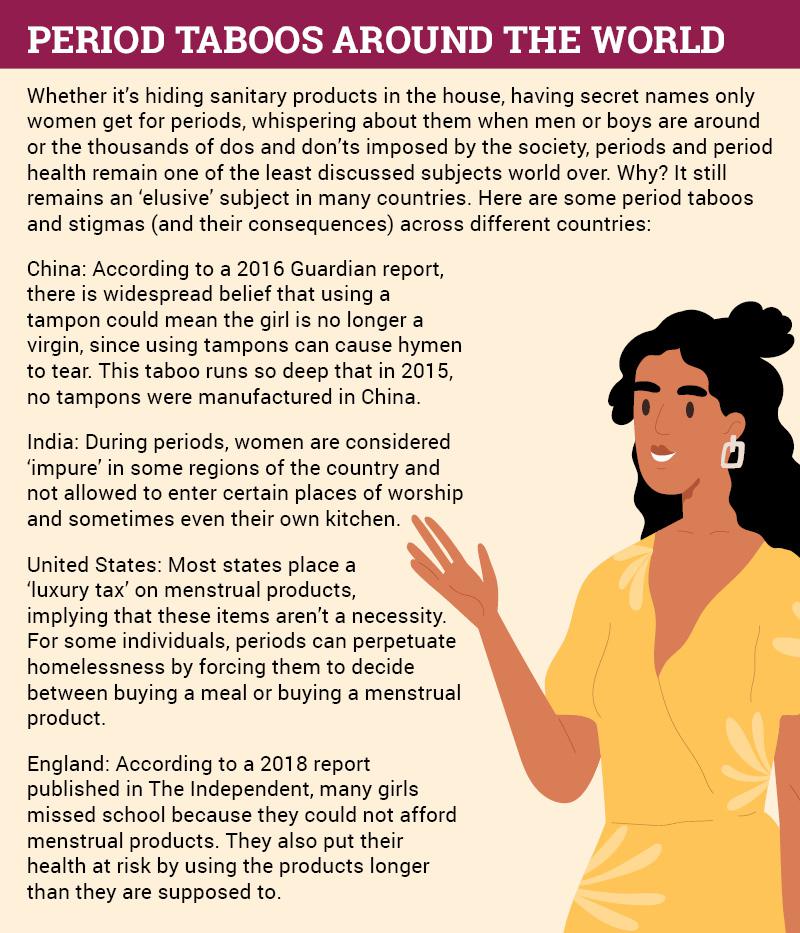
- Open conversations about periods busts myths about menstruation while also paving the way for a more egalitarian society (see box).
- Talking about periods openly with your child ensures it de-couples the concept from a sense of shame and secrecy, and educates children about periods being a normal, healthy, and important bodily function. Cheetham also says, “Educating boys about menstruation at a young age can help counter the stigma surrounding menstruation, enabling them to be more respectful of girls and knowledgeable and understanding of the changes that girls are experiencing."
Expert speakParentCircle interacted with Bonnie J Rough, author of the book Beyond Birds and Bees: Bringing Home a New Message to Our Kids about Sex, Love, and Equality, on the importance of talking to pre-teen boys about periods. Here’s what she has to say: “Being understanding, kind, and supportive of menstruating people in his life is not just desirable but important for a boy. The more he knows about menstruation, the less strange and odd it will seem. Information is power for him; he can use whatever he has learned to communicate and support girls and women around him. (By the way, this goes across all genders: developing fellow-feeling for other people’s puberty experiences can also work in favor of boys who would like friends to be understanding about their own potentially embarrassing situations, such as an unexpected erection). Also, it is a matter of gender equality. When bodies and their parts and functions are dramatized rather than normalized, they can become shrouded in secrecy, shame, and humiliation. These emotions can make a person feel diminished. In societies where menstruation is explained and normalized at home and in schools, there’s higher gender equality, less fear of the ‘other’ sex/gender, and an overall deeper sense of egalitarianism and human unity. Menstruation is one of the most obviously different body functions between men and women. Therefore, bringing menstruation out in the open and speaking of it as normal and acceptable is a single small effort that can do tremendous work toward producing gender equality.” |
When to have the period talk
Though the average global age of menarche (the first period) is 12 years, some girls may get their first period as early as eight or nine. So it’s best to start talking to prepubescent girls and boys (starting at the age of 7-8 years) about bodily functions, including those of the reproductive system. Talking about periods shouldn’t be restricted to one conversation at a particular age. It should start early and gradually build, based on your child’s understanding.
How to have the period talk
Below are some guidelines you can use in having the period talk with your child:
- Utilize day-to-day situations to initiate conversations about puberty in general, and periods in particular, with both your girl and boy. For example, you may ask your child what questions he has when you walk down the sanitary products aisle at the supermarket or when you catch a commercial for a sanitary pad on television.
- Keep your explanation age-appropriate and simple. Let your child’s level of understanding and maturity determine how specific you should get with the details.
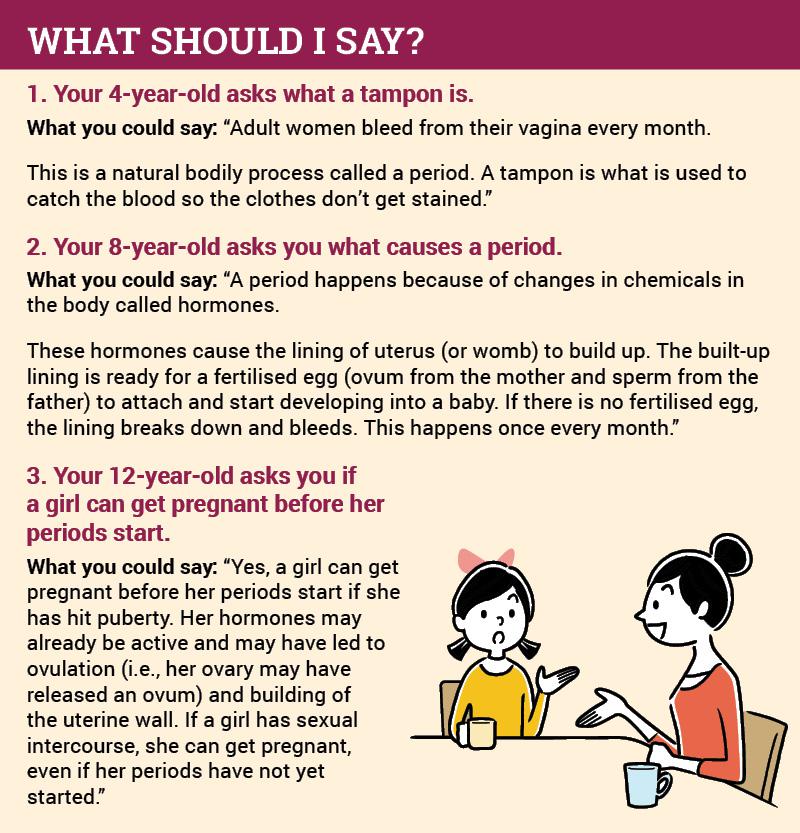
- Indulge in a series of conversations, rather than one talk. If you initially feel awkward, practice with a partner or friend by using the correct terminology and acting like it’s perfectly normal to talk about these things.
| “If you feel embarrassed or awkward while you rehearse using a normal chatty voice to talk about periods, then go ahead and let yourself laugh! You can also be really honest with your kids by telling them something like this: 'I think it’s important for our family to treat menstruation as normal and healthy—but nobody approached it that way with me when I was growing up, so I’ll be trying my best and we’ll learn together. I’ll try to help you, and you can help me, too.' Also, some children find it easier to talk without eye contact, so you could talk to your child while you’re traveling in the car", says Bonnie J. Rough. |
- If your child asks a question that catches you off-guard, stay calm and respond in a measured manner. It’s acceptable to say, “I will think about how to best answer this question and let you know.” Or if you really don’t know the answer, you can tell your child you’re glad he asked the question, that you will look for information, and come back to her. Ensure you get back to your child with a satisfactory response.
- Use correct names for genitals, such as penis, vagina, vulva, etc. Using correct names sends the message that talking about these body parts is normal and healthy. It is also an important part of keeping your child safe. It helps draw healthy body boundaries for your child and helps her communicate about her body if she needs to.
- A good way to have a conversation about periods is to follow these three steps:
- Find out what your child already knows. For example, if your 8-year-old boy asks you why girls bleed every month, you could ask him ‘why do you think they do?’
- Give your child facts and remember to correct any misinformation. For example, if he has heard from friends that periods’ blood is impure, you could provide him with the correct information.
- Use the conversation as an opportunity to talk further about the topic. For example, you could tell your child how he could support his peers (siblings, friends, and cousins).
- It is a good idea to convey clearly to your child that she can come back to you should she require more information
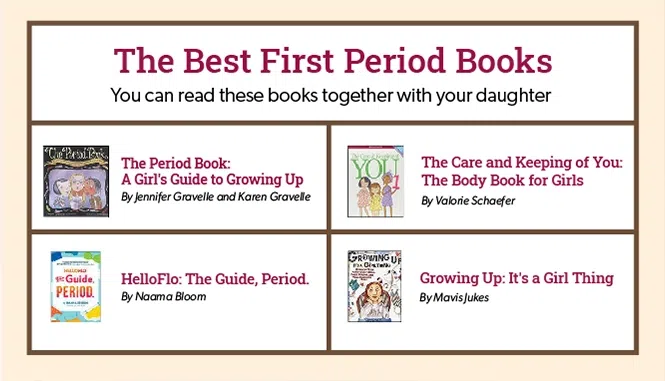
When your daughter reaches puberty, or a little before that (around 8-9 years of age), these are some of the things you could talk to her about:
Discuss puberty-related changes
- Discuss that she should expect the first signs of breasts (called buds) to appear and the areola (dark area around the nipple) to expand. Explain that it is normal for breasts to be tender and for the right and left breasts to grow at different rates.
- Explain that she should expect pubic hair to appear and get thicker. Discuss that her body shape will also change (for example, her hips will widen).
- Discuss that during puberty, a new sweat gland develops in the armpit and genital area. When skin bacteria feed off the sweat, it produces body odor. Acne can result from skin glands producing more oil. Give the products that will help her deal with body odor and acne.
Discuss the preparation for the first period
Discuss hygiene related to the menstrual cycle. Ensure your child has access to menstrual supplies and knows how to use them. Discuss the importance of changing the sanitary pad or tampon or menstrual cup several times a day, and of not wearing a tampon overnight.
- Discuss that for a few months before she gets her first period, she will get a clear or whitish discharge from her vagina. This is completely normal and is a signal that her periods are about to start.
- Make a period kit with supplies such as a sanitary pad and spare underwear. Have your girl keep it in her locker at school or carry it in her bag at all times. Discuss with her what she could do if she gets her period when outside, or if her clothes get stained.
Discuss periods-related considerations
Explain that initially, her periods may be irregular, as her body adapts to rapid physiological changes. Teach her how to track and calculate her menstrual cycle. Discuss that she may experience some cramps before or during her periods. Suggest ways to alleviate the cramps, such as doing physical exercise or using a hot water bottle.
- Discuss the activities she can participate in during her periods. Reassure her that she can swim, do horseback riding, and attend physical education classes during her periods. Exercise can sometimes even ease the cramps associated with periods.
- Discuss the feeling of fatigue and low energy sometimes experienced during periods. Discuss ways in which she could help herself feel better.
- Explain what Pre-Menstrual Syndrome (PMS) is and how it can affect one’s mood and body. Discuss that PMS doesn’t usually affect all girls and doesn’t usually begin until several years after menstruation starts, if ever. For those who do get affected by PMS, plenty of rest, exercise, and eating a nutritious diet help.
- Girls with a delayed onset of the menstrual cycle may become anxious when their friends talk about periods. Some begin to feel there’s something wrong with them. Talk to your child about her feelings and reassure her, and if she hasn’t experienced menarche by the time she turns 15, take her to an obstetrician-gynaecologist.
When your son reaches puberty, or a little before that (around 8-9 years of age), these are some of the things you could talk to him about:
- Teach your boy a few specific ways to be helpful to menstruating friends or relatives. Bonnie J Rough recommends what these ways can be. She says, “What are the names of period supplies, and how do they work? Can he practice fetching them from the store with a sister or friend, in case he should need to do this alone on her behalf sometime? And what should he do if a friend has had a leak of menstrual fluid on her clothes? Can he offer an item of clothing for his friend to tie around her waist until she can change it? I think any boy, or really any person at all, would rather be a hero than a bully. Let’s give children that chance by teaching them to be knowledgeable and helpful about periods."
- Teach your boy how to respond when someone in his peer group cracks jokes about periods. Teach him to think courteously and compassionately about menstruating people in his life. Developing empathy for other people’s puberty experiences can also work in favor of boys who would like friends to be understanding about their own potentially embarrassing situations, such as an unexpected erection.
In a nutshell
- It is important to have ‘period talk’ with your prepubescent child. It entails open, honest, and ongoing conversations with both your girl and boy.
- Talking about periods openly to your child de-couples the concept from a sense of shame and secrecy, and educates children about periods being a normal, healthy, and important bodily function.
- Keep your explanation age-appropriate and simple. Let your child’s level of understanding and maturity determine how specific you may want to get with the details.
- Help your daughter be prepared for menarche. Help your boy support girls around him (peers, cousins, or his own sister) thereby breaking down period taboos.
What you can do right away…
- Practice with a partner or friend using the correct terminology and acting like it’s perfectly normal to talk about periods with your child.
- Utilize day-to-day situations to initiate conversations about puberty in general, and periods in particular, with both your prepubescent girl and boy.
- Teach your child how to practice empathy toward menstruating others.


























Comments
Edit
Comment Flag
Cancel Update