
Healthy Solid Foods To Help Toddlers Gain Weight And Support Growth Naturally
Shiny Lizia M
If your toddler is on the leaner side, don’t stress—many children take time to gain weight. Introducing healthy, nutrient-rich solid foods can help your little one grow stronger and stay active without resorting to unhealthy options
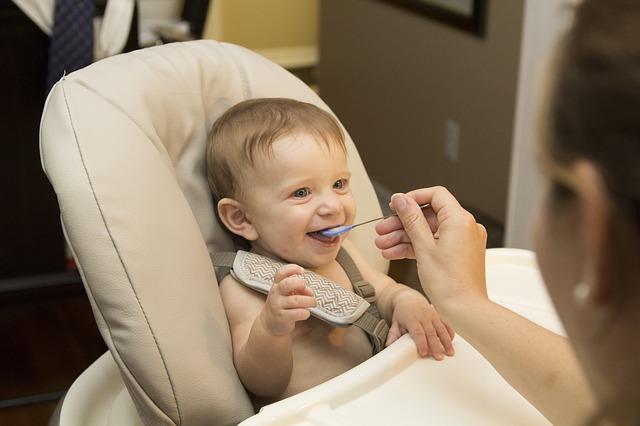
Archita, mother to a two-year-old boy, was often worried about her baby's low weight. She tried increasing the quantity of food, but to no avail. It was only after an appointment with the doctor and the nutritionist that she realised there are specific foods that help gain weight in different age groups. After following this routine, the results started to show, and today, Archita is a happy mother with a healthy child.
Archita's case is not a solitary one. Low body weight in your toddler can lead to health problems. When your baby becomes a toddler, there is a transition from dependent to independent feeding, and they start to acquire self-feeding skills and individual food choices. They may reject certain foods during this period, leading to irregular weight gain.
WHO recommends that babies start receiving complementary foods at 6 months of age in addition to breast milk, initially 2-3 times a day between 6-8 months, increasing to 3-4 times daily between 9-11 months and 12-24 months with additional nutritious snacks offered 1-2 times per day, as desired.
Complementary feeding
Introducing your baby to solid foods is referred to as weaning or complementary feeding, which should ideally start after six months of exclusive breastfeeding. Children cannot eat large quantities of food in one sitting at a given time. So, they should be fed small quantities at frequent intervals (around 4 times a day). The baby may find full solid foods difficult to chew and hence try to swallow them, which may lead to choking and indigestion.
Therefore, the food should be of semi-solid consistency for easy swallowing. When such semi-solid foods are offered initially, your baby tends to spit them out.
Calorie Requirement:
According to the National Institute of Nutrition, under the Indian Council of Medical Research, the recommended calorie allowance for 2-4-year-old children ranges from 1060-1350 Kcal per day.
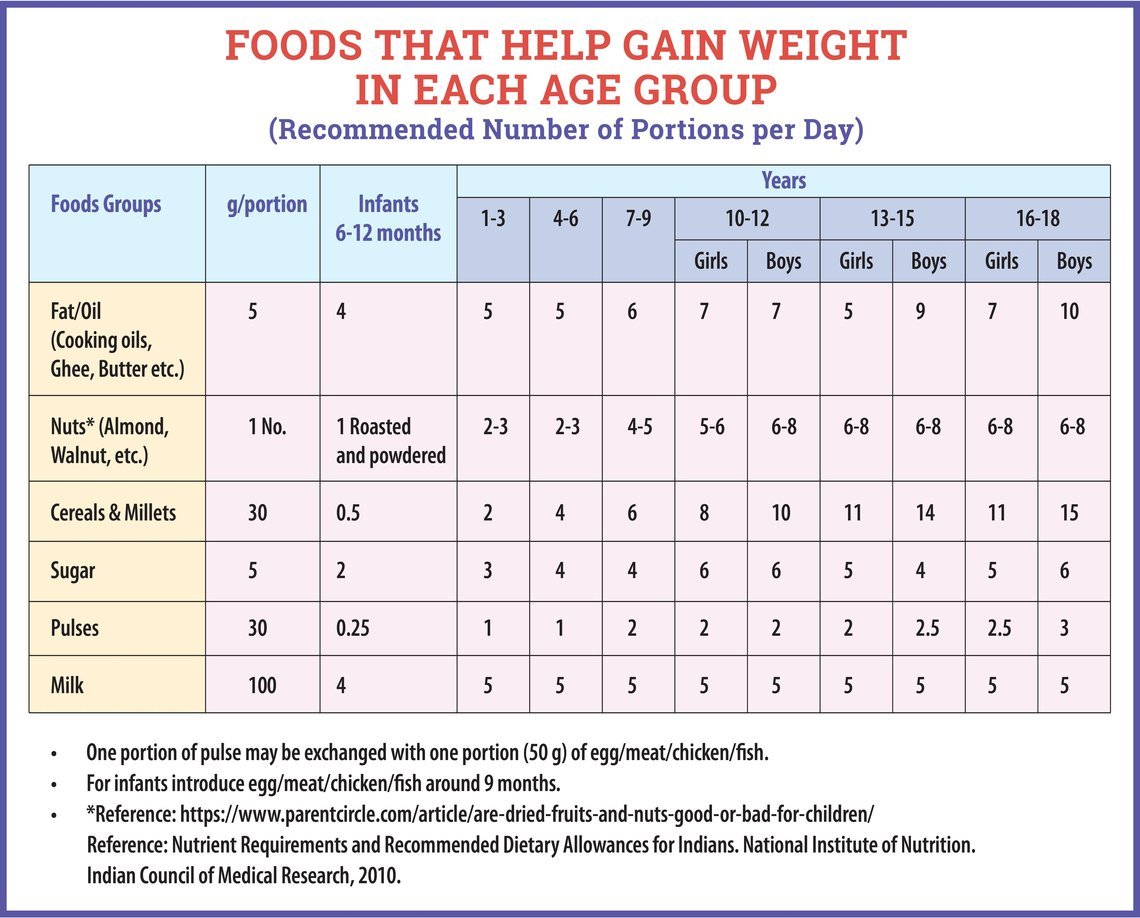
Calorie requirement:
| Foods Group: | Fat/Oil (Cooking oils, Ghee, Butter, etc.) |
| g/portion | 5 |
| Age groups | Portions/Day |
| Infants 6-12 months | 4 |
| 1-3 years | 5 |
| 4-6 years | 5 |
| 7-9 years | 6 |
| 10-12 years | 7 (Girls) 7(Boys) |
| 13-15 years | 5 (Girls ) 9 (Boys ) |
| 16-18 years | 7 (Girls ) 10 (Boys ) |
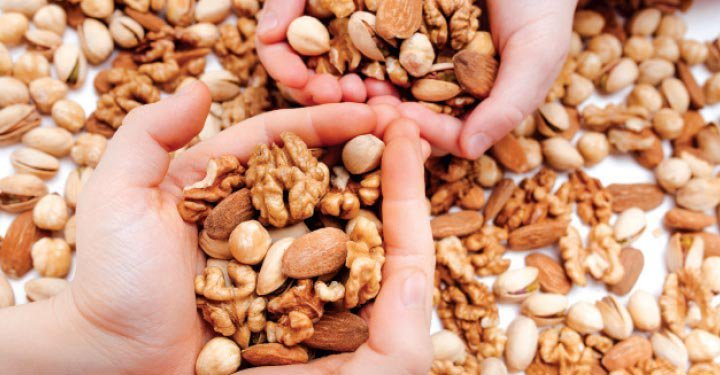
| Foods Group: | Nuts* (Almond, Walnut, etc.) |
| g/portion | 1 No. |
| Age groups | Portions/Day |
| Infants 6-12 months | 1 roasted and powdered |
| 1-3 years | 2-3 |
| 4-6 years | 2-3 |
| 7-9 years | 4-5 |
| 10-12 years | 5-6 (Girls), 6-8 (Boys) |
| 13-15 years | 6-8 (Girls), 6-8 (Boys) |
| 16-18 years | 6-8 (Girls), 6-8 (Boys) |
| Food group: | Cereals & Millets |
| g/portion | 30 |
| Age groups | Portions/Day |
| Infants 6-12 months | 0.5 |
| 1-3 years | 2 |
| 4-6 years | 4 |
| 7-9 years | 6 |
| 10-12 years | 8 (Girls), 10 (Boys) |
| 13-15 years | 11 (Girls), 14 (Boys) |
| 16-18 years | 11 (Girls), 15 (Boys) |
| Food group: | Sugar |
| g/portion | 5 |
| Age groups | Portions/Day |
| Infants 6-12 months | 2 |
| 1-3 years | 3 |
| 4-6 years | 4 |
| 7-9 years | 4 |
| 10-12 years | 6 (Girls), 6 (Boys) |
| 13-15 years | 5 (Girls), 4 (Boys) |
| 16-18 years | 5 (Girls), 6 (Boys) |
| Food group: | Pulses |
| g/portion | 30 |
| Age groups | Portions/Day |
| Infants 6-12 months | 0.25 |
| 1-3 years | 1 |
| 4-6 years | 1 |
| 7-9 years | 2 |
| 10-12 years | 2 (Girls), 2 (Boys) |
| 13-15 years | 2 (Girls), 2.5 (Boys) |
| 16-18 years | 2.5 (Girls), 3 (Boys) |
| Food group: | Milk |
| g/portion | 100 |
| Age groups | Portions/Day |
| Infants 6-12 months | 4 |
| 1-3 years | 5 |
| 4-6 years | 5 |
| 7-9 years | 5 |
| 10-12 years | 5 (Girls), 5 (Boys) |
| 13-15 years | 5 (Girls), 5 (Boys) |
| 16-18 years | 5 (Girls), 5 (Boys) |
Why Some Toddlers Take Time to Gain Weight
The period of transitional feeding is very vulnerable. It is the time when malnutrition starts in many infants, contributing to the high prevalence of malnutrition in children under two years of age. The link between malnutrition and infant feeding has been clearly established. Improper feeding practices in infancy and early childhood result in malnutrition, which leads to impaired cognitive and social development and future health complications.
According to the Rapid Survey of Children (2013-2014) data, the high prevalence of stunting (26.7%) and wasting (13%) exists among children under five years belonging to the highest wealth index (HWI) communities in India. Running in similar lines, Gupta et al. (2017) found that inadequate infant and young child feeding (IYCF), important determinants of stunting and underweight amongst children under 5 years, may have resulted in high undernutrition amongst HWI families.
Best solid foods to help toddlers gain weight naturally
Weaning foods are based on cereal-pulse-nut and sugar/jaggery combinations, constituting good quality protein, adequate calories, and other protective nutrients. Since babies cannot consume bulky complementary food in sufficient quantities, energy-rich foods like fats and sugars should be included in such preparations. You can also feed them green leafy vegetables, which are rich yet inexpensive sources of vitamins and minerals. However, greens should be well cleaned before cooking to prevent foodborne infections. Toddlers should be introduced to different vegetables and fruits gradually.
The Food and Nutrition Board under the Ministry of Women and Child Development, India, released a document on Nutritious Recipes for Complementary Feeding of Infants and Young Children. This is a very useful book that offers many nutritious recipe suggestions for your toddler.
Instant food mixes utilising different cereals, millets, pulses, nuts, and oilseeds are important as the child needs to be fed 5-6 times a day. These can be easily prepared at home and stored in airtight containers for at least a month. These mixes could be reconstituted with boiled water, milk, or dal and fed to the child whenever required.
Fresh food preparations
Finger Foods:
- Laddus using Ragi / Millet / Suji along with a pulse (green gram/Bengal gram) or groundnuts with jaggery. Laddus are ideal snack options for toddlers and are rich sources of energy, protein, and fats.
- Cutlets using starchy vegetables/meat/fish, which should be shallow-fried. These are interesting snack options rich in energy, vitamins, and minerals.
- Traditional dishes like suzhiyam, kozhukattai, etc. can also be included in your toddler's diet, as these are nutritious snack options.
Cup Foods:
Porridges made using Suji / Dalia; Ponga / Upma / Khichdi made using rice / Dalia / Suji; rice or millet-based dishes. All of these are good meal options for your toddler. These are mostly cereal-based or cereal and pulse-based foods, which are good sources of energy, protein, and B vitamins.
Increasing energy density in your toddler's feed
- Add a teaspoon of oil or ghee in every feed. As fats and oils are concentrated sources of energy, they substantially increase the energy content of foods.
- Add sugar or jaggery to the feed.
Add malting foods. Malting reduces the viscosity of foods and hence increases the quantity that the child may consume. Scientifically, flours of germinated cereals, rich in the enzyme alpha-amylase, constitute Amylase-Rich Foods (ARFs). Even small amounts of this type of food liquefy and reduce the bulk of the cereal-based diet. Thus, ARFs help in increasing the energy density of weaning gruels and in reducing their bulk as well. Mothers can add ARF to increase the digestibility of the low-cost weaning foods prepared at home.
How to prepare ARF
- Take 250g of wheat
- Add 2-3 volumes of water and soak it for 8 hours
- Drain the excess water
- Germinate the wheat in the dark for 24-48 hours
- Dry it in sunlight for about 5-8 hours
- Roast it gently in a flat pan to remove moisture
- Grind and powder the grains to make ARF. Store in airtight jars.
- Add 5 grams (1 teaspoon) of ARF to the cooked feeds
Source: National Institute of Nutrition, Indian Council of Medical Research.
Breakfast is the most important meal of the day for toddlers. What you feed them will provide the required energy and nutrients.
Although there are many initiatives in India to promote Infant and Young Child Feeding, the number of undernourished children in India still exists. Equally, with the growing evidence and interest in the role of infant nutrition, overnutrition, and non-communicable disease, it is important to plan appropriate complementary feeding interventions that result in optimal growth in children.
Last updated on: August 1, 2025
Have insights, questions, or tips to share? Join the discussion on nutrition here.

























Comments
Edit
Comment Flag
Cancel Update