
Choosing The Right Toys For Children: A Toy Designer’s Practical Guide For Parents
Neha Makdey
Parentcircle author ............................................
After designing hundreds of toys and watching her son play with them, a toy designer shares what she has learned about choosing toys based on children's interests, recognizing readiness, giving play the space to unfold, and understanding the best toys for child development
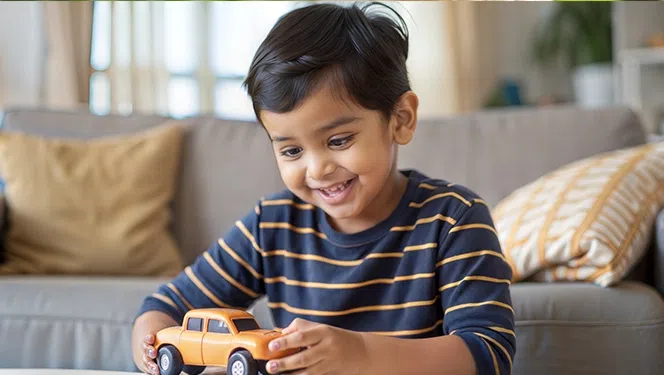
My entrepreneurial journey started when my son was around one and a half years old, and for a long time I worked two jobs without realizing it. During the day, I designed and developed toys, going back and forth with vendors, arguing over which grade of plywood to use. Then I would come home and be a mother, sitting on the floor, watching my child lose interest in a toy I'd spent months getting right. Four minutes, maybe less. Then he was off chasing an empty cardboard box instead. That happened more than once. And it stung a little every time.
Over the years, I've designed hundreds of toy concepts and prototypes and bought toys from brands around the world to see what they did differently. I spent more evenings than I can count playing on the floor with my son.
Some toys sat untouched on our shelf for months. Some became obsessions overnight. A few surprised me in ways I didn't see coming, including one I was embarrassed to admit worked better than anything I had designed myself.
Honestly, what taught me the most wasn't any of the toy designing.
It was watching my son.
The toys he liked, the ones he kept coming back to or dropped after a day, or held his interest for weeks. None of it was dramatic.
But those little moments have taught me more about toys than any parenting book on my shelf ever did.
People ask me a lot: “How do I decide which toys to buy?”
I don't really have a neat answer, even though I probably should by now, given what I do for a living. But every child is different. What worked for my son may not work for someone else's. A few things have stuck with me, simply from watching him closely, and they've changed how I think about play.
Here are a few things I've learnt about choosing toys and creating a learning environment that works for my child.
What watching my child taught me about choosing toys
1. Follow your child's interests
One thing that caught me off guard was how fast his interests moved. There was a stretch where everything was cars, down to the exact model names of things he saw on the road. A few months later it was space. Then dinosaurs. Then animals. Then pretend play. Each phase quietly replacing the last. At first, I thought he was just getting bored fast, and that worried me more than it should have.
It took me a long time to understand that this was just how he explored things. Nothing wrong with that; it just took a while to stop panicking.
I stopped buying toys at random and started building around whatever captured his interest. For example, when he was fascinated by cars, I chose toys, puzzles, books, activity kits, and other activities centered on that theme. When he tried something new, it connected to something he already loved. Each phase became a bridge to different kinds of play—from solving puzzles and reading to building, creating, and learning, while keeping him naturally engaged. None of it felt like learning to him, which was the point.
NOTE: These are the author's observations, not a claim that every child follows the same pattern.
2. Keep the next challenge within reach
When he was one year old, I started him with simple 4-piece jumbo wooden knob puzzles. Once he got comfortable with those, I introduced the next challenge—an 8–10-piece wooden puzzle, followed by a 12-piece floor puzzle, and so on. The next challenge was always waiting on his shelf, often before he had even thought to ask for it.
| The point was never to push him along faster than he wanted to go. He seems to enjoy stretching himself, so I make sure something is there the moment he feels ready. Too easy and he loses interest almost immediately. Too hard and he gives up before he's really started, sometimes within seconds. |
Getting that particular balance right has mattered to me far more than hunting down the ‘perfect’ toy ever did.
3. A child's readiness matters more than the age recommendation on the box
This one took me the longest to learn, and I'm still learning. I once bought a set of 115 wooden building blocks, completely convinced he'd love them. He didn't even glance at them. I remember standing in his room one evening, looking at the blocks sitting under a thin layer of dust. Then, one day, he suddenly started playing with them and couldn't put them down for hours.
Kids just don't run on our schedule. We can put things in front of them, but when the interest actually kicks in isn't really up to us.
Once I understood that, things got a lot less stressful. My job is to provide the toys; choosing what he wants to play with is entirely up to him.
Creating space for children to explore
4. Sometimes, the best thing you can do is step back
Kids need real, uninterrupted time before they actually sink into something, whether it's blocks, pretend play, drawing, whatever. It takes longer than you'd think to get to that point where they're really in it, not just poking at it for a minute and wandering off.
For us, that meant cutting out distractions during playtime.
- No TV in the background. Not even low volume. If I want to watch something myself, it waits until he's asleep.
- This isn't some anti-screen stance, to be clear. I've just noticed he plays differently when nothing else is competing for his attention.
- My child picks up a lot from watching us rather than from being told. He reads more when he sees me reading, not when I tell him reading is important.
Some of my favorite moments have just been watching him get lost in something, narrating a whole story to himself, solving a small problem, with nobody telling him what to do next.
5. Not all screen time is the same
Every family has to work this one out on their own terms. Here's what worked for us.
Around three and a half to four years of age, we introduced a small amount of screen time with clear limits. More recently, at six, he got his first tablet, though not mainly for entertainment. He started exploring block-based coding and a few beginner robotics challenges.
That shifted what the screen actually meant in our house. He wasn't only watching something anymore; he was building something.
I've come to think about screen use not just in terms of how much time my son spends on a device, but also what he is doing during that time. In our case, coding and beginner robotics gave him opportunities to create and solve problems rather than merely watch.
He still enjoys an occasional video, and I don't think that's wrong. The aim has been to keep screen use within clear limits and balance it with play, movement, reading, family time, and other activities.
Looking back
If there's one thing motherhood has taught me about creating a learning environment for a child, it's that picking the right toys gets a lot easier once you spend more time watching your kid than shopping.
What actually excites them? What do they keep going back to without being told? The odd or random questions they've been asking lately. Those observations can be more useful than choosing a toy simply because it carries an ‘educational’ label.
I'm still figuring a lot of this out myself, and I expect some of what I believe today will change again as my son grows older. These aren't rules, and they're certainly not the only way to raise a child. They're just what worked for me, imperfectly, over the last few years.
If any of this makes one decision easier for another parent or takes a bit of the overwhelm out of standing in a toy aisle wondering what to grab, then I'm glad I sat down and wrote this out.
What the evidence says Play need not be complicated or expensive to support children's development. Research and pediatric guidance highlight the value of toys and activities that encourage imagination, problem-solving, language, physical activity, and interaction with caregivers. Simple toys such as blocks, puzzles, and pretend-play materials can provide rich opportunities for children to explore and create. (American Academy of Pediatrics) UNICEF India also highlights play as an important way for young children to learn, explore, solve problems, express ideas, and strengthen relationships with caregivers. (UNICEF) |
Neha Makdey is the Founder & CEO of NESTA TOYS, an Indian toy brand. An IIM alumna with over a decade of consulting experience, she has designed and developed hundreds of toy prototypes. Mother of a 6-year-old, Neha brings together her work experience and firsthand insights into how children play, learn, and explore. She is also the recipient of the IIM Trichy Young Alumni Excellence Award for Outstanding Entrepreneurship and the Bootstrapped Champion Award at The Economic Times One-of-a-Kind Awards 2026.
Published: September 25, 2026























Comments
Edit
Comment Flag
Cancel Update