
Vegan Lifestyle Advocate Vijayalakshmi Vikram On Her Journey To Veganism
Monali Bordoloi
As vegan diets are growing in popularity among the health-conscious, we chat with Instagrammer and vegan lifestyle advocate, Vijayalakshmi Vikram, to know what veganism is all about and how it has helped her lead a healthy life.
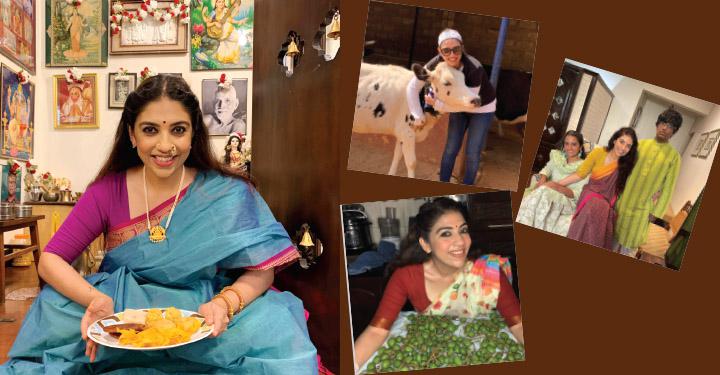
“My shift to veganism has happened over the years. I was not raised a vegan, and I got married into a family that ate nonvegetarian food. I’ve not raised my kids as vegans and am completely fine with cooking nonvegetarian food for them,” begins Vijayalakshmi (Viji).
She continues: “We've always been vegetarians at home. But I’ve had Irritable Bowel Syndrome (IBS) since I was a kid, and had acne from my teenage years right up to adulthood. So, when I read an article that said dairy products and gluten could lead to bad gut and skin for some people, I decided to try a diet that excluded both and discovered I was fine with gluten but not dairy products. For the next 7-8 years, I diligently started avoiding dairy products, and the results were apparent - my gut and skin health improved—IBS was under control and my acne had reduced.”
Although IBS made her shun dairy products, the turning point came when Viji became aware of animal cruelty in the dairy and meat industries. “Around 2017, I began reading about animal farming and the dairy and meat industries. I also started volunteering at an animal shelter. The plight of male calves and cows that were abandoned by the dairy farming industry shook me. That’s when I decided to switch to a vegan lifestyle. Of course, my diet didn’t change overnight—it took me a year to get a grip on my cravings. There were moments of weakness, but I was able to put that aside and move forward.”
But as Viji talks, we begin to wonder what could be the daily challenges of being a vegan in an Indian family setup. For instance, if one’s family is not vegan, how does one plan daily meals? Says Viji: “Never force your beliefs or lifestyle on others. Don’t try to convince your family and friends about your food choices.
And here are a few pointers on that based on my experience:
- If you are the only one following a plant-based diet at home, accept the fact that you’ll have to cook a lot more.
- Don’t assume that healthy means not tasty; if food is made well, everyone will eat everything.
- You don’t need to explain your choices to anyone.
- Take your time with the transition.
- Lastly, don’t feel guilty if you are not following it strictly.”
Still, she must have faced some challenges.
“Of course, I did. When you try to do something that is against the age-old way of life, you are bound to face criticism. Sometimes because of my food choices, well-meaning friends would say that veganism has its disadvantages, that it would lead to weaker bones and other issues later. Your only weapon at such times is the power of knowledge. Read up, research, and know your subject well. For me, the hardest part was keeping my emotions in check in the face of criticism or sniggering. But with time, I’ve learned to laugh it off or give a witty response,” explains Viji.
Viji goes on to add that her mother-in-law, Dr SD Premavathi (who passed away last year), was her biggest inspiration. “She was a gynecologist who also delivered my two kids! She was an excellent cook, and she taught me to drive, to cook and to appreciate the beauty of a simple cotton sari!” says Viji. “My husband has mostly switched over to a plant-based diet and now supports my choices. As for my kids, my daughter is 21 and my son is a teenager. Both of them respect my choices and love gorging on the vegan food I make at home. They are free to make their own decisions, however, it feels good when I see that both of them are sensitive toward animal cruelty.”
What started as an experiment has now become a healthy lifestyle mantra for Viji, so much so that she is now an advocate of veganism. “I try to focus on the journey and that keeps me committed without regrets. We need millions practicing a vegan lifestyle, as it’s one sustainable solution to live and let live on this planet,” Viji sums up her philosophy.
Viji’s Guide To Going Vegan
Make a list of food items using animal ingredients (meat, eggs, dairy, honey) that:
- you don’t care much for (my list had cakes, etc.)
- you love (my list had cheese, kulfi, paneer, biryani, etc.)
- you are addicted to (my list had yogurt and filter coffee)
Half the work is done when you make the list. Here are the next steps:
- Stop consuming all items on List 1 immediately. Don’t think too much.
- Reduce the frequency and quantity of consumption of items on List 2 (foods you love). For example, I reduced cheese consumption to once a month.
- Look for alternatives to the items you love. I experimented with plant-based cheese. Set a date (3–4 months) by which you can eliminate the items you love.
- Work on the items on List 3 (addictive foods) only after you have control over your cravings on items from List 2. Reduce the frequency and quantity of consumption of items on List 3.
- Look for alternatives to the foods you are addicted to, and set a date by when you want to cut them out of your diet.
- It’s okay to take the time to transition sustainably. Don’t let anyone tell you otherwise.
Also read articles on diet and nutrition.



















Comments
Edit
Comment Flag
Cancel Update