
How To Raise A Science-loving Child And Help Them Learn More About The World Around Them
Arun Sharma
As science pervades almost every aspect of our lives, teaching children to take a keen interest in science is very important.
- 6.3K
- 1
- 1
For children to learn more about the world around them, it is necessary to teach them science. An interest in science helps evoke a child's sense of curiosity and motivates them to seek answers to questions arising in their mind. Therefore, encouraging a child to develop a healthy interest in science can have a tremendous impact on their learning. Here are some ways you can help your child learn to love science.
- Encourage exploration: The learning process in a child begins long before they steps into a school or picks up the first book. It happens through observation and exploration. Encourage your child to begin exploring by doing things like taking a walk in the backyard or closely watching the equipment in the park or trying to understand how his toys work.
- Allow your child to play: Children always learn better through play. So, allow your child to play as much as possible. Ask them to make a paper boat float on water in the bathtub, or make an airplane or a kite that flies. While your child is enjoying these activities, tell them in age-appropriate words about the principles that makes these things work.
- Plan a few experiments: Most children are enthusiastic about learning through hands-on projects and enjoy getting their hands dirty. Make some space in the corner of a room and set up a science lab where your child can engage in experiments. Some of the things your child can do are check out which substances absorb water, make balloon rockets or a catapult with pencils, make a ping pong ball launcher using cloth clips, or mix different colours to see the result.
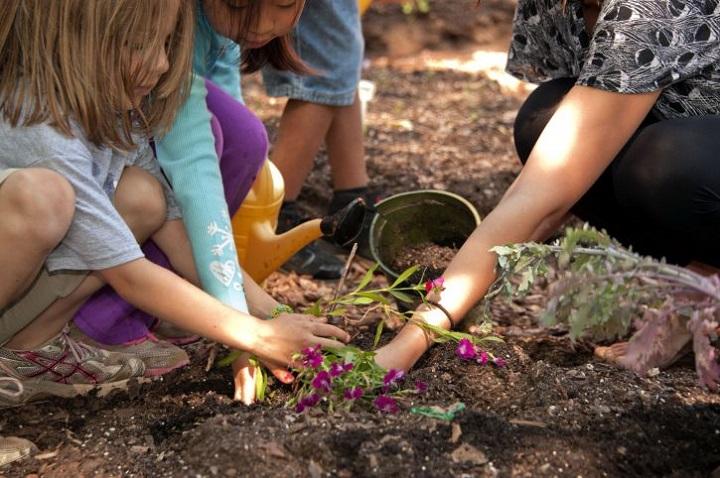
- Engage in gardening: Developing a love for gardening in your child will not only help them learn about plants but also take them closer to nature. Designate a small area in your backyard as your child's farm and encourage them to plant seeds of different plants. Guide them on how to water the seeds and take care of the little saplings that erupt after a few days.
- Observe various life forms: When you take your child to play in the park or on a picnic, encourage them to observe the various insects like ants and crickets, birds, chameleons and squirrels, and other animals in the vicinity. Observing these life forms will help them understand how they live and behave, and dispel their fear of wild things.
- Record information: Before your child engages in exploration and observation, hand them a notebook and a pencil, and ask them to record the findings. Then, sit with them and discuss what they have written in their notebook. This will help clear any wrong notions they may have developed or any doubts they may have.
- Read books: By talking to your child, try to learn the areas of science that are of interest to them, like heavenly bodies, ships and aircraft, or plants and animals. Once you know what interests your child, buy some age-appropriate books that both of you can read together.
- Talk about great discoveries: Scientists have made invaluable contributions towards making the world a better place. Tell your child about some great scientific inventions that have made our lives easier and better. Some of the inventions you can talk about that your child will find interesting are microscope and telescope, electricity, telephone, and locomotive. Who knows, this may motivate your child to become a scientist!
Learning science benefits children in numerous ways. It helps engage their senses, gives them a chance to do experiments and make discoveries (an experience nothing else can replace), encourages critical thinking skills and so on. So, put on your thinking cap and find some more ways of getting your child interested in science.
Enhance your child's cognitive skills and scientific thinking skills with The Dot Me and My World program for kindergarten. It provides a solid foundation in science through sensory explorations and engaging experiments.





























Comments
Simi Ramesh May 29, 2019
Edit
Comment Flag
Cancel Update