
How to Help Kids Handle Exam Stress: Effective Planning And Study Tips For Parents
Team ParentCircle
Is your child feeling anxious or stressed about exams? Understand why children worry, how to make exam preparation easier, and the most effective study habits. Discover practical tips on reducing exam anxiety so your child feels supported, calm, and ready to do their best

Madhu’s hands start to tremble as her 12th standard teacher hands her the final examination schedule. She has been dreading this moment ever since her teacher told them a few weeks ago that their exam dates would soon be announced. She feels unprepared, anxious, and stressed. She takes a deep breath and vows to immediately start preparing for her exams. However, over the next few days, her parents notice that Madhu is irritable, stressed, and moody.
Why do children feel stressed during exams
How last-minute studying increases exam anxiety
Does Madhu’s situation sound familiar to you? The pressure of preparing for exams is nerve-racking. While schedules are often given out ahead of time, many students still wait till the last moment and start studying only when the exams draw closer. Hence, they are unable to manage their time and study load. Panic sets in, which makes it very difficult for the child to concentrate and study.
When should children begin preparing for exams?
Benefits of studying lessons as they are taught
It is best to encourage your child to study the portions as and when the lessons are taught in class. This way, your child will have a good knowledge of their subjects and will find it easier to study for the exams.
Why early preparation reduces exam pressure
However, the seriousness of examinations often hits children only a couple of weeks before the exams. So, many of them begin exam preparations at the last minute. This last-minute cramming only leads to stress. So, it's best to have your child set up a plan that includes set times for studying each subject, along with tasks to be accomplished in that time frame.
How to help your child create an effective study plan
The first step is to help your child make a study plan that works for them. Next, you need to make sure they can adhere to the plan. Today, it is easy for your child to get distracted by smartphones, gadgets, television, the Internet, and social media.
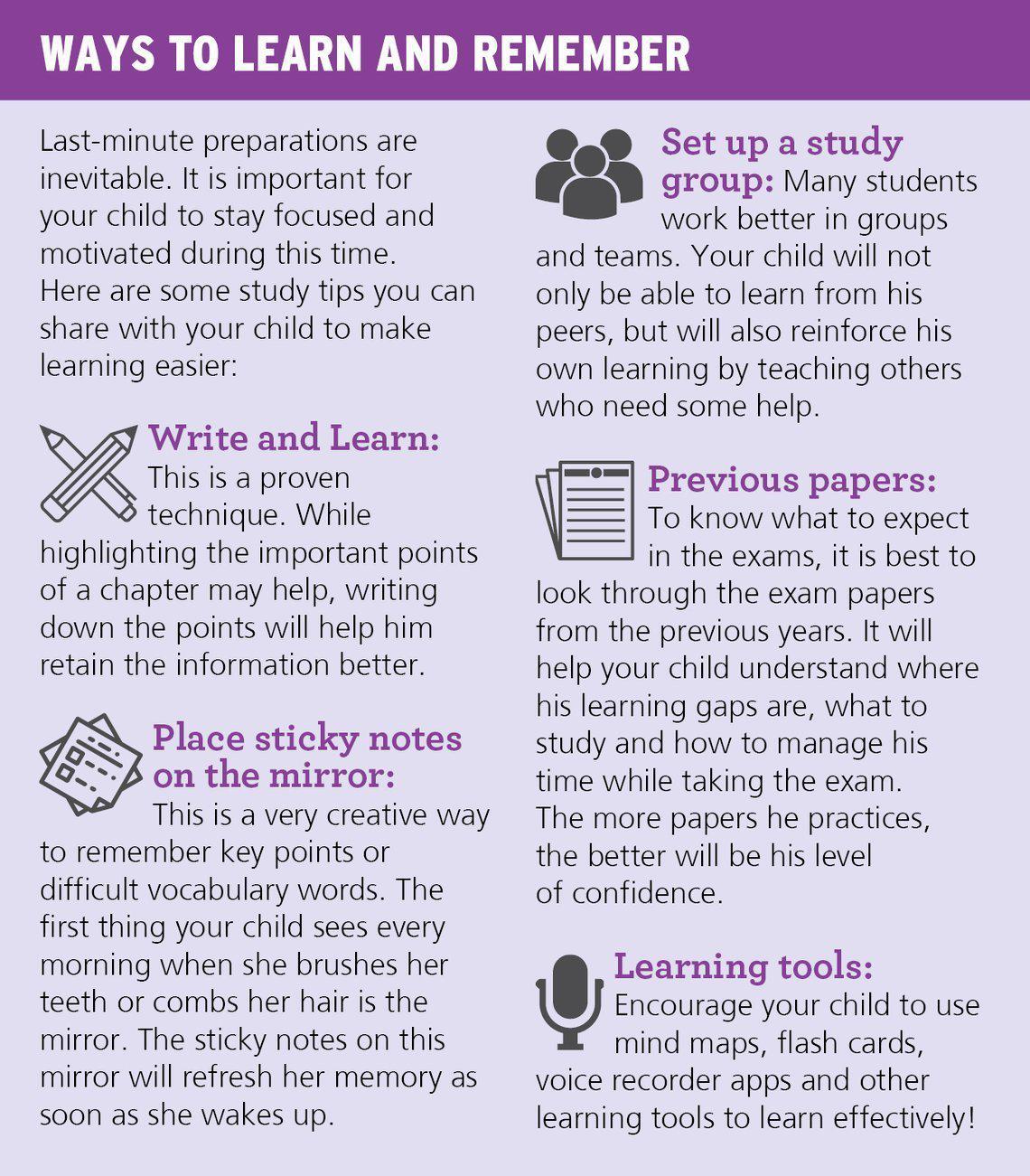
Smart study habits that make exam preparations easier
Identifying learning gaps early
For each subject, help your child list out which topics they don't understand or are challenging. Help them think about and plan how they are going to study these topics.
| What you can do Ask your child to ask themself a few thought-provoking questions:
|
Following a realistic study timetable
Get your child to make a study plan for each subject and set up a study timetable. Some subjects will need more study time than others, so they must plan accordingly. It is important that your child makes a practical timetable that takes into account breaks, extra-curricular activities, and even time for entertainment. The plan must include the chapters that need to be covered and the tasks that need to be completed within the specified time.
| What you can do Ask your child to use a diary, a planning calendar, or one of the many planning apps freely available to set up their study schedule. |
Using short breaks to improve retention
While it may seem that your child can study many topics in one sitting, recollecting all this information can become challenging. The brain needs rest to be able to retain more information.
| What you can do Encourage your child to take a 5-7 minute break after studying for 45 minutes. This will go a long way in helping them retain what they have studied. |
Managing gadget distractions during study time
Keep away from gadgets
Research shows that the brain is most effective when it is focused on one thing and not multitasking. Smartphones and Social media can be a huge distraction during study time if your child keeps checking phone messages. Even if your child has to use the Internet to study, make sure they stay away from the distractions of Facebook, Snapchat, Instagram, WhatsApp, or YouTube.
| What you can do Ask your child to hand over their smartphone or shut down the computer (if it is not required) while studying. |
Switching subjects to boost memory and reduce boredom
Instead of studying the same subject the whole day, it is best to switch between subjects in different categories—analytical, theoretical, and creative. This helps to reduce stress and increase retention power.
| What you can do If your child has been studying Math for 2 hours, encourage them to take a break and switch to studying Social Studies after the break. |
Exercise and movement for better concentration
Studying in a room all day can get quite boring. Besides, several research studies show that just 20 minutes of exercise a day can boost concentration and improve focus. So get your child out of their room and exercise to relieve boredom and re-energize the body and mind.
| What you can do Make sure your child sets aside at least 20 minutes a day for physical exercise. Get them to run, go for a walk, play a sport, or even just dance to music. |
Eating the right foods for sharper thinking
In a research study conducted at the University of Oxford, college students were tested for attention and thinking speed. They were then fed a low-carb, high-fat diet of meats, eggs, cream, and cheese. When tested again, their performance actually declined. But when students who ate a balanced diet that included fruits and vegetables were tested, their performance held steady. It is therefore important to ensure your child eats a healthy and balanced diet during their exam preparation time.
| What you can do Let your child start the day with a high-carb, high-fiber breakfast. Keep plenty of healthy snacks like nuts and dry fruits available during study time. |
Importance of sleep during exam preparation
Getting enough sleep is very critical. Good sleep is essential for enhancing thinking skills, boosting memory, and improving concentration. Many students pull an all-nighter studying and wake up tired and unable to focus the next day. It is important to give the mind and body enough rest to recuperate and start the next day.
| What you can do Give your child this magic tip: Ask them to learn the toughest portion right before their bedtime. The REM (Rapid Eye Movement) stage of sleep is proven to boost memory and is likely to retain information better! |
How parents can emotionally support children during exams
Reassuring your child that effort matters more than marks
During the time of exams, children are often stressed because they are worried about their inability to meet the expectations of their family, school, or peers, and are afraid of failure. It's important to help your child overcome this fear. Encourage them to put in the necessary effort and do their best. Let your child know you are with them every step of the way. Assure them that whatever the results may be, you are still there for them, and it’s the effort that matters.
A simple 15-minute parent strategy to improve exam performance
Just 15 minutes of your time can help boost your child's grades |
A recent study by Stanford University, titled 'Strategic Resource Use for Learning: A Self-Administered Intervention That Guides Self-Reflection on Effective Resource Use Enhances Academic Performance', 2017, shows that when children think about how they want to perform and what they should do to improve, their performance improves. So spending just 15 minutes of your time with your child, helping them reflect on their preparation, can magically translate into good scores. Thought-provoking questions to help your child plan better
|
A proven technique to reduce exam anxiety instantly
Simple hack to reduce exam anxiety |
Even if your child is well prepared, do they get anxious and stressed before the exams? Is this affecting their exam performance and grades? Here’s a simple hack that can help your child feel less anxious and more confident: How writing down worries calms the mindA day before the exam, or even just an hour before, have your child list out and write down all the things that are making them anxious about the exam. They may write things like:
|
Turning exam season into a time of growth and self-belief
Exams are an inevitable part of every child's school journey, but the stress and anxiety that come with them don’t have to be. With the right guidance, a practical study plan, and consistent emotional support, children can learn to prepare with confidence instead of fear.
As parents, the most powerful tools we can offer are our time, patience, and reassurance. When children know that their effort matters more than their marks and that we stand by them no matter what, they begin to approach exams with a positive and calm mindset. With your steady encouragement and their committed effort, exam time can turn from a period of pressure into an opportunity for growth, learning, and self-belief.
Last updated on: December 09, 2025



























Comments
Edit
Comment Flag
Cancel Update