
Exam Tension Tips For Parents: Expert-backed Ways To Reduce Children’s Exam Stress
Leena Ghosh
Worried about your child’s exam tension? Here are some expert-backed, practical ways to reduce exam stress in children. Learn how small changes in routines and emotional support can help your child stay calm, confident, and focused during exams

What is exam tension, and why does it affect children
When exams approach, parents cancel their social appointments, and children suddenly have a new set of rules to follow. These include how much time they can spend outside and for how long they must study. Curfews are set, and the television is switched off. All these signal the onset of exam tension.
However, an examination need not be the monster we make it out to be. The Oxford Dictionary defines an examination as a formal test of a person's knowledge or proficiency in a subject or skill. And, that's all an exam is, a test to understand how much your child has learned so far in each subject. How well they do in an examination does not define them or their abilities.
Support available for students and parents during exam season
CBSE now offers Pre-Examination psychological counseling services to students and parents to deal with exam tension. Students and parents can call a toll-free number to make use of the services.
The counseling session will include tips on tackling board exams, stress management, time management, and live tele-counseling services.
As you help your child prepare for the exams, let them know it's not a life-and-death situation. Exams are just a challenge they need to face, an evaluation of what they've learned at school.
Common reasons behind exam tension in children
High expectations and fear of not meeting goals
It's not just parents who have high expectations of their children. Children also set high goals for themselves, and the fear of not achieving those goals makes them feel stressed.
Inadequate preparation and last-minute studying
Last-minute preparations never help, and both you and your child know that. If they are not well prepared for the exams, they are bound to feel stressed about their performance.
Worry about the future and academic outcomes
Somehow, an exam score is believed to define how smart a child is. This is not true. However, worrying about the question paper and how much they'll be able to score can increase the tension before an exam.
Common mistakes parents make while trying to reduce exam stress
Before you help your child deal with examination tension, be aware of some common mistakes parents make while trying to help their children. Arundhati Swamy, Counselor and Head of Parent Engagement Programs at ParentCircle, explains:
- Before parents try to help their children cope with exam stress, it would help to check their own stress levels. Many parents know they are stressed but tend to ignore it, believing that the child is more important and, hence, needs all their attention and care.
- Some vulnerable parents fall prey to strong opinions and advice from extended family members. This can be confusing for parents, and they end up confusing their children, too. While it's helpful to have someone older than you or a friend to talk with and share worries, offloading your worries on several people will only invite a flood of advice. Do remember that most people's advice is based on their own experiences, which could be quite different from yours.
- Comparing your child with other children, repeatedly recalling past mistakes, and harping on the child's limitations are not helpful. It will only make the child feel upset, angry and helpless.
- Some working parents take leave during exam time to support their children. They hover around their child and try to micro-manage their routine. This may backfire as the parent's presence becomes interference.
How parents can truly support children during exams
The role of parents becomes crucial during examinations. Not only do they need to ensure a stress-free environment at home, but they also need to keep their child's motivation levels high. And, while doing all this, parents also be mindful of their own fears and anxieties. This isn't easy at all.
Expert advice to reduce exam tension in children
Help your child understand the real purpose of exams
Dr Nithya Poornima, Assistant Professor, Dept of Clinical Psychology, NIMHANS, Bengaluru, says it's important to make the child understand what an examination stands for. "Exams are meant to assess learning. Ask your child to focus on the joys and the learning process and see exams as a concept to evaluate learning. Then, the whole experience becomes different, and the levels of stress come down," she says.
Aparna Balasundaram, Psychotherapist and Founder of LifeSkills Experts, Chennai, says that it's important to remind children that exams are not the end of the world, especially the Board exams. "Children start hearing about Board exams from class 6 and start preparing for them from class 8. The Board exams become a monster that they have to slay. Remind your child that it's important to do well, but it is not a life-and-death situation. Ask her if she heard anyone ask her parent's score in the board exams!"
Reduce your own stress before trying to calm your child
Arundhati says it's as important for parents to de-stress during exams as it is for their children. "Make sure you have your stress-busters. Do whatever helps to relax you. Be completely aware of the things that raise your stress—it could be talking to other parents (comparisons fill the mind) or depriving yourself of time-offs. Examine your thoughts and behaviors that trigger additional stress. You must first take loving care of yourself so that you can take loving care of your children," she points out.
Maintain a normal family routine during exams
Aparna says that, as a family, it's important to not give exams too much importance. "Don't stop going out or calling people over. Parents tend to schedule their lives around their child's exam. That's when they create too much stress in the home environment. Do family things together, like going out for a movie or dinner. When your children see you not getting stressed about exams, they too will adopt that attitude," she says.
Arundhati says that working parents can take leave if they feel like it, but they must also learn to give their children some space. "By all means, avail leave if it helps you and your child. But your sudden presence at home can also upset the home atmosphere. Plan with your child, respect their space, and ask them what kind of support they would like from you. Also, use your time at home to do things that are relaxing, things that you would enjoy but are not distracting for your child."
Use visualisation and imagery to build confidence
Aparna recommends the imagery technique to overcome examination tension. "Ask your child to close his eyes and think of a time when he did something well. It could be related to academics, sports, or any extracurricular activity. This is called a snapshot of success. Once he visualizes that, he can understand that since he has succeeded in the past, he could do it again. This acts as a positive reinforcement and helps alleviate any anxiety he feels about the upcoming exams," she explains.
Teach simple relaxation techniques while studying
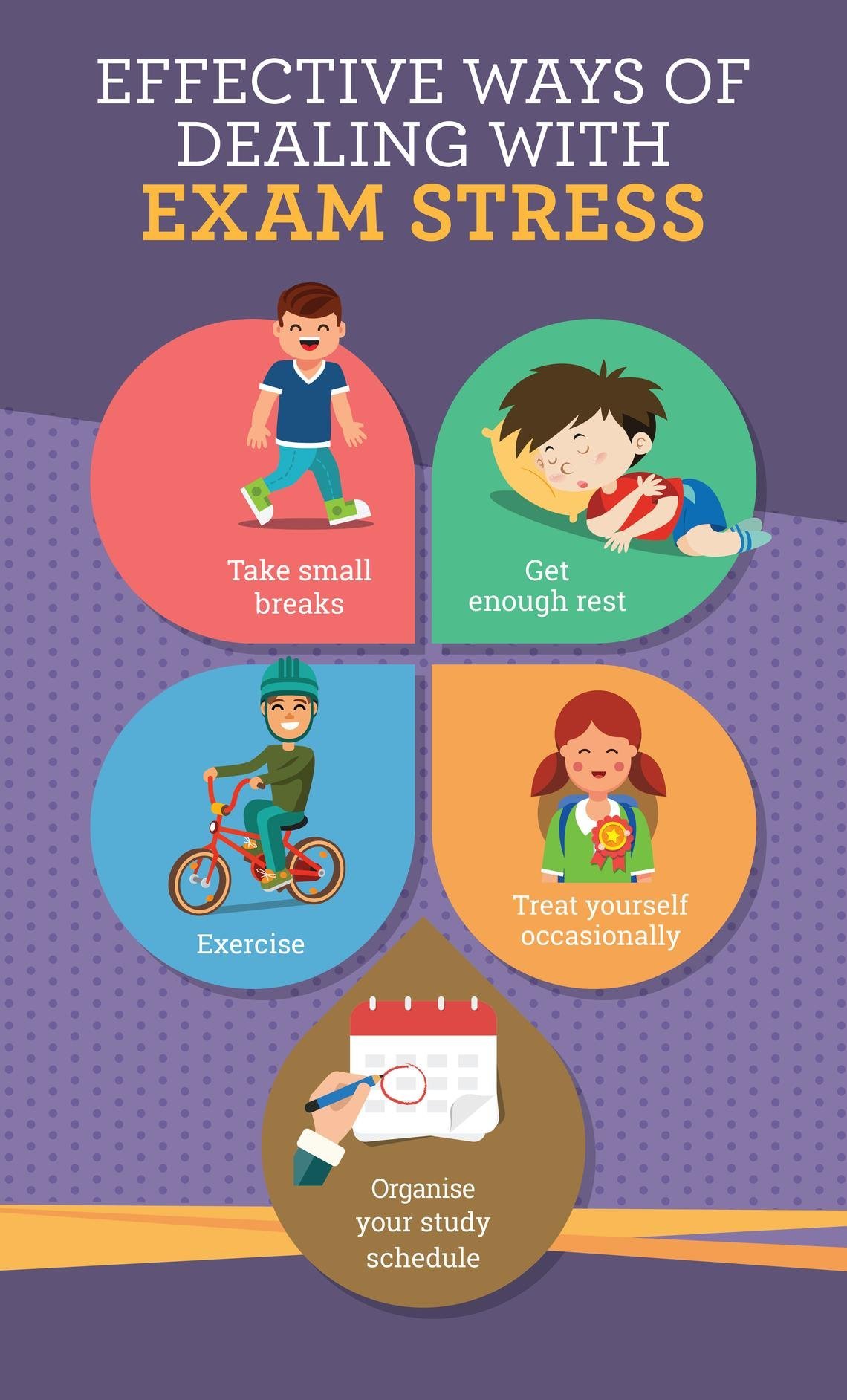
Dr Nithya recommends practicing relaxation methods while studying for exams. "Some children are more anxious or set higher expectations. It's important to have some component of relaxation included in their daily schedules, as when you become too anxious, it is difficult for you to remember things. Taking deep breaths, going for walks, sketching, coloring, listening to music, or taking breaks will help your child relax," she says.
She adds, "Your child can visualize going through the process of exams, approaching the exam hall in a relaxed way, or sitting down in the exam hall in a relaxed way. Often, our mind only believes what we can see."
Help your child focus on the present, not the outcome
Dr Nithya says that both students and parents should try and remain as focused on the present as they can. "Worrying about the future makes it more stressful for everyone. You can't predict the future, and it's beyond everyone's control. Teach your child to focus on the task at hand and what he can do right now," she says.
Ask your child what kind of help they really need
Arundhati says that it's important for parents to assess the kind of help the child needs. "Much as you have tried to push your child to work hard, talking about it endlessly will only make them shut down. Ask them what kind of help they need from you and others, help them with practical suggestions, and most importantly, maintain a calm and peaceful atmosphere at home. This will, in many ways, reduce the stress for you and your child," she explains.
The parent’s role in reducing exam tension at home
As parents, you must remember that exam season is a stressful time, and your child will face some amount of anxiety, no matter what. Do your best to support and encourage them whenever they need it, and help them give their best. Good luck!
Parent checklist: Simple ways to reduce exam tension at home
Remind your child regularly that exams do not define their worth or future.
Keep conversations focused on effort and learning, not marks and ranks.
Maintain a calm, predictable home routine during exam days.
Ask your child what kind of support they would find helpful.
Avoid comparisons with siblings, classmates or neighbours’ children.
Encourage short breaks, light movement and relaxation every day.
Help your child focus on what can be done today instead of worrying about results.
Watch for signs of excessive anxiety and seek professional help when needed.
Take care of your own stress and emotional well-being, especially during the exam period.
Reassure your child of your unconditional support, regardless of performance.
Click here for more tips on what parents can do during exam season.
Last updated on: February 27, 2026



























Comments
Edit
Comment Flag
Cancel Update