
Can Comic Books Aid Learning?
Prathmesh Kher
Comics have been around since the turn of the century but it's only recently that they are being considered a legitimate educational tool by experts. Read on to know how they can help children learn
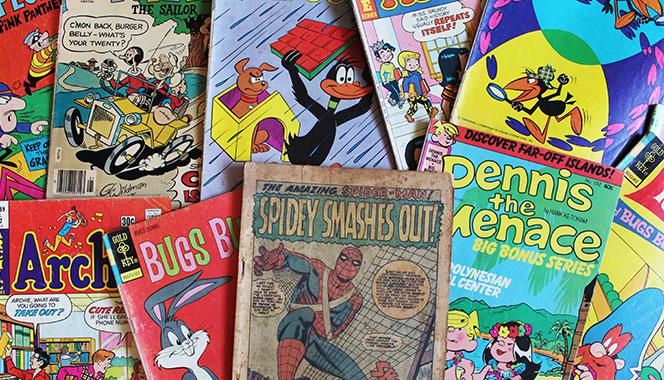
Children love reading comics. Often, their pester power to purchase a Tinkle Digest or Superman comic is so strong that parents don't know how to handle it. We can recall our own parents asking us, "What will you gain by reading comics? The entertainment lasts for a few minutes and then you cast them away forever - and comics are so expensive. Why don't you buy a book instead?"
Carol L Tiley, a professor of Library and Information Science at Illinois, who conducted research on comics, has stated in an ANI report that a lot of the criticism of comics comes from people who think that kids are just looking at the pictures and not putting them together with the words. She adds that this holds good with picture books as well.
"Any book can be good or bad, to an extent. It's up to the reader's personality and intellect. And if you consider how the pictures and words work together in consonance to tell a story, you can make the case that comics are just as complex as any other kind of literature."
She concludes that comics are another medium or genre, which can be used as instructional units.
| Comic book author, historian, and philosopher, Scott McCloud once tried to define the medium. After much deliberation, he declared comics to be 'juxtaposed pictorial and other images in deliberate sequence', with the addendum, 'Well, anyway this should do for now'. In his landmark book Understanding Comics, McCloud contended that comics could well be used for educating students. |
Other recent studies have also confirmed that comics are a stronger learning tool than textbooks if they are appropriately designed. (Also read Mike Parkinson's article The Power of Visual Communication at www.billiondollargraphics.com).
"These studies should also be a strong signal to educators across the board that teaching through comics in schools is the right way to go. Comics combine story and information simultaneously, more ably and seamlessly than almost any other medium." - Corey Blake, author at Robot6@comicbook resources
Comics in schools
Back home, the Amar Chitra Katha and their clones are doing a good job of not only highlighting mythological stories but are also bringing out comics about illustrious personalities (like our freedom fighters). Another independent publisher from Chennai is bringing out biographical comics on musicians. Many of these comics are also brought out in other Indian languages. Such comics, unlike the pure-play, entertainment ones, are popular with children and face fewer barriers in terms of parent purchases, because they provide a direct connection to our roots.

History is therefore among the easier subjects that can be produced and taught successfully through the comic medium. But this approach can also be brought to English, science, and math. Creating story narratives for math can look tough, but it's not impossible. The recent Solar comic, for instance, features mathematical formulae as part of the hero's power-generating mantra.
Beast Academy is a set of comic books from www.artofproblemsolving.com that teaches math to children from grades two to five. Likewise, The Young Scientists comic series distributed from Singapore and available in India is doing a good job of introducing youngsters to various scientific concepts in a fun way. This series consists of three levels, with the highest level catering to the preteen segment.
Helping children with reading difficulties
Bhopal-based psychologist Vinay Mishra says that sequential art is a great way to teach. He explains that images are processed 60,000 times faster than words.
"Also, including comics will allow teachers to help kids with reading disabilities such as dyslexia wherein a child may face difficulty in learning to read with conventional instruction, despite having adequate intelligence. In such cases, the use of visual aids such as comic books can be of tremendous help", he adds.
Sparking interest in the subject, Dhanraj Chaudhary, a Delhi-based software engineer, and comic book buff says,
"I became interested in the sciences as a child when I read Fantastic Four comics. Granted that the science content in the books was inane, but it still got me interested in the subject."
Chaudhary adds that comics would need to be adapted for different cultural settings.
"Indian comics are far too busy mirroring their American counterparts. There is more to India than sadhus and dhotis. We could use more interesting stories to tell our kids about the various urban phantom cultures across the country." He says that Sarnath Banerjee has been working on this concept for a while and that his comics are not about dead towns but about the very active underbelly of the big city.
Creating a better variety of comics
Artist David D'Mello from Mumbai, says that Indian comics are much like printed versions of masala films. However, he agrees that comics can help young readers get acclimatized with the social sciences.
"I have seen some very beautiful examples of historical figures presented in sequential art," he says.
Rakeysh Arora, a Guwahati-based doctor, and comic book aficionado adds that most Indian superheroes tend to replicate the Western variety. He explains,
"With a few honorable exceptions, we have had comic books in India for nigh close to five decades. Can we not now produce a better variety of comics, and across subjects?"
The good news is that people are already putting on their thinking hats worldwide to promote comics for educational purposes, and India is bound to catch up.
| "There's great potential in the medium; one can incorporate interactive elements into digital versions of comics. Audio commentary can supplement the reading. The possibilities are limited only by the user's imagination", says Corey. |
And in the end, is that not what education is about... thinking anew?

























Comments
Edit
Comment Flag
Cancel Update