
Simple Ways To Strengthen Your Preschooler's Memory Through Everyday Experiences
Kerina De Floras Felix
author parentcircle author parentcircle author parentcircle author parentcircle author parentcircle author parentcircle author parentcircle author parentcircle author parentcircle author parentcircle author parentcircle author parentcircle
Discover simple activities that support early childhood memory development in preschoolers and help children learn better through everyday experiences. This article explains how play, routines, storytelling and engaging activities can strengthen memory skills while supporting cognitive development in preschoolers. Learn easy ways parents can encourage learning and brain growth at home
| Thinking Skills for Preschoolers Series |
| Part 1: Attention – Learning to Focus |
| Part 3: Comprehension – Learning to Understand |
Memory
Memory is the brain’s ability to acquire, store, and later retrieve information. Simply put, it’s the ability to recall past experiences or information.
Early childhood (from birth to age 8) is an important time for memory development. During this time, rapid brain development enhances children’s memory and planning abilities. In preschoolers, recognition memory (identifying faces and objects) and episodic memory (memory of recurring events) improve.
As your child’s memory development is still in progress at this age, their ability to remember begins with understanding. Therefore, rote learning is not a realistic way to help them remember.
You might notice...
Your child can remember every action in a favorite nursery rhyme or exactly where their favorite toy is kept, yet forget where they kept their crayons a few minutes ago. This is perfectly normal. Different types of memory develop gradually throughout early childhood.
Why building memory skills is important
Supports thinking and learning
Memory is a complex cognitive ability that is key to the development of thinking and learning skills such as reading, attention, comprehension, problem-solving, and imagining.
Builds everyday thinking skills
A good memory helps your preschooler follow instructions, remember routines, connect new ideas with familiar ones, and become more confident when learning new skills.
Helps children connect new learning with existing knowledge
Memory and learning go hand in hand. As children learn something new, memory helps them connect it with what they already know, making future learning easier and more meaningful.
Simple ways to build memory
Good memory skills will help your preschooler perform tasks better and learn new concepts. Here are a few tips to improve your child’s memory skills.
Use songs and rhymes
Musical patterns seem to jog a child’s memory, so creating rhymes and songs to help them remember simple tasks might help. For example, you can create a song that tells them how to tie their shoelaces.
Encourage mind mapping and visualization
Encourage your child to picture what they read or hear. As they progress, they will learn to build a mental map by connecting different ideas. This will help them actively engage in the topic and develop a deeper understanding. Flashcards or images improve their visual memory and can help them remember concepts.
Engage all the senses
Help them learn by engaging all their senses. For example, if your child is learning about a fruit or vegetable, instead of just reading about it, let them feel, smell, and taste it. Sensory experiences improve memory of experiences.
Connect learning with real-life experiences
Draw from personal experiences whenever you can to help your child create a strong memory. For example, when you read to them about farm animals, you can talk about your visit to the farm, what animals they saw there, and what each animal ate. This will make it fun for your child to remember what is read.
Play memory games
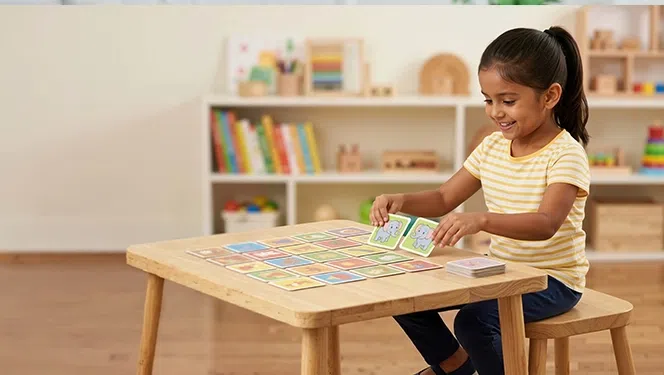
Games like matching picture cards and the magic cup game (finding out which inverted cup has a hidden object) can help your preschooler enhance their memory skills.
You can also create new games at home or when you travel. For example, you can show your preschooler 10 household items, ask them to close their eyes, then remove one item and ask them to guess which one is missing.
Make repetition enjoyable
Young children learn through repetition. Hearing the same story, singing the same songs, or practicing the same skill again and again strengthens the brain connections and helps them remember, understand, and learn.
Encourage them to sing familiar songs, dance to favorite tunes, or practice everyday skills like tying shoelaces or buttoning a shirt. These repeated experiences build memory and their confidence.
Prioritize good-quality sleep
Good-quality sleep is essential for your preschooler's growing brain. While your child sleeps, their brain processes and stores what they have learned during the day, helping turn new experiences into lasting memories. That's why a regular bedtime routine and enough restful sleep are just as important for memory development as play and learning activities.
| Myth | Fact |
| Good memory means memorizing facts quickly | Young children remember best when learning is meaningful and enjoyable |
| Repeating books or songs is unnecessary | Repetition strengthens brain connections and improves long-term memory |
| Memory develops only in school | Everyday conversations, play, and routines help build memory from early childhood |
| Every child remembers things in the same way | Children develop memory skills at different rates and may remember different kinds of information more easily |
Parent checklist: Helping your preschooler build memory
- Read favorite books repeatedly
- Sing songs and nursery rhymes together
- Encourage your child to talk about their day
- Connect new learning with familiar experiences
- Play memory and matching games regularly
- Encourage learning through all five senses
- Give your child opportunities to practice everyday skills
- Ensure they get enough sleep and rest
- Be patient; memory develops gradually through repeated experiences
Memory is much more than remembering facts. It helps your preschooler make sense of the world, connect new experiences with what they already know, and build the foundation for future learning. The best part is that strengthening memory doesn't require formal lessons.
Reading together, singing songs, talking about everyday experiences, and enjoying playful activities all help build strong and lasting memories.
With patience, repetition, and plenty of encouragement, you're helping your child develop a skill that will support learning for years to come.
Trusted sources:
- National Institute of Mental Health and Neurosciences – Child development and parenting resources
- Center on the Developing Child – Brain development and early learning research
Help your preschooler build stronger concentration and memory through fun everyday activities. Explore Boosting Concentration and Memory Power in Preschoolers and start nurturing essential thinking skills today!
Published: July 15, 2026




























Comments
Edit
Comment Flag
Cancel Update