
Did you know that your child has more than one type of intelligence? Find out about multiple intelligences
Rangashree Srinivas
Did you know that there is more to intelligence than IQ? Multiple intelligences theory believes that every child has eight intelligences. Curious to learn more? Read on

“An intelligence is the ability to solve problems, or to create products, that are valued within one or more cultural settings.” - Howard Gardner, Frames Of Mind (1983)
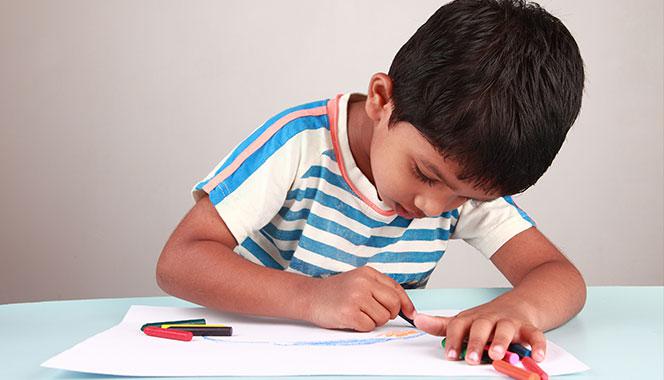
Your seven-year-old daughter’s teachers at school are complaining about her. The child has some difficulty following the lessons taught; her classwork is often incomplete. But she draws beautiful diagrams; her project work is imaginative. At home, you know that she likes science. She brings you an illustrated encyclopedia with pictures of fiery volcanoes, surging seas and interesting pot-bellied ants and asks you to read aloud to her. She cannot bear to see a mosquito squashed. She cannot tolerate the fact that dirty water is going untreated into the sea.
You feel that she has an intelligence innate in her that makes her appreciate the world outside. What is this intelligence and is it enough for her to get by in academics? How should this intelligence be tapped? Are schools (and parents too) progressive enough to treat each child as a unique individual, and adapt themselves accordingly to satisfy her needs? It is therefore important that both you as a parent and her teachers understand the multiple intelligences (MI) present in every child, learn to identify the dominant ones and tap them appropriately.
The MI theory suggests that an individual possesses intelligences in several areas as against the traditional idea of a single intelligence.
In the 30 years since Howard Gardner, the father of the Multiple Intelligence theory, first propounded the theory of MI, further research has been done, not just by him, but by several other scholars and practitioners around the world.
What is MI?
Gardner developed this theory based on his observations of hundreds of people from different walks of life, under everyday circumstances. His study also included stroke victims, prodigies, autistic individuals, and the so-called ‘idiot savants’. According to Gardner:
- All human beings possess all eight intelligences in varying amounts, with some, more dominant than others.
- Each person has a different intellectual composition.
- We can improve education by addressing the multiple intelligences of our students.
- These intelligences are located in different areas of the brain and can either work independently or together.
- These intelligences may define the human species.
The MI theory suggests that an individual possesses intelligences in several areas as against the traditional idea of a single intelligence. An intelligent person has been recognized so far only by her linguistic (language) abilities or logical (mathematical) abilities as these are considered to be important for academic advancement. Thus, only the student who achieves high scores in class is considered intelligent. Another child may just be ‘talented’ in the area of her achievement – ‘She is a good dancer; let us send her for the interschool dance competition.’ ‘He is a good cricket player; but he needs to concentrate now on improving his grades’ and so on.
Worse still, in some schools only the academically well-performing students are given the opportunity to participate in co-curricular activities when there could be others more suited for this. For instance, it is the class topper who gets to deliver the school’s morning assembly speech. It is the girl who scores a 100% in math who gets to automatically represent her school in the inter-school quiz competition.
In contrast, the MI theory recognizes at least eight different intelligences that have to be considered while creating an ‘intelligence’ profile of a person.
MI theory strives to provide educators and parents with a tool to recognize and nurture the different abilities of the child. It redefines the word ‘intelligent’ or ‘smart’. It brings in new thinking towards nurturing excellence, creativity and genius. It emphasizes that all children can learn and that it is the adults who need to know how to teach them.
The 8 intelligences in the MI framework

Chitra Ravi (Founder and CEO, EZ Vidya), who has worked under Gardner on Project Zero at Harvard University, gives some pointers to parents to spot intelligences in their children.
1.Linguistic intelligence is the capacity to use languages, to express oneself, and to understand other people. Poets specialize in linguistic intelligence. But any kind of writer, orator, speaker, lawyer, or a person for whom language is an important stock in trade, highlights linguistic intelligence.
Does your child love to read and write? Does he enjoy solving word puzzles? Does he think in more languages than one?
2. People with a highly developed logical-mathematical intelligence understand the underlying principles of some kind of a causal system, the way a scientist or a logician does. They can manipulate numbers, quantities, and operations, the way a mathematician does.
Does your child reason out why he needs to budget his pocket money? Does he like to pack his school bag in a particular sequence? Is he number smart?
3. Visual-spatial intelligence refers to the ability to represent the spatial world internally in one’s mind – the way a sailor or a pilot navigates the large spatial world or the way a chess player or sculptor represents a more circumscribed spatial world. Spatial intelligence can be used in the arts or in the sciences. If your child is spatially intelligent and oriented toward the arts, he is more likely to become a painter or a sculptor or an architect than, say, a musician or a writer. Similarly, certain sciences like anatomy or topology emphasize spatial intelligence.
So if your child is caught doodling in class, it is not necessarily a sign of disinterest – he is just ‘mapping’ the lesson out!
4. Bodily-kinesthetic intelligence is the capacity to use the whole body or parts of the body – hand, fingers, arms – either to solve a problem, or to create something. Evident examples: athletes or performing artists, particularly dancers or actors.
Some children appear to be restless while studying; they need to take a ‘running’ break every 20 minutes. If your child is doing a cross-legged jig while you are revising his science lessons with him, understand that it is his way of learning. Is he body smart? Can he mime? Look at his facial expressions closely.
5. Musical intelligence is the capacity to think in music, to be able to hear patterns, recognize them, remember them, and perhaps manipulate them.
If your child drums on the table or whistles during his lessons or listens to music while studying, then it is this dominant intelligence at work.
6. Interpersonal intelligence is the ability to understand other people. It is an ability we all need, but it is substantial in teachers, psychologists, salespersons, or politicians. Anybody who deals with other people has to be skilled in the interpersonal sphere.
Does your child enjoy talking to other children and adults? Does he empathize with them? Does he understand ‘the right moments’ to approach people to get his work done?
7. Intrapersonal intelligence refers to understanding the self, knowing who you are, what you can do, what you want to do, how you react, what to avoid, etc. We are drawn to people who have a good understanding of themselves because they do not screw up. They tend to know what they can do, what they cannot do and if they need help.
Does your child know that if he wears his favorite color green, he gets pepped up? Does he understand what upsets him?
8. Naturalist intelligence designates the human ability to discriminate among living things (plants, animals) as well as sensitivity to other features of the natural world (clouds, rock configurations). This ability was clearly of value in our evolutionary past as hunters, gatherers, and farmers; it continues to be central in such roles as botanist or chef.
Does your child point out to you the difference between a camel and a dromedary?
9. A ninth intelligence is to be added to this list and that is Existential intelligence – sensitivity and capacity to tackle deep questions about human existence, such as the meaning of life, why do we die, and how did we get here.
Implications of MI for a parent

Says Chitra, “Every parent should nurture the native intelligence/s of her child. This is better done during the primary days when the child still displays his natural propensities without inhibition. The parent has a great chance of observing his child at home, where the environment is less rigid and structured, compared to school. If the child is encouraged to do what comes naturally to him from early on, he has a very good chance of leading a happy and fulfilling life. He would make lesser mistakes in his choice of a career, as he would confidently gravitate to where his interest and intelligence lies.
The parent can detect multiple intelligences in a child even when he's in middle or high school. But, a lot of the child's spontaneity would have died by then and much of the intelligence would have been pruned.”
| What parents can do |
Shirin Mammen, Coordinator, HRD, Vidyasagar advises parents to nurture the intelligences of their children.
|
According to Gardner, MI should be used to do good work – work that is deemed to be of high quality and which is socially responsible. He echoes Ralph Emerson when he says “Character is more important than intellect”.
By nurturing MI in our children, we can foster a new global renaissance, which calls upon everyone – the genius, the impaired and the ordinary to work together in their unique capacities.






























Comments
Edit
Comment Flag
Cancel Update