
What Do Gender Stereotypes Have To Do With Raising My Young Child?
Dr Meghna Singhal
What are gender stereotypes and how can they impact my child? What can I do as a parent to raise a child who doesn't feel limited by her gender? Read on to find out.

Let's do an experiment. Visualize an astronaut. A cricketer. A firefighter. A bus driver. A physicist. A surgeon. Which of these people did you visualize as a man? And which ones a woman?
If you are among the vast majority of people (including children!), you would have imagined all these to be men.
That's how deeply ingrained gender roles are in our minds. And that's just one way how gender stereotypes show up.
When we generalize qualities or attributes based on gender, it is called gender stereotyping. Gender stereotypes are unfair because they create bias in our minds about each gender. This bias could lead to discrimination and even violence.
On the other hand, gender sensitivity entails recognizing issues with the way societies look at gender.
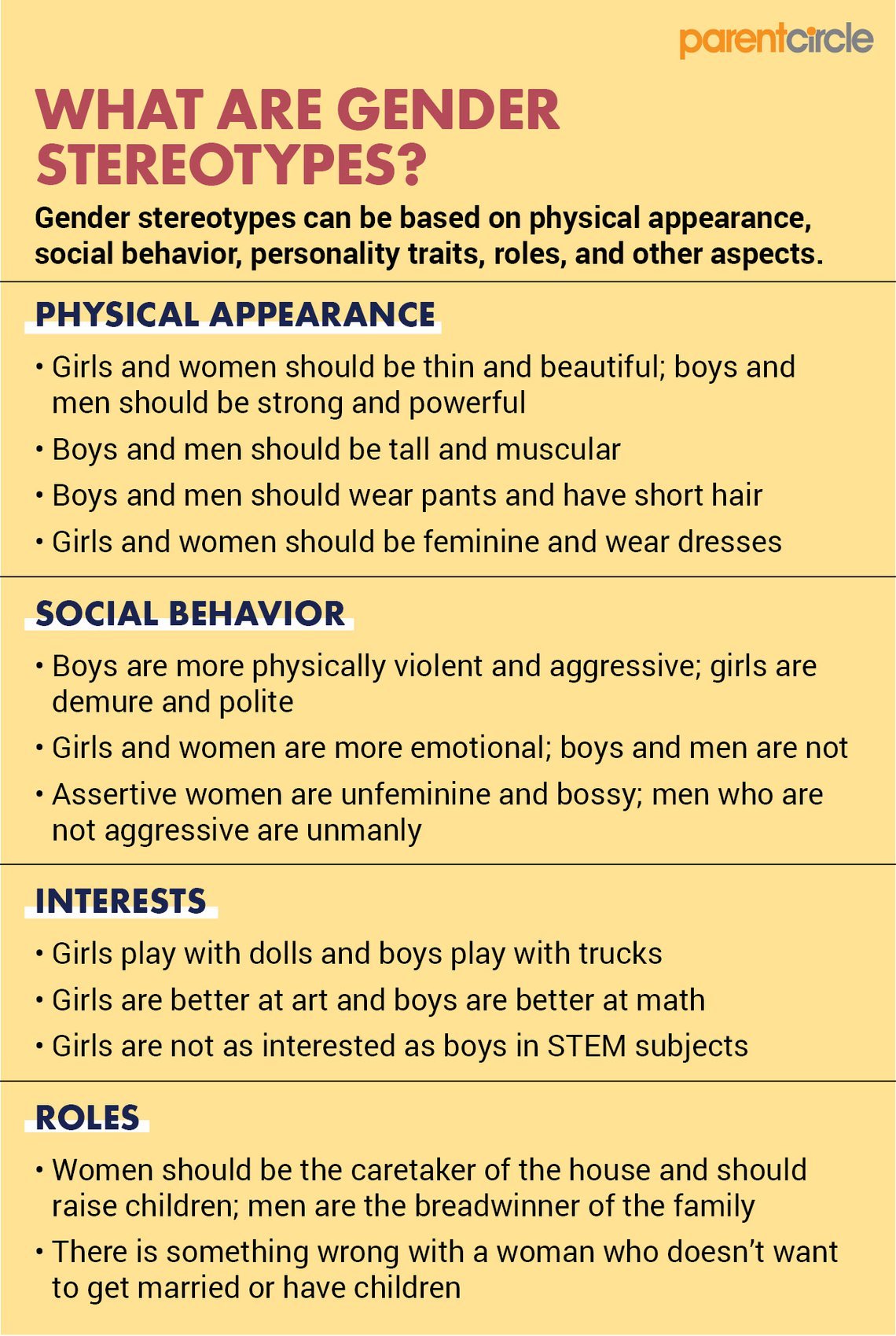
But how are gender stereotypes formed?
- Picture a newborn. Now think about who is caring for that newborn. If a woman comes to your mind, you wouldn't be off the mark. A majority of women do in fact care for newborns. But how many men have you seen involved in newborn care?
And this is one way in which generalizations may be formed. When we observe a group overrepresented in certain roles, we extrapolate the traits enacted in these roles (such as being more nurturing when caring for a newborn) and use those traits to define the entire group, that is, women in general. And this results in a stereotype that women are more nurturing and caring than men.
Fortunately, stereotypes are neither fixed nor rigid. In fact, research shows that if enough members of a stereotyped group manage to break into new roles (for example, women into math and science, men into nursing), prevailing stereotypes about them are likely to change.
Moreover, if people see enough instances of new traits they don't traditionally associate with a stereotyped group, this may change their beliefs about the group.
- According to research, implicit prejudices of parents can contribute to gender-stereotyped attitudes in children. Even if parents don't voice a belief explicitly, their implicit attitudes are picked up by children, who use them to form their own stereotypes.
In one study, girls as young as 3 years old were found to mirror their mothers' implicit gender stereotypes.
Again, there's hope. If we sensitize parents to become aware of their own unconscious biases, they can change the messages they pass on to their children.
What's gender stereotyping got to do with parenting?
Well, everything!
When we parent our children by giving them gender messages about their behavior, it's called gendered parenting. There are two ways in which we do that-through direct messages and through indirect messages that we send to our children during early childhood.
1. Direct gender messages
When we consistently buy female-stereotyped toys such as dolls and tea sets for our daughters, or male-stereotyped toys such as trains and dinosaurs for our sons, we implicitly link our children's sex to gender roles.
We may also respond differently to disruptive behavior in boys and girls. Research has shown that mothers respond less negatively to a son's risky and disruptive behavior and are less likely to encourage a son's prosocial or helping behavior. This is consistent with the stereotype that boys are risk-takers and challenging, but girls are nice and helpful to others.
2. Indirect gender messages
The biggest example of this is how our household is organized. We may model stereotypical male and female behaviors in the way we divide work, care and housework. So when children see their mother doing the majority of the household chores and looking after young children and elders, they assume that this is what women are supposed to do. And because they see their father as the family's breadwinner and don't see him contributing to household work, they assume that this is what men are supposed to do.
Because children generally identify more with the parent of their own sex, they are motivated to imitate that parent's interests and activities.
So, what is the impact of these gender stereotypes on children's development?
The problem with gender stereotypes is that children pick up on these stereotypes and then start trying to fit in with these ideas and expectations. For example, a girl who has observed her mother doing all the housework is more likely to assume that housework is for girls and will try to mimic that role during pretend play.
There are other ways in which gender stereotypes can be limiting and harmful. They can result in boys and girls being treated differently or offered different opportunities based on their gender. Stereotypes can affect children's academic performance, their choice of subjects in school or college, and even their overall well-being.
Girls may learn to be compliant, not take risks, and refrain from sharing ideas in group discussions. This may hold them back from pursuing prestigious roles in professions they believe they won't excel.
Boys, on the other hand, learn to suppress their emotions, show aggression to assert their power, and value being "tough" as the most important trait to be "masculine."
Today, education emphasizes sitting in one place in the classroom to study and focuses more on exam performance. This fits in more with a girl's style of learning and hence we see girls performing better academically in school and in exams. So, we begin to stereotype boys as being unfocused and academically inferior to girls. Research shows that this type of stereotyping may actually impact a boy's performance in academics, making it a self-fulfilling prophecy.
What can parents do to fight gender stereotypes?
We can't always control the messages our children get from the media and from society at large. But being the primary source of our child's learning in early childhood, there are many things we can do as a parent.
Here are some ways of busting gender stereotypes while parenting your child:
1. Let your child choose their own toys
To a young child, a doll is the same as a toy car-something to play with. It is when parents or friends gift a boy a science kit and a girl a kitchen set that gender-based conditioning comes into play. Let your child play with toys of his choice. You could buy more gender-neutral toys for your child, that is, toys not meant for a specific gender, like building blocks, musical toys, art supplies and board games.
Let your children choose whatever characters they want to be in their pretend-play games, even if they don't match their gender stereotypes.
Encourage playdates, activities and birthday parties with children of the opposite gender. The more comfortable your child is in playing with others who are different from her, the more it'll benefit her in school, in the workplace and in personal relationships.
2. Model healthier emotional behaviors
Instead of telling your daughter not to get mad, you can acknowledge her anger and help her find appropriate ways to express it. When your son is upset about something, you can empathize with him and help him find the words to talk about what he is feeling.
Let your child know that all feelings are okay. Giving her an accepting space of your presence will enable her to express her feelings safely.
3. Check what messages your child is receiving from the media
In the video your child is watching, is a boy criticized for crying? Talk to your child about how the boy might have felt when that happened. Share with him that the world isn't always comfortable with boys having feelings, but that it's really important to find healthy ways, such as crying, to express his feelings. Talk about movies that show men expressing emotions or discuss the men in your family who show their emotions or talk about their feelings.
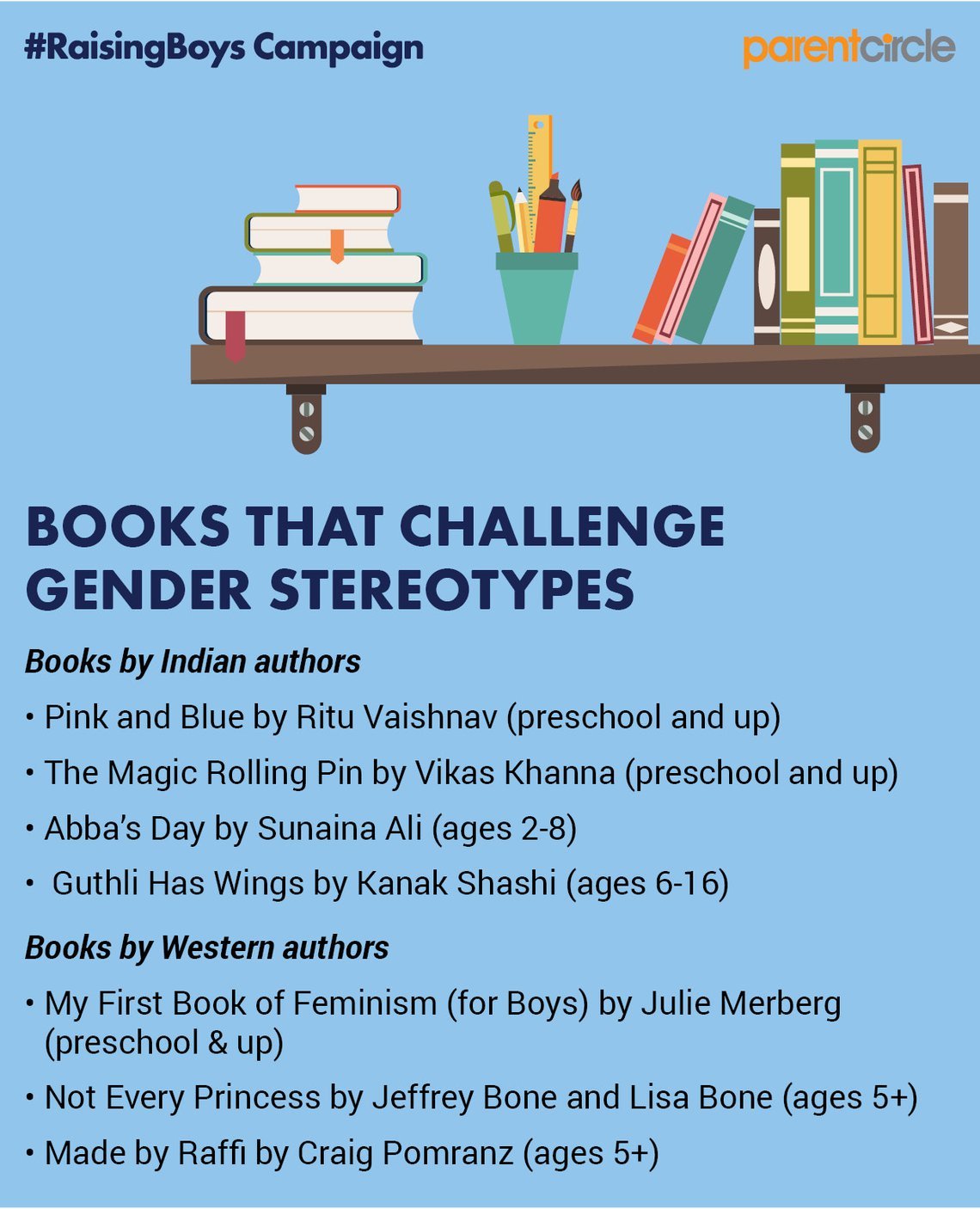
4. Expose your child to non-stereotypical books
In many traditional fairy tales, the girl is usually portrayed as a damsel in distress, who needs to be rescued by a handsome prince. This further reinforces stereotypical notions of what it means to be a girl or a boy. Consider exposing your child to books that challenge misperceptions about traditional gender roles and broaden your child's horizons. The list below consists of books about powerful girls and sensitive boys and children who dare to be different.
5. Check gender roles at home
Reject the idea of gender-specific chores. Assign tasks equally to your children-have your son help out in the kitchen and your daughter fix a light bulb.
Cultivate a relationship with your partner based on mutual respect, which involves joint decision-making, equal participation in financial matters, and equal division of household and outside chores.
Make it clear to your child that what each of you does as a parent (whether it's cooking or childcare) is determined by your individual skills, interests and what works best for the family, not your gender.
6. Watch what you say to (or about) your child
Avoid saying statements and questions such as "Don't walk like a girl" or "Why are you dressed like a tomboy?" Watch out for comments on your (or any other) girl's physical appearance. Comments such as "You're wearing such a pretty frock" emphasize that appearing attractive is a value that girls should aspire to. Instead, consider commenting on internal attributes or behaviors, such as "You are so kind to your sister" or "Wow! That was a tall tower you built!"
Using gender-neutral language is another good way of busting gender stereotypes. For instance, saying firefighters (not firemen) or ballet dancers (not ballerinas) makes children realize that professions are not gender-specific.
7. Expose your child to diverse role models
Role models come in all shapes, sizes, genders, ages, skin tones, cultural backgrounds, religions and castes. Encourage your child to embrace diversity by exposing him to role models from different genders who are challenging gender stereotypes and roles. For example, Greta Thunberg, Malala Yousafzai, Kiran Mazumdar-Shaw, Mary Kom and Kalpana Chawla are some inspiring female role models.
Remind your child that he can be anything he wants to be, regardless of his gender.
8. Accept your child for who she is
Every child has their own unique personality, interests and abilities. Learning about what makes your child tick and what makes them special helps you accept your child for who they are, irrespective of gender. Accepting your child enables you to create opportunities for them to pursue their interests and passions.
Avoid comparisons with other sexes, siblings, friends and peers, as such comparisons affect your child's self-esteem.
9. Build a connected relationship with your child
Spend time nurturing your relationship with your child. This strengthens your child's core sense of who they are and therefore empowers them to resist the pull of peer culture and resist the pressures of a society that is trying to fit them into a stereotype.
By practising all these strategies, the idea is not to erase gender, but to reduce the impact of gender stereotypes that accompany gender labels.
By paying attention to our ingrained gender stereotypes and taking small steps to change our family's attitudes, we can move the needle just a little away from gender stereotypes and toward authentic children, teens and adults.
In a nutshell
- When we parent our children by giving them gender-stereotyped messages (directly or indirectly) about their behavior, it is called gendered parenting.
- Gender stereotypes can be limiting and harmful. They can result in boys and girls being treated differently or being offered different opportunities based on their gender.
- There are many things we can do as parents to bust these gender stereotypes while raising our child(ren): Exposing them to diverse role models, reading them non-stereotypical books, checking gender roles at home, and checking messages from the media.
What you can do right away
- Expose your child to a wide variety of role models who challenge gender stereotypes. For example, show instances in your family or talk about your friends-men who are artists or dancers and moms who are scientists and engineers.
- Talk to your young child about equality between the sexes and model it in the way you organize your roles at home.
- Emphasize the idea that there are lots of different ways to be male and female by reading books to your child that challenge gender stereotypes.
































Comments
Edit
Comment Flag
Cancel Update