
How Parent's Technology Usage Is Affecting Children’s Behaviour And Development In The Digital Age
Malini Gopalakrishnan
Discover how parents’ technology use shapes children’s behavior and development in the digital age, with tips to build mindful family tech habits
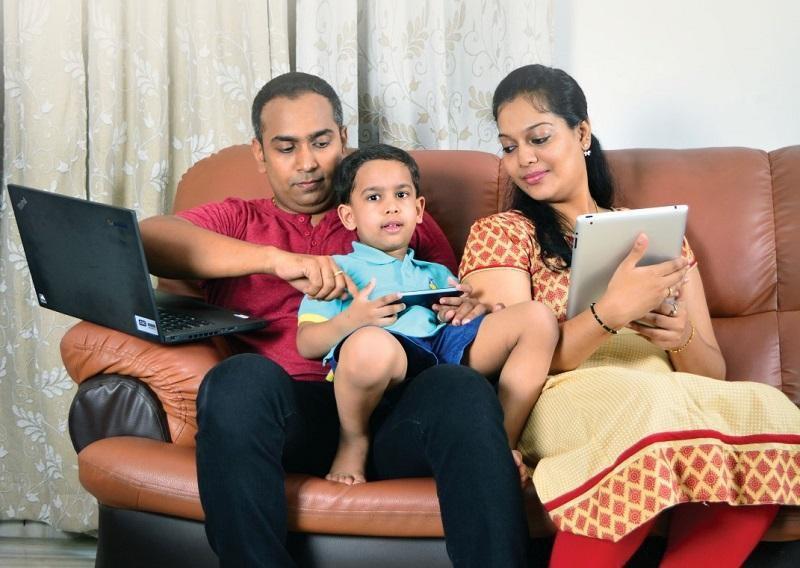
A piping hot meal sits invitingly at the table as a small family gathers to sit together after a long day. But, instead of cheerful banter, it's the 'tap-tap' on the phones or a swipe for every morsel that goes into the mouth. Sounds familiar? You might just be living in a classic modern family. But, is this what we envision as the paragon of 'family time'? The answer is, quite simply, no.
Yes, there is no arguing about the extent to which technology has simplified our lives. We have tools today that our parents did not. Today's scenario is like this: Can't figure out how to deal with a behavioral issue in your child? Look it up on the Internet for professional tips. Need to rush your child to a doctor? Simply book an appointment online. Looking for a good school for your little one? You have hundreds of reviews and ratings just a tap and a swipe away!
However, the same world of technology has us hooked in a sinister way. Our dependency on gadgets keeps us constantly engaged, and our preoccupation with our virtual lives is taking us further away from our human interactions. Applied to the context of parenting, what we see today is a disconnect between a parent and a child - quality time that is being sacrificed at the altar of technology.
Disturbing truths
How this quality time is being sacrificed is evident through various research studies in the last couple of years.
Studies highlight gadget dependence
- An anthropological study was conducted at the Boston Medical Center by Dr Jenny Radesky and her colleagues on patterns of mobile device usage by parents/caregivers and children during meals in fast food restaurants. The study, which was published in Pediatrics, the official journal of the American Academy of Pediatrics, in March 2014, shed some light on this subject. It observed caregivers, eating with one or more children at restaurants, to understand the degree of usage of this gadget and the corresponding effect of such usage on caregiver-child interactions. The findings showed that 73% of the caregivers were using their devices during the meal. Other important findings included the degree of absorption of the adult with the mobile phone, the lack of response to children's bids to attract attention, and, in some cases, even harsh responses towards children.
- A global study conducted by AVG Technologies in 2015 examined children's perceptions of parents' mobile phone usage by surveying 6,000 children (ages 8-13). Disturbingly, about 54% of the children surveyed felt that their parents spent too much time on their smartphones, and 32% stated that they felt unimportant when their parents were busy with their phones.
Expert Insight
Psychologist and author of 'The Big Disconnect: Protecting Childhood and Family Relationships in the Digital Age,' Catherine Steiner-Adair, interviewed 1,000 children (ages 4-18), as part of the research for her book. She found that across age groups, children had very negative emotional associations with their parents' cell phones. While some children confessed to feeling sad, angry, or lonely, others took to hiding or throwing away their parents' phones (even flushing them down the toilet)! The one common message was that children felt that mobile phones were an intrusion into their relationships with their parents.
Emotional and Behavioural Effects on Children
Not now! I'm busy!
As illustrated in various studies, it is evident that parents who are always busy with their cell phones are likely to have more negative interactions with their children. So, parents who are busy tapping away on their phones are more likely to get irritated and angry with their children for any interruptions.
Why do parents get irritable?
There is even a scientific explanation for this: While texting or typing, the brain senses an urgency to finish the task at hand. This urgency translates into an escalation of stress levels, especially since no one stops at one text or a single message through email. When interrupted from this task, the stress levels cause us to become irritable and impatient. For children, parents constantly shushing them, making little or no eye contact, and staying continuously engaged with their gadgets translates into a feeling of being neglected. The children feel unimportant and unloved.
Expert opinions
Giving an expert perspective on this subject, Dr Nithya Poornima, Assistant Professor, Child and Adolescent Psychiatry Services, NIMHANS (National Institute of Mental Health and Neurosciences) Bengaluru, opines that gadgets can be highly addictive and, therefore, a serious cause for concern. "There is an inherent risk when you use these gadgets. Many people feel more connected to both people as well as work when they are on their gadgets. But, what they fail to understand is that it takes them away from the present moment and, thereby, their ability or resources to respond to the child's needs in the most appropriate manner is elsewhere."
Emphasizing the need to spend quality time with your children, Dr Gittanjali Saxena, a Mumbai-based counsellor, says, "In many cases, parents are not even aware of what is happening in their children's lives. Because of parents' preoccupation with gadgets, behavioural issues will come to light quite late. For children to grow into well-rounded individuals, for them to develop confidence and healthy self-esteem, for them to know that their parents love them and will always be there for them, they need to receive a substantial amount of attention from their parents."
Validating the stance of how new-age parents are always engrossed with technology, Vasundhara Reddy, an HR professional and mother to a four-year-old from Hyderabad, says, "When I think about my 'parent fail' moment, I always think back to how my son, when asked to imitate the members of his family, 'played' me as being busy with my phone. Apart from being terribly embarrassed, I also realised that I had often been ignoring him in favour of my phone. I have been making a conscious effort, since then, to reduce my on-screen time."
Like Vasundhara, all parents should take efforts to reduce their time with gadgets.
Gadgets: the new age babysitters
How often is it that we see a crying toddler being handed a pacifier in the form of a video or app on a smartphone? Says Dr Nithya Poornima, "Gadgets have become the new-age medium of pacification or engagement for a child. Parents often give them to children to keep them busy. It forms an interpersonal barrier because both the adult and child are relying on this technology to stay engaged instead of interacting with each other. It may still serve a purpose when it is used in short spurts of time, as when done consciously by a parent who says, 'I am going to be on a call for the next ten minutes, and during that time you may play on the tablet'. Now, that is better than something that is unconscious and becomes a habit. Like children who cannot eat or drink without a gadget because they've been conditioned to do so."
Such gadget-dependence is really sad, since infants and toddlers depend heavily on face-to-face interactions to learn language, expression, and behaviour. The absence of such an interaction could hamper healthy physical and mental development in children. In August 2015, the British politician Tristram Hunt, who was at that time the Shadow Education Secretary, opined that the effect of a parent tapping away at an iPhone instead of interacting with her child is no less harmful than smoking around children. He also expressed concerns about the inability of children who had just been enrolled in schools to speak properly due to a lack of communication with their parents during their early years.
Now, why do these things happen? All because gadgets have replaced many activities that parents should be doing with their children.
Lead and they will follow
As parents, we are responsible for modeling the kind of behavior we want our children to emulate. However, our gadget etiquette is anything but a yardstick for our children to learn from. Those of us who are always busy with our phones are more likely to be swiping off during meals, mumbling into headphones while driving, and even tapping away as we walk. We avoid personal interactions with family and friends, falling prey to the 'constant networking' illusion that our handheld devices provide us.
Remember, your children won't be children forever. Enjoy every minute of their growing years. Show them that you love them every single day. Your phone won't miss you, but your children will.
As parents, we are responsible for modelling the kind of behaviour we want our children to emulate.
Parent express
It's a tricky choice!
By Natasha Singh Besterwich
My husband and I made our first parenting decision when I was pregnant and ready to pop, and that was to minimize the exposure of social media and technology in our little one's life.
This decision was very thoughtfully made. Nine months of pregnancy gave us enough time to do our homework, observe fellow parents, Google everything from 'how to change diapers' to 'new-age parent hacks', and filter welcome as well as unwelcome pieces of parenting advice from everyone around.
We observed babies and small children as well, and what we both found common among all children was that they were hooked on to some gadget or the other. Yes, they were all around us, a two-year-old at the mall, sitting in a shopping cart and glued to a mobile phone; a six-year-old at the airport lobby with an iPad and earphones; a nine-year-old engrossed in a Kindle; a young mother in a restaurant, in an attempt to calm her barely six-month-old baby, showing him cartoons on a smartphone! What appalled us further was the fact that this crazy gadget addiction in children was just a reflection of their parents' behavior.
Having seen all that, we made the decision to withhold technology from our children. Proud of our first parenting call, we welcomed our son, Ryan, in 2014. In his first year, we managed to stick to our decision, and it looked like it worked. He liked being outdoors, loved the birds and trees, and enjoyed the trips to the beach. But, in his second year, when Ryan was 1 year and 7 months, my husband, Derek, had to move to New York for a six-month-long work assignment. That was when we introduced Ryan to the iPad. The reason was that it was the only way to communicate/video-chat with my husband. Initially, Ryan didn't take too well to the gadgets. He seemed very confused and uncomfortable, while other children in his daycare were already pros at maneuvering their way around a tablet or smartphone. Eventually, it worked, and Ryan and I looked forward to our 'video chats with Dadda' every day.
During that period, we realized that we had been too critical of technology. It was because of technology that Dadda could talk to his baby boy every day and watch him grow. It was because of technology that the little fella didn't miss his Dadda at night, though he lived thousands of miles away. So, during that phase of our lives, we realized that technology made parenting possible, especially in keeping our family together.
This revelation made us revoke our technology ban. Of course, we do make sure that we use technology only in good measure and for a good purpose. We know very well that technology cannot replace human connections, but it can definitely play a role in facilitating them. Today, our 2-year-old Ryan is quite fluent with remotes and mobile phones. But, as parents, we make sure that we restrict his usage as much as we can. Also, we make sure not to use gadgets when we are with him. As parents, the greatest joy is to be with Ryan. Nothing else can distract us from that, not even a ring, beep, or click.
It's not a 'one-size-fits-all' answer
by Kiruba Shankar
Parenting has always been, and will continue to be, a challenging part of life. It is all the more challenging in the digital era. As far as technology goes, yes, it can hamper parenting, but it can also enrich it. For example, parents can stay connected with their children through video calls even when they are away on business trips. And, we have the baby monitor, which has been a blessing to parents, especially in nuclear families. So, you see, parents can certainly benefit from technology. But, generally, we forget this angle when asked the question, 'Is technology hampering parenting?' Of course, there's no 'one-size-fits-all' answer to this question. Some parents are obsessed with their online lives, sitting glued to their mobile phones or tablets. This results in their children being neglected. In such cases, the challenge is to exercise control over parents' own obsession with technology. However, a bigger challenge is ensuring that children, especially teens and pre-teens, are not addicted to their cellular devices and other gadgets.
Another way of viewing this scenario objectively would be neither from the parents' point of view nor from the child's perspective, but considering technology as a tool that can be used and misused like any other tool. As parents, it is our responsibility to introduce technology to our children and not keep them away from it. It is also our responsibility to make them understand the pros and cons of using technology and the judicious use of the same. And, what better way to teach them than to lead by example? If a parent is forever engrossed in a cellular phone or iPad, the child, in all probability, will follow this example. On the other hand, when a parent strictly stays away from these gadgets during mealtimes and family bonding time, it will be a demonstration of responsible use of technology.
Until a decade or so ago, the invasion of television into our drawing rooms was considered to be an intrusion into family bonding time. However, over the years, we have realized that in the right doses, and given the right content, television programs can be good sources of information, education, and entertainment. The same holds for today's technological devices, be it the laptop or the cell phone. There's always the right approach and a wrong approach to deal with anything. Where technology is concerned, as parents, it is our responsibility to choose the right approach.
Step up to the digital 'diet'
Whether we like it or not, the cell phone has become a necessity in this fast-paced world. As with anything, moderation is the key to making it work for you. Here are a few tips to cut back on your screen time and spend more time with your family.
Make the house a 'no-phone' zone: Set aside one small area where phones are allowed and leave it there after you're done. This way, you are truly hands-free around your home. Your mind and senses are open to movements around you.
Make family time truly gadget-free: This includes mealtime, playtime, and other family bonding time. Just turn your phone to silent mode and place it on the sideboard.
Set family rules: Rules work better when they apply to everyone. So, get your spouse/partner and your child to adhere to the 'diet'.
Track your phone usage: Most phones allow you to track your phone usage. Set a time limit for yourself and be strict about following it.
Cut down on your digital life: You know that clutter of apps on your phone. Well, take a deep breath and delete as many of them as possible. The more the number of applications running on your phone, the more the temptation to procrastinate. While you are at it, turn off the notifications.
Our dependency on gadgets keep us constantly engaged and our preoccupation with our virtual lives is taking us further away from our human interactions.
Quick Takeaways
- Reduce screen time during meals, play, and bonding moments.
- Model responsible gadget usage for children to follow.
- Use technology as a tool for learning and connection, not as a substitute for attention.
- Set family rules and boundaries for device use.
- Track usage and reduce unnecessary apps to minimize distractions.
Find out why parents should put down their gadgets and phones at home and create meaningful family time without distractions.
Last updated on: September 25, 2025





























Comments
Edit
Comment Flag
Cancel Update