
How To Help Your Teen Handle Exam Anxiety: Expert Tips For Parents To Reduce Exam Stress
Dr Meghna Singhal
Almost every student feels anxious while taking an exam, but some students may experience an intense anxiety that affects their exam performance. Read on to know how you can help your teen calm those exam nerves

Understanding exam anxiety in teens
Four months before her Grade 12 preboard exams, Shruti sought help from her parents. She had been feeling anxious for a while, but in the last two weeks, she had a panic attack while taking her semester exams. Her main worry was that she might get a panic attack during her preboards. Her worry was connected to the fear that she had not covered her syllabus portions and was far behind compared with her peers.
Vikram pulled an all-nighter, studying for his Grade 10 science semester exam till 4:30 a.m. His mother woke him up at 7 a.m. to get ready and go to school to write his exam. When he sat in his usual classroom to take his exam, he felt his mind go blank. The minute he saw the question paper, he froze. Why couldn’t he remember anything he had studied?
Both these instances reflect exam or test anxiety. The student may feel stressed, helpless, unable to manage the exam situation, or may completely blank out.
What is exam anxiety?
Exam anxiety (also called performance anxiety) is a feeling of fear, nervousness, uneasiness, or panic before or during an exam or any testing situation. It interferes with learning, reduces working memory (or the ability to think spontaneously and make decisions), increases mistakes, and lowers test performance. While your teen may have prepared well for the exam and may have the skills and knowledge to do well, their excessive anxiety may impair their performance in the exam.
Nervousness vs. Debilitating Anxiety
But everyone gets nervous before an exam!
While most individuals get nervous before an exam, a few can experience anxiety so debilitating, they find it difficult to concentrate and struggle to recall the things they have studied. A little nervousness before an exam has actually been found to be productive (famously called the Yerkes–Dodson law), making you mentally alert and enhancing your performance. But when that anxiety becomes excessive, it can interfere with test performance. You may know that you know your material, but you could still be unable to recall it because of anxiety, which may make you even more stressed. This may further make it harder for you to focus your attention on the test, and consequently, you may make silly mistakes, not read all the questions, or completely blank out.
Extreme exam anxiety can express itself in the following ways: Cognitive (thoughts), behavioral (actions), physiological (bodily signs), and emotional (feelings). See the box below.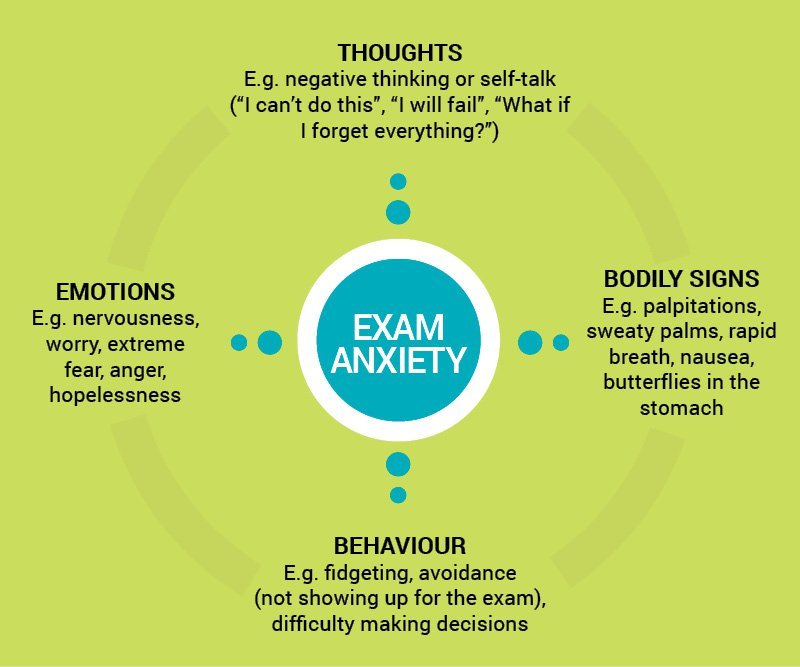
Why do some students experience exam anxiety, while others don't?
The role of parents in reducing exam stress
Sources of teen exam anxiety
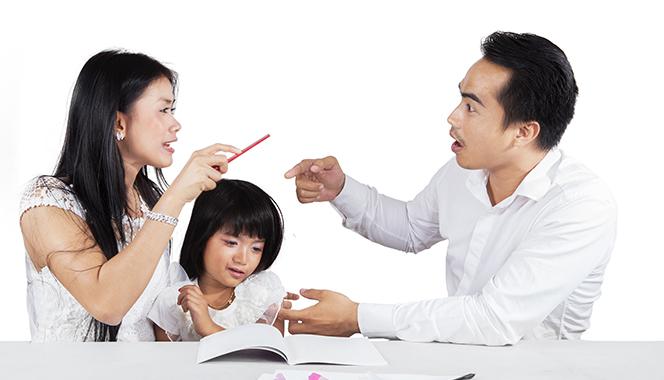
One of the biggest sources of exam anxiety is parental pressure. It’s usually expressed in the thought: “My parents will be extremely mad at me if I get low marks.” Isn’t it unfortunate that what is meant to be an assessment of a student’s knowledge ends up being a mad scramble for marks and parental approval?
Other sources of exam anxiety include lack of preparation, fear of failure, negative thinking, competition, and negative past experiences, such as a previous testing situation in which the teen perhaps froze.
Practical strategies to help your teen manage anxiety
Let us look at how exam anxiety expresses itself and examine how you can help your teen with each of those aspects:
1. Thoughts: Turn negative thinking into realistic thinking
This entails looking at the complete picture (not only the negative aspects of a situation) in a balanced manner.
Step 1: Pay attention to self-talk
We are often unaware of our self-talk (the things we say to ourselves without speaking them out loud), but it can have a huge impact on our feelings. This self-talk is important to detect. When your teen is getting anxious, they could start paying attention to the thoughts running through their mind. Getting anxious (signalled by slight or obvious bodily changes, such as a racing heart, butterflies in your stomach, nausea, or sweaty palms) is inadvertently accompanied by anxiety-provoking thoughts. A good way to identify these anxiety-provoking thoughts is to ask oneself: “What am I thinking about right now? What is making me feel nervous right now? What bad thing do I think will happen?” A good starting point is encouraging your teen to make a list of all the thoughts that are making them anxious.
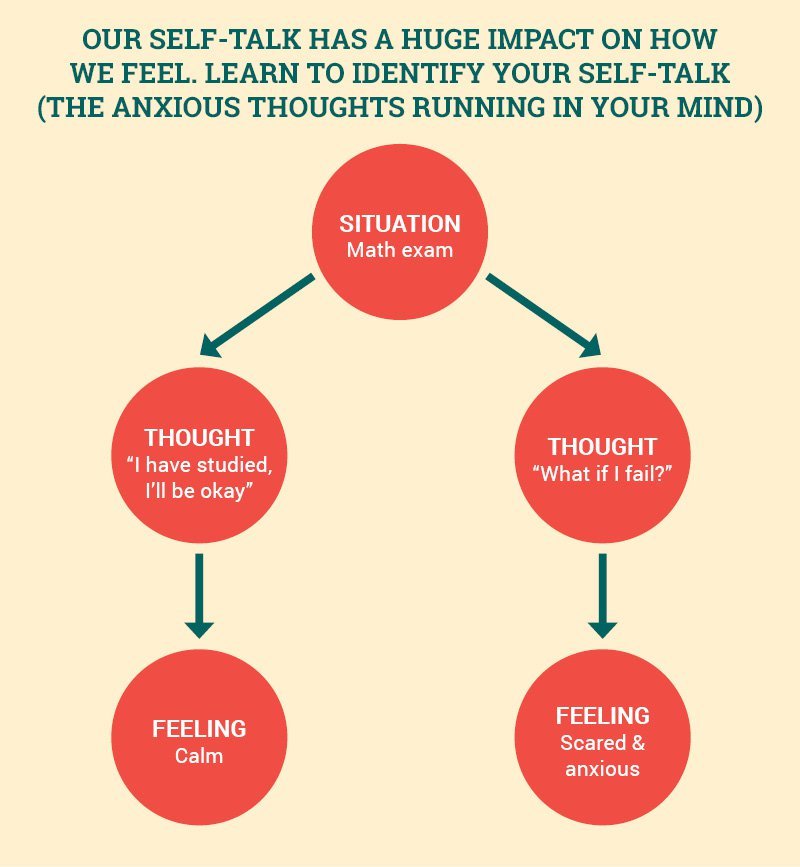
Step 2: Challenge your anxious thoughts
You must make your teen understand that thinking something doesn’t make it happen! For example, just because your teen thinks they will fare poorly doesn’t mean they will. But how can you explain that to your teen?
One good way of doing so is learning to challenge our anxious thoughts. This can be done in many ways:
- Providing oneself with evidence or proof against our anxious thoughts. What is the evidence that this thought (“I will fail my math exam”) is true?
- What would I tell a friend if she had the same thought?
- Am I 100% sure that ________________ (my anxious thought) will happen?
- How many times has ________________ happened before?
- What is the worst that will happen if ________________ comes true?
- If _______________ does happen, what can I do to cope with it/handle it?
It might also help your teen understand that some types of anxious thoughts are so common, they have been called “Thinking Traps.” Thinking traps are overly negative and unrealistic ways of seeing oneself, others, or one’s world, and they serve to maintain one’s anxiety. The table below illustrates some common exam anxiety-related thinking traps and how your teen could challenge her anxious thoughts using some of the above questions. Share this chart with your teen. 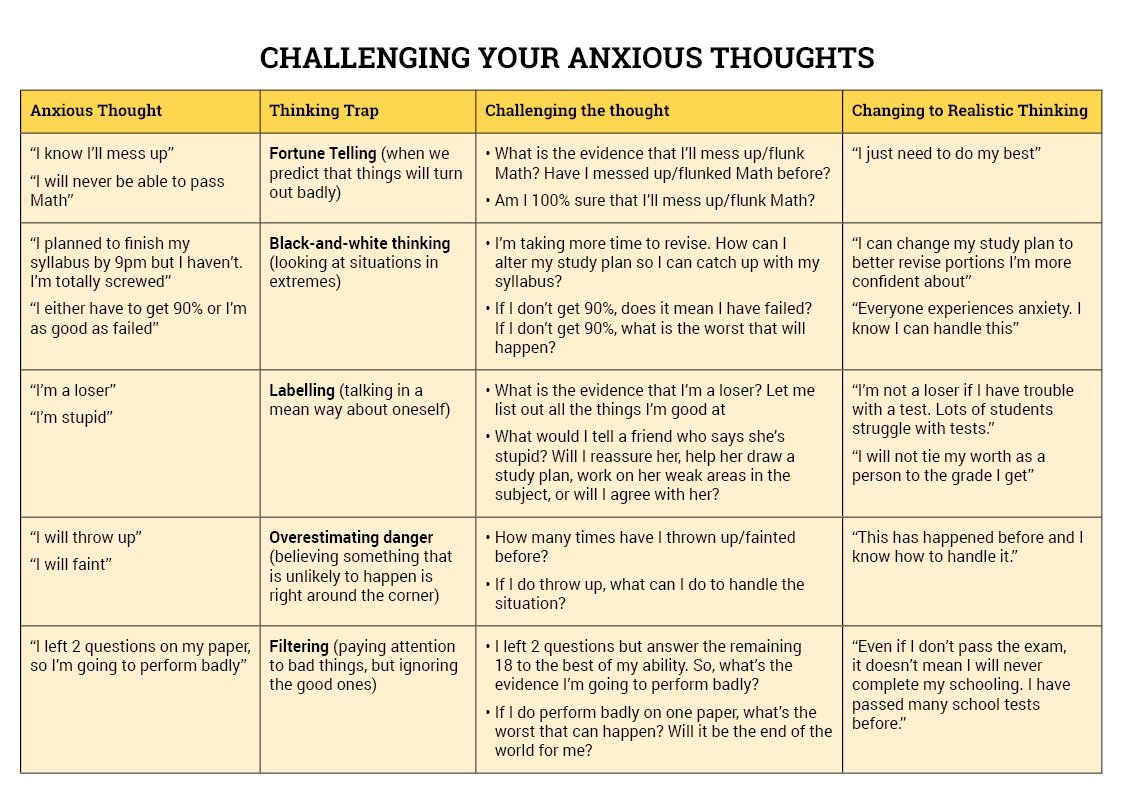
2. Feelings: Empathize with your teen
The most common parental response to a teen’s exam anxiety is offering reassurance: “Don’t worry, you will do well.” Or giving solutions: “Eat well and you will not feel weak.” But this may not be helpful to the teen who is overwhelmed with anxiety. You can, instead, do the following:
- Empathize: Expressing empathy is one of the best ways to respond to your teen, because it makes them feel heard. You don’t even have to wait for your child to express anxiety. Saying, “You seem worried,” or “I’m seeing that you’re having difficulty studying,” or “It’s hard for you when … ” can help open conversations about your child’s feelings. Just resist the urge to jump in with a solution. Rather, empathize and wait—let your child do most of the talking and don’t offer help unless asked.
- List out worries: If your child reports feeling worried, ask them to list down all the reasons behind their worry. Then, go over each reason (e.g., “I feel I will forget what I have learned in the exam”) and brainstorm how they can tackle each (e.g., when they start to notice feeling anxious during the exam, can they start doing deep breathing or focus on a distant sound to distract from the anxiety?)
- Don’t brush aside feelings: “It’s no big deal” is the last thing you want to say to your child. For them, anxiety is a big deal, and they may have reasons aplenty to feel anxious—failure, judgment, parental disapproval, embarrassment, etc. Instead, you can say, “I can see you’re feeling worried about this. I’m here to help if you need it.”
- Discourage avoidance: Avoidance of the feared situation (such as bunking the exam) makes the anxiety worse by reinforcing it. Helping your child choose the brave response (that is, writing the exam) will enable you to support them, not their anxiety.
- Get professional help: If your child’s anxiety exceeds their capacity to cope with it, debilitating them and making it difficult to study, you could consider seeking help from a counselor or clinical psychologist.
3. Body: Banish bodily tension
There are many ways to deal with your teen's exam anxiety that is expressed at the physiological (or bodily) level:
- Getting enough sleep
Getting a full night’s sleep for your teen, especially during exam season, is extremely important. Sleep is critical to learning—it’s far more effective to learn something for four hours after your teen has slept for eight hours than for her to learn for eight hours after she has slept for four! Sleep deprivation can impact your teen’s thinking and exam performance. It can also weaken the connection between her prefrontal cortex (her thinking brain) and amygdala (her feeling brain) and trigger anxiety. No wonder the students most prone to experiencing exam anxiety are the most sleep-deprived ones. - Breathing exercises
Practicing deep breathing regularly can help your teen feel calm and relaxed, with a brain that is alert and active. Here are two breathing exercises that can be practiced for just five minutes each every day. However, it’s important to remember that your teen can derive benefits from them only when he practices them regularly.
i) Diaphragmatic Breathing: Sit in a comfortable position (either on the bed or chair). Keep your right hand on your chest and left on your stomach. Close your eyes softly. Now take a deep breath in through your nostrils and make sure your chest does not rise, but your belly expands as you inhale. As you breathe in, count slowly from 1 to 5. Now exhale that breath through your nose, gently contracting your stomach, counting backward from 5 to 1. As you gain practice in this deep breathing technique, you won't have to keep your hands on your chest and stomach to monitor the expansion and contraction.
ii) Flower/Candle breathing: Sit in a comfortable position and close your eyes. Now take a long, deep breath as if you're smelling a beautiful flower. Then, exhale it like you're blowing out a candle on a birthday cake.
- Radical downtime
Our brains need deep rest, anything that is relaxing and rejuvenating, that involves doing nothing purposeful. An activity that does not require highly focused thought is one of the most powerful things we can do for our brains. Radical downtime is an enormously important antidote to the mind-scattering and mind-numbing effects of 24/7 technology and multitasking. Radical downtime does not mean playing video games, watching TV, surfing YouTube videos, texting a friend, or participating in organized sports or activities.
What can your teen do to get some radical downtime? Daydream, meditate, and sleep.
Justin Coulson, parenting expert and author of 10 Things Every Parent Needs to Know, recommends: “Get time outside in nature when studying for exams. Downtime matters to help your teen’s brain catch up with all the learning they’re doing.”
Try mindfulness meditation with your teen by downloading apps such as Headspace or Mind Yeti, which can be particularly useful at times of stress. Encourage your teen to look outside the window (instead of turning to technology) the next time you're driving together.
4. Exam Day Tips: Keep the anxiety off!
The pointers below can serve as a useful reminder to your teen about reducing their exam anxiety before, during, and after the exam. Share the chart below with your teen. 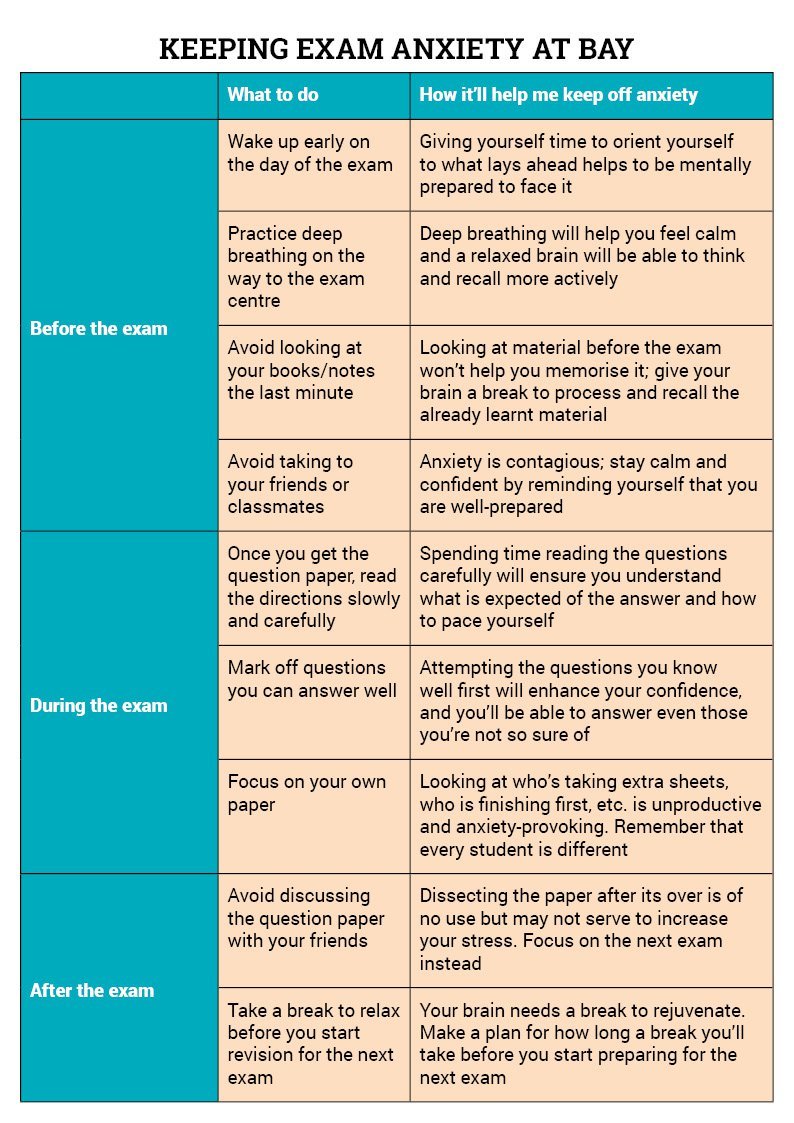
In a Nutshell
- While most people feel nervous before an exam, some feel particularly tense and anxious. Exam anxiety can impair performance in the exam and make mistakes likely.
- Exam anxiety expresses itself in a person's thoughts, bodily signs, actions, and feelings.
- Parental pressure is one of the biggest sources of exam anxiety. Other sources include lack of preparation, fear of failure, negative thinking, competition, and negative past experiences.
What you can do right away
- Help your child challenge their negative self-talk.
- Empathize with your child's feelings, rather than brushing them aside.
- Ensure your child gets enough sleep and radical downtime during exams.
- Don't review the question paper with your child after the exam.
Last updated on: September 26, 2025





























Comments
Edit
Comment Flag
Cancel Update