
Fun Ways To Make Kids Fall In Love With Math & Science – Practical Tips Inside!
Subhechha Chatterjee
Make math and science fun! Discover practical tips to spark curiosity, encourage hands-on learning, and turn everyday moments into exciting discoveries for your child.

Quite often, I see my neighbor's 8-year-old daughter crying in despair as she sits down to do her math homework. She complains to her mother that she cannot solve the problems and that math is a scary subject. Her mother, a chemistry teacher by profession, tries multiple ways to teach her daughter but often feels frustrated and gives up.
Does your child show a similar attitude toward math? Like my neighbor, many of us find it difficult to get our children excited about math or science. Some of us might feel that only if we have a background in STEM (science, technology, engineering, and math) can we instill a love for these subjects in our children. But that's not true. There are several things you can do at home to get your child interested in science and math, regardless of your academic background.
Read on for some simple tips to help your child lose their fear or dislike for math and science.
1. Show a positive attitude toward math and science
Children are great at sensing our likes and dislikes. Quite often, our personal biases tend to influence the way we teach or talk about a subject. A study conducted by psychologists at the University of Kentucky and Purdue University suggests that parents' attitudes toward math can influence their children's attitudes toward the subject. If parents express an aversion to science or math, children automatically start developing a fear of the subject. So, it's best not to say things such as 'I hate math,' 'Math is a bore,' or 'I was so glad when I finished Class 12 because there was no more math!'
Dear parents, put aside your biases and get set to explore STEM along with your child. Encourage your child to ask many questions related to math and science. And if you don't know the answers, that's OK. Admit it and learn together!
2. Introduce your child to people in STEM
Share inspiring stories of great men and women who struggled and worked hard to make a name for themselves as great mathematicians or scientists. Talk about stalwarts such as Satyendra Nath Bose, Srinivasa Ramanujan, Dr Vikram Sarabhai, Dr APJ Abdul Kalam, Dr Tessy Thomas, and Kalpana Chawla and their achievements. This will introduce your child to role models they can look up to.
Introduce your child to family members and friends working in STEM or associated fields. As your child hears about their experiences and converses with them, they will learn more about these subjects. They will realize that anybody can excel in STEM subjects through hard work and persistence, and there's nothing unusual or scary about them. They will also learn about various career options in STEM.
Help your child find a mentor with whom they can interact regularly and turn for guidance and inspiration.
Show your child exciting movies and documentaries on science and math, and give them a chance to be enamored by everything STEM has to offer!
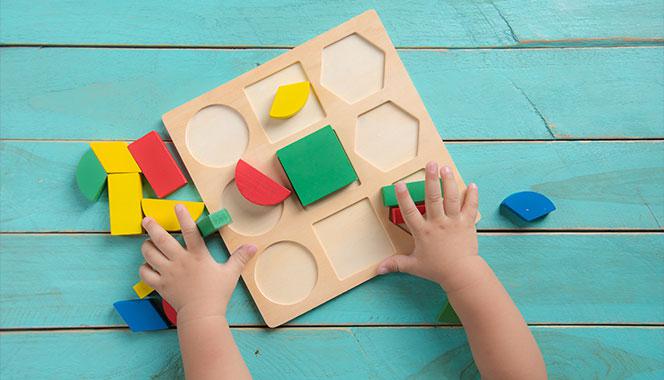
Introducing children to toys such as Rubik's Cube, jigsaw puzzles, and LEGO blocks exposes them to the world of math, science, and engineering in a fun way
3. Focus on the process, not the outcome
When we expect perfection in our children, we limit their enthusiasm to explore, experiment, discover, and learn. Remember, science and math are all about trial and error. So here's what you can do to encourage your child's curiosity and interest in these subjects:
More than methods and formulae, make sure your child understands the fundamental concepts, which can then be applied to solve problems.
Allow for mistakes and failures, these are opportunities to learn. If you expect your child to never make a mistake, they will be reluctant to experiment. A willingness to experiment will help them explore and learn.
When your child makes a mistake or comes up with a wrong answer, instead of saying, 'No, that's wrong,' ask them to explain how they arrived at the answer. As they discuss the steps, more often than not, they will discover the mistakes. Otherwise, you can guide them.
When your child does come up with a creative way to solve a problem, appreciate their innovative thinking. For example, if you ask them to add 27 and 35, they may say, 20 + 30 = 50; 7 + 5 = 12; 50 + 12 = 62, instead of using the traditional regrouping (carry-over) method. So, instead of forcing them to solve the problem in a particular way, appreciate their thinking.
Give your child time to think and explore. Don't rush the process of experimentation or problem-solving. When you add the pressure of time their brain may not work efficiently.
4. Engage your child in fun math and science activities
Here are some ways you can develop your child's math and science skills:
Expose your child to toys that promote logical thinking: "When my son was about 3 years old, I casually gave him an old Rubik's Cube to distract him with its colors. He was completely engrossed in rotating the cube and playing with it. Today, my son is 14 and solves a Rubik's Cube faster than any of us at home. And math is his favorite subject!" says Malini Chowdhury, an oncologist from Kolkata.
Introducing children to toys such as Rubik's Cube, jigsaw puzzles, LEGO blocks, or simple DIY science and engineering kits exposes them to the world of math, science, and engineering in a fun way, thus making them more curious. Your child may not be able to solve all the puzzles or stack all the blocks right away, but they will interact with these toys and find ingenious ways to play with them.
Show your child how math and science are used in everyday life: My love for math developed in the busy Sunday markets of Kolkata when, as children, my elder brother and I would intently watch our father negotiate the prices of vegetables with the vendors. Exposing your child to everyday math and science applications is one of the best ways to get them interested in the subjects. Here are some examples of math in everyday life:
- Measure ingredients as you cook a meal together
- Check the bill before making the payment
- Figure out the time needed to travel from Point A to Point B
- Manage time for any task
- Calculate sale prices based on discounts and settle on the best price for a product
- Make a budget
- Measure your room size and calculate its surface area to find out how much paint you need to paint the room
Show your child exciting movies and documentaries on science and math
As for science, well, life would be unimaginable without it! Cooking, use of LPG gas stoves, agriculture, transport, medicine, you name it, and you'll find science in it. Talk to your child about these things and pique their curiosity. Some examples:
- Why doesn't water boil over like milk?
- Why do the stars appear smaller than the moon?
- How do airplanes fly?
- When you're looking out of a moving train, why do things appear to move in the opposite direction?
- Why does glass sometimes break when exposed to high-pitched sounds?
- Don't forget science in the kitchen—how the same ingredients look, taste, and feel different based on whether they're baked, boiled, steamed, or fried; why food spoils, and so much more.
Set aside time for math games and science experiments:
Sundays were fun days at home. "I remember sitting with my grandfather on the veranda and trying to focus the sun's rays through a magnifying glass on a piece of paper. The joy of seeing the paper finally burn was equivalent to winning a Nobel Prize for my 12-year-old self," says Ashish Sood, a virologist from Pune.
Set aside a day in the week when the family engages in interesting experiments. Try making a DIY volcano using chewable peppermint and some aerated drink, or germinate seeds on a wet cotton bed and see how much fun your child has exploring and learning.
For more ideas, check out:
- https://www.parentcircle.com/easy-and-fun-science-experiments-for-kids/article
For interesting math activities, visit: - https://www.parentcircle.com/fun-maths-games-for-kids-to-improve-calculation-skills/article
- https://www.parentcircle.com/interesting-ways-to-make-maths-fun-for-children/article
The role of parents in helping children overcome their fear of math and science cannot be emphasized enough. Science and math are essential not only to pursue a career in STEM but also to develop a questioning and critical-thinking mind. Let's put our biases and dislikes aside and nurture our children's love for these subjects.
If after enough exposure and fun learning opportunities, your child chooses a non-STEM path, that's okay, too! Let your child follow their passion in any field of their choice.
Enhance your child's cognitive skills and scientific thinking skills with The Dot Me and My World program for kindergarten. It provides a solid foundation in science through sensory explorations and engaging experiments.































Comments
Edit
Comment Flag
Cancel Update