
How science can be taught to the old and young alike: An easy approach to learn science with everyday objects
Nitya Varadarajan
Want to inculcate a love for science in your child? Encourage their budding curiosity about how things work and why they work that way with some everyday experiments
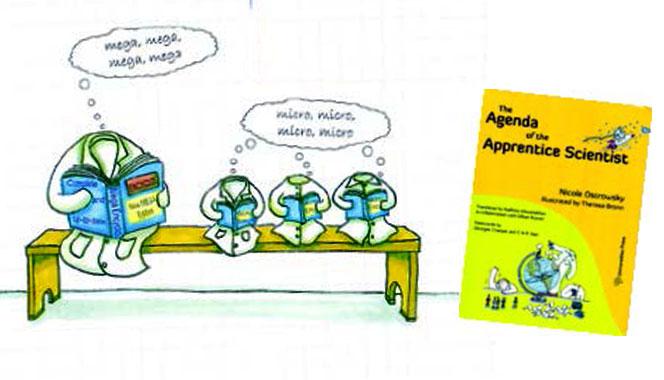
What is white color composed of?
I remember that as a child I was taught, that white could be broken into seven colors. I learnt after 40 years, that white could be broken into even three colors and that the correct answer is that it is not tied down by a finite number. I would not have learnt it, if I did not do an easy experiment that got me to think, and made me as curious as a child! We are never too old to learn – never mind if people tell you that the brain at 50 plus has gotten into an obstinate groove from where it refuses to budge. Nicole Ostrowsky’s awesome workbook is one of the best examples of how science can be taught to the old and young alike, from the age of 7 to 107!
There are other wisdom-filled quotes, “Don’t waste time inventing things that people would not want to buy” by Thomas Edison or “Look at life through the windshield, not the rear-view mirror” by Byrd Baggett. These provide an impetus to read through the instructions and get along with the experiment! The Agenda of the Apprentice Scientist is a treasure for its singular contribution to children and adults – that is inculcating a love for science. Or should I say, encouraging a budding curiosity about how things work and why they work that way? We are not talking about the Knowledge series mini encyclopedias that have been published in the past. This book is more experiment-oriented; we can use simple knick-knacks available at home, make observations and arrive at interesting conclusions.
For instance, how do you tell the difference between a raw egg and a hard-boiled egg?
Instruction: Spin them both and see if you find any difference. The hard-boiled egg spins easily for a while. The raw egg is slower to spin, owing to the viscous liquid inside and stops very quickly.
Or, can you thread a needle with one eye closed?
After trying this out, we learn that the brain receives a slightly different image from each of our eyes; its interpretation of these differences is the basis of our perception of depth. There are 365 experiments to kindle one’s curiosity – How to draw an impossible triangle; How to ‘see’ sound; and according to you what do a banging hammer and a playing radio have in common, etc.
At the bottom of every page is a small explanation to help the parents or teachers understand the phenomenon of the experiment better so that they can guide a young child. The aim of the book, Nicole says, is to help one to discover the answer for oneself. She is also planning to bring out a very comprehensive website that would provide additional resources to satisfy the increasing curiosity of the ‘apprentice’ scientist.
Clever illustrations do the trick
How does Nicole enhance interest in the learning process through her book? Her very clever illustrator has brought in a lot of humor in the book through two cartoon characters – Labcoat and Net. Labcoat is the scientist, but he has no head and limbs and Net is an empty-headed one who wants to become as clever as Labcoat. Every page also has a very interesting quote. For instance, under the experiment ‘How can you cut through an ice cube with a thread’, there is a quote by Auguste Detoeuf, ‘‘A judge has to split the difference between two parties as if he were cutting butter with a thread.” There are other wisdom-filled quotes, “Don’t waste time inventing things that people would not want to buy” by Thomas Edison or “Look at life through the windshield, not the rear-view mirror” by Byrd Baggett. These provide an impetus to read through the instructions and get along with the experiment!
Motivating factor
Ask Nicole, why she got interested in teaching science rather than actually pursuing a lucrative course in the field that she loves. After all, she has come from a family of scientists. She quips with a quote from Montaigne, “I do not teach, I tell stories.” On a more serious note, she ends, “It was the love for learning. I learned so much more about science by actually teaching it! My greatest reward after I finish teaching children is their question “When are you coming back?”
Enhance your child's cognitive skills and scientific thinking skills with The Dot Me and My World program for kindergarten. It provides a solid foundation in science through sensory explorations and engaging experiments.






















Comments
Edit
Comment Flag
Cancel Update