
FEATURED
Why It’s Important To Develop Your Preschooler’s Social Skills
Leena Ghosh
Preschoolers are just beginning to navigate the world of friendships and peer relationships. Help your child develop key social skills, which will boost their confidence and help them achieve success in life.
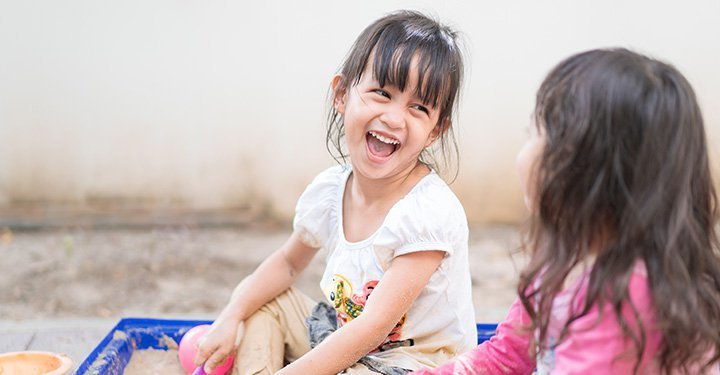
Meera stood outside her 3-year-old daughter’s classroom and peeked in through the glass window. She observed her little girl, Sandhya, sitting alone in a corner, building trains and rockets with different-shaped colored blocks, while her peers were laughing and playing together on the other side of the room. Over the past few weeks, Meera has been observing a similar pattern, where her daughter always played by herself. Meera was concerned that her daughter was not interacting with her peers.
Worrying questions raced through her mind: Why was Sandhya not mingling and interacting with her peers? Was she finding it difficult to make friends? Was she just shy? Was she being rejected by her peers? Was she feeling lonely at school?
At the next parent-teacher meeting, Sandhya’s class teacher confirmed Meera’s fears. The teacher explained that Sandhya was a kind child, very creative and academically sound. But, yes, she was finding it difficult to mingle and interact with other children.
Back home, Meera asked her little daughter, “Sweetie, who are your friends?”
Sandhya perked up and replied, “Mamma, you are my best friend!”
While the answer made her happy, Meera persisted, “But, what about your friends at school?”
Sandhya fell silent. Despite prodding, she didn’t look up from her toys.
So, what can Meera do? How can she help her daughter make friends and be more social?
If you, as a parent, are also struggling with such questions, be assured you are not alone. Preschool children are still developing many social skills. They are learning to make friends, cooperate with peers, share, take turns and be more sensitive to other people’s feelings. Some children may be extroverts, who naturally like to interact and socialize with others. Other children may be introverts or socially awkward and may not be very comfortable interacting with their peers.
If your child is an introvert, it only means their temperament (which is biologically based) is such that they need quiet “me time” to recharge and energize. But this doesn’t mean they lack social skills.
However, some children, who are socially awkward, may be lacking the necessary social skills. They may not know how to behave in a social setting, how to express themselves, how to cooperate and take turns, how to share, how to communicate with empathy, or how to resolve conflicts. Because of this, these children may struggle to make friends.
So, as a parent, it’s very important to understand why your child has difficulty making friends, so you can support them as necessary to strengthen their social skills.
Importance Of Social Skills In Early Childhood
Social skills are intrinsic to a child’s overall well-being. Research shows that good social skills in a preschooler contribute to positive behavioral, social, and academic outcomes in later childhood. Specifically, young children’s social skills are an important precursor to their development of school readiness and peer acceptance.
Children who are socially competent have:
- increased socialization opportunities with peers
- develop more friendships
- have better relationships with their parents and teachers
- enjoy more academic and social success
Children who lack social and emotional competence:
- are at risk for reduced socialization opportunities
- face rejection from peers
- display behavioral issues
- suffer from achievement problems
While research demonstrates that early development of key social skills translates into academic and career-related success, here are other important reasons why you need to pay attention to your little one’s social skills. Having a set of social skills:
Builds social competence – Better social skills automatically translate into better relationships with peers. When your child is eager to talk, share and play with other children his age, it will pave the way for stronger friendships. This makes the whole school-going experience a pleasure for the child. His ability to make friends boosts his competence to handle even tricky peer interactions.
Increases social awareness – Your child’s ability to socialize easily makes her a keen learner, as she becomes more aware of her social surroundings. The more your child interacts with other children her age, the more she becomes aware of different cultures, preferences, traditions and beliefs. From tasting a new dish during lunch hour to learning a new custom or tradition, the preschool social experience is an enriching one for your child.
Helps build empathy – A socially competent child not only communicates better, he is also able to better understand the perspective of his peers. He will show more empathy, kindness and tolerance, as he understands the feelings of others through his observations and interactions.
Sharpens language skills – When your child is exposed to different languages during her interactions with her friends and caretakers, she will pick up new words and learn to communicate, sometimes in languages other than her mother tongue.
Builds self-reliance – The ability to communicate effectively is key to facing and solving difficult situations. If your child is able to express himself effectively to his caretaker or teacher, he will be better able to build a healthy bond and trust with them. This helps him learn that when faced with a problem, talking to others about it can help him solve the situation. This is a great step toward making a child self-reliant.
Paves the way for better mental and physical health – Better social skills lead to better mental and physical health. A study titled ‘Indirect Effects of Social Skills on Health through Stress and Loneliness,’ published in 2017 in the Journal of Health Communication, showed that poor social skills were linked to poor mental and physical health.
Can Preschool Education Help Develop Your Child’s Social Skills?
Yes, preschools definitely have an impact on your child’s social skills. A playschool is a place where children are encouraged to interact in an organized and safe setting. This simply means that there are rules—you have to share, take turns with the swing, and learn to say words like “Please” and “Thank you” while expressing yourself.
5 Ways To Help Your Preschooler Build Social Competence
Here are some strategies to boost your child’s social skills.
1. EXPOSE YOUR CHILD TO VARIOUS SOCIAL SITUATIONS: Playdates, hobby classes, activity centers, or simply the good old playground are all great places to introduce your child to his peers. This will help him practice and learn interpersonal skills. Try to observe your child interacting with his peers. This will help you understand your child’s personality, and social skills, and what you can do to support him.
2. HELP YOUR CHILD EXPRESS HERSELF-USING WORDS: At this age, your child is still developing her vocabulary and language skills. Often, she may not know what to say or how to express herself. Because of this, she may hesitate to interact with people. Teach your child words and phrases she could use in different situations to help her overcome some of her social awkwardness.
Encourage her to answer questions directed at her. Even if your child is feeling shy and clinging to you, avoid answering the questions on her behalf, and if she doesn’t answer, don’t force her. Instead, you can ask her:
“Aunty is asking your name. Would you like to tell her?”
“Looks like this young girl wants to play with you. Would you like to play with her?”
Model asking questions. In everyday conversations, let your child hear you use words like "Please," "Sorry" and "Thank you." She will learn from you. Other phrases to teach your child to use include:
"I like this."
"You are right."
"You're welcome."
"It's okay. I forgive you."
3. FOSTER EMPATHY: When you help your child to become sensitive to another person’s feelings and emotions, you are building empathy in your child. Being empathetic is key to building strong relationships. Children who receive empathy themselves are more likely to be empathetic toward others.
Be attuned to your child. Being aware of your child’s needs and feelings means you are providing space for your child to interact with his peers, without pressuring him to socialize. Some children, especially introverts, may be uncomfortable playing with a large group of children. Such children may do well interacting with only one friend at a time. As an example, when you organize a birthday party for your child, a good rule of thumb is to invite one friend for every year of your child’s age. So, if your child is turning 3, invite no more than three friends to his party.
Acknowledge feelings with words. When you acknowledge your child’s feelings with words, you are teaching him to respect others and not dismiss their needs and feelings. You are also teaching him to name his own emotions. Learning to name one’s emotions is an important part of emotional regulation in children and adults alike.
You could reflect back your child’s feelings by saying, “I’m sorry that your tower broke. You must be feeling so disappointed! Do you want my help?”
If your preschooler says, “I hate Sasha. I’m never playing with her again,” resist the urge to delve into an explanation about why he shouldn’t use the word “hate.” Good feelings won’t come in until the bad feelings are let out. Instead, try saying, “Sounds like you’re really angry with Sasha right now!”
Develop empathy. Help your child understand how other people may be feeling in different situations. Here are some ways you can inculcate empathy in your child:
Read books and share stories with your child. Discuss the different characters and what they may be feeling as they experience different situations throughout the story.
Point out instances of kindness on the playground or in his playschool, “You saw how Sheila helped Rahul climb up on the monkey bar. How do you think Rahul is feeling right now?”
4. ENCOURAGE COOPERATION: At this age, children are still learning to share and cooperate with other children. Here’s what you can do to help your child with cooperative play:
Sharing. In your child’s mind, she feels entitled, and everything is still “mine.” When your child learns to share her toys and other things, she learns to cooperate and build good relationships.
If your child tries to snatch a train that her friend is playing with, you could say, “Muhil is still playing with his train. Muhil, after you are done playing with the train, could you give it to Misha? Thanks so much, Muhil! Misha, let’s find something else to play with. Would you like to slide your cars down this slope?”
Taking turns. While playing with other children, help your child understand the concept of taking turns, as opposed to forcing her to give up what she is doing.
If your child is playing on the swing and another child wants to also play on the swing, you could say, “Saana would like to play on the swing too. After you play for five more minutes, it is Saana’s turn on the swing.”
Showing kindness. Encourage your child to help a friend in need—helping soothe a friend who is hurt, sharing her pencil if the other child needs one, helping a friend build a sandcastle, and so on.
5. TEACH CONFLICT MANAGEMENT SKILLS: How your child responds to peers in times of conflict can make or break his friendships and relationships. Here are some ways in which you could coach your child to handle conflicts effectively.
How to say it. When your child is facing a conflict situation, coach your child on what he should say to his friend to diffuse the situation. Role play is also a great way to help your child learn how to deal with peers in different situations.
Dr Laura Markham, creator of ahaparenting.com, and author of the bestselling book, Peaceful Parent, Happy Kids: How to Stop Yelling and Start Connecting, recommends, “If your child grabs his peer’s toy, see how the other child reacts. If they don’t get bothered, drop the issue.” If the other child does object, here’s what you can gently say to your child, “We don’t snatch. If you’re not okay with Amit playing with your football, you can tell him, ‘My football! Please give it to me.’”
If another child is pushing your child playfully and your child isn’t enjoying it, teach your child how to stand up for himself and be assertive. He could say, “I don’t like being pushed. Can we play something else?”
When your child is having a difficult time. There will be times when your child is the one causing trouble or misbehaving with his peers and refusing to cooperate. Your child is throwing sand on his friends while playing in the sandpit. What can you do? Here are some strategies to get him to stop, while ensuring cooperative play:
Describe how you feel: This way you avoid blaming the child while sharing your concerns in a respectful manner. It models a vocabulary of emotions that your child can use when he is frustrated, upset or scared. It also helps your child understand how others may be feeling.
“I’m worried about the sand hurting other children’s eyes.”
Give information: It’s more effective to give your child simple information rather than giving an order. When you share information it allows your child to figure out for himself what to do; it helps avoid your child’s natural resistance to a direct order. It also helps your child develop self-control.
“When sand gets in our eyes, it hurts a lot and it can damage our eyes.”
Be playful: Turning something into a game or a challenge has the power to transform an uncooperative or disruptive child into one who is eager to try the challenge.
“Let’s see who can build the tallest sandcastle!”
Offer a choice: Give your child choices and some control over his life, instead of just giving instructions and commands. This helps him learn that he can make his own decisions, and it helps build self-reliance.
“I see you’re in a throwing mood. What can you find that’s safe to throw? Would you like to throw leaves or flowers?”
Take action without insulting: When nothing else works, without scolding or accusing the child, you can stand your ground and enforce a limit.
“I’m taking you home. I can’t let children get sand in their eyes. We can come back another time.”
Handling meltdowns. Despite your best efforts to distract and diffuse a conflict situation, your child may end up having a meltdown. Meltdowns are a way for children to express their overwhelming feelings. (No, your child is not “misbehaving.” She’s unable to contain her big feelings.) This is not an opportunity to discipline your child, as a distressed child is unlikely to register your instructions or reprimands. As Dr Markham says, “Your acceptance of your child’s feelings is what will help her calm down and feel accepted” and make it less likely for her to repeat the behavior.
Connect and calm your child: So, if there is a meltdown, pause to calm yourself down first—a frustrated parent can’t calm a frustrated child. Connect with your child by letting her know you understand how she feels. Then, allow your child to let out her big emotions and settle down before you try to show her how she could better handle the situation. You could say, “You really wanted to play with that train! Do you want a hug? I’m here for you.” Then when she has calmed down, ask her how she could have handled the situation better, “How could you have told Muhil that you also wanted to play with the train?”
A preschooler is like a sponge. They absorb and imitate whatever they see in their immediate environment and in their social circles. Your child observes how you socialize and interact with others and learns from you. You, as a parent, play a very important role in helping your child develop key social skills that will last them a lifetime. So, go ahead and let your child play, interact and have fun with their buddies!
In a nutshell
1. Preschoolers with good social skills develop more friendships, have better relationships with their parents and teachers, and enjoy more academic and social success.
2. Children develop social skills when they get opportunities to interact with their peers and have a parent to guide and teach them the skills to communicate, share, take turns, show empathy and handle conflicts.
What you can do right away
1. Observe your child playing with her friends and see how she interacts to understand her social skills.
2. Show your child how to take turns.
3. The next time your child gets upset, acknowledge his emotions and help him name his feelings, “I can see you are upset.”
The Dot KG learning program helps teachers and children effectively manage their emotions to maintain a calm and positive environment in the classroom.






















Comments
Edit
Comment Flag
Cancel Update