
How to make your child mentally strong: 12 strategies to build mental muscle
Aruna Raghuram
Being mentally strong does not mean acting tough and swallowing your tears when you are hurt. It is about dealing with challenges and bouncing back from setbacks

When she was just 16 years old, Sudha Chandran was involved in a road accident. Her leg was seriously injured and had to be amputated. But this did not deter the gutsy teenager. She had a Jaipur foot fixed, and went on to become an accomplished Bharatanatyam dancer and a well-known TV actress.
Arunima Sinha was a national volleyball player and wanted to join the Indian paramilitary forces. One fateful day, she was pushed from a running train by robbers. Her left leg had to be amputated, and she had multiple fractures in the spinal cord. Despite this tragedy, Arunima rose to great heights—she became the world’s first female amputee to scale Mt Everest.
The stories of Sudha and Arunima tell us that people can be mentally strong—and incredibly so. What was their childhood like? What did their parents do right? How did these youngsters develop the mental strength to overcome adversity?
Before delving into strategies to build mental strength, let’s explore what exactly mental strength is. Mentally strong kids are able to find solutions to their problems, endure hardships, and bounce back from adversity. Grit, self-discipline and resilience are all facets of mental strength. So are impulse control and the ability to resist temptation.
Psychologist Dr Peter Clough and businessman Doug Strycharczyk, authors of the book Developing Mental Toughness, describe mental toughness as: “A personality trait which determines, in large part, how people respond to challenge, stress and pressure, irrespective of their circumstances.”
According to the authors, the four pillars of mental toughness are:
Challenge: Seeing challenge as an opportunity
Confidence: Having high levels of self-belief
Commitment: Being able to stick to tasks
Control: Believing that each one has control over their own destiny
Clough and Strycharczyk also see mental toughness as the ability to view change positively and embrace it in order to develop. According to research by Dr Clough, mentally strong kids perform better academically and are also less likely to indulge in antisocial activities.
Mental strength should not be confused with acting tough or suppressing emotions, says Amy Morin, psychologist, social worker and author of 13 Things Mentally Strong Parents Don’t Do. Speaking exclusively to ParentCircle, she explains: “Mental strength is what you need to reach your greatest potential, during good times and bad. It has three parts—regulating your thoughts (not overly positive, not overly negative, but thinking realistically), controlling your emotions (you have control over how you feel—you can take steps to calm yourself down when angry, for example), and taking positive action (irrespective of the circumstances). It’s all about choices you make every day.”
Building mental muscle: 12 strategies
What can parents do to help their children develop mental strength? Here are some suggestions, most of which are linked to the four pillars described by Clough and Strycharczyk.
1. Let your child make mistakes: Parents hate to see their children make mistakes and suffer the consequences. But learning from one’s mistakes is probably one of the best ways that children can develop mental strength.
Say your high school child sleeps through the alarm and misses a class test. When he gets a zero in the test, he will learn to be more responsible the next time around.
Ensure your child does not feel ashamed or embarrassed about making a mistake. Instead, get your child to think about what he has learned from his mistake and what he could do better next time. This way he learns that he is in control of his destiny.
2. Avoid rushing to her rescue: Your child may face an uncomfortable situation when she has to move to another section in school and make new friends, learn a new skill, or when she gets a lower grade than normal on her tests. Allow your child to face the situation and pull herself out of it, instead of trying to solve the issue and protecting her.
Of course, be there to provide help and support if needed. If you rescue your child every time she is struggling, she will only feel that she is helpless and hopeless. By allowing her to work out solutions on her own, you are helping her develop confidence.
3. Help him deal with his fears: Children can be afraid of many things—of sleeping alone, of insects, or of public speaking. Parents have to encourage their children to face their fears and gradually get over them. Praise your child for his bravery as he tries to do so. Also, make sure that your child notes how you deal with your own fears. Every opportunity to overcome a fear is a challenge.
4. Urge her to think realistically: Sports psychologist Sara Robinson explains in an article on the website afineparent.com how you can help your child reframe her thoughts. “Reframing, or ‘flip the coin’ is a cognitive strategy that helps to look at the situation from a different perspective,” Robinson writes. Tell your child to write down negative thoughts on one side of a paper, she advises. Your child should then find another version for each thought. For instance, she may be struggling to learn to play a complex new piece on the piano. Instead of giving up, encourage your child to break up the piece into smaller achievable sections so that she can practice and master it before she puts it all together. This way she will learn the value of commitment.
5. Discuss feelings and how to regulate emotions: To prepare your child emotionally for adulthood means frequently talking about feelings. Amy Morin (while speaking to ParentCircle) said: “Feelings aren’t either all good or all bad. Every emotion can be a friend or enemy sometimes. For example, anger is a friend when it helps you stand up to social injustice. But it might be an enemy if it causes your child to get into a fight and he gets in trouble.” Basically, children need to recognize when emotions are a friend and when they are an enemy.
Never tell a child: “Don’t be anxious about tomorrow’s test” or “How can you be scared of a little insect?” This will make him think that he should suppress his emotions, which is unhealthy. Listen keenly when your child is struggling to express his emotions, and validate his feelings. Give your child importance and respect by listening and taking him seriously. Thoughts and emotions affect actions and decisions. That’s why it’s important that your child learn coping skills—how to manage his emotions in a healthy manner. When your child learns to regulate his emotions, he feels in control and can take on challenges.
6. Avoid being too indulgent: Some parents tend to buy expensive gifts for their children and give in to their every whim. Working parents may do this out of guilt for not having enough time to spend with their children. But giving your children all that they ask for prevents them from developing self-control and the strength to accept a “no.” Instead, parents can reward their children with nonmaterial things like half an hour of TV time after they have completed their homework.
Parents may be overindulgent in other ways like praising their children too much or giving in to their every request. This will give their children a sense of entitlement, which may lead to disappointment when they don’t get what they want at some other point in life. Your child should be able to take “no” for an answer. This way she learns to handle disappointments so she will be more willing to take on challenges.
7. Teach him the importance of being accountable: Make your child accountable for his actions. This means facing the consequences if he does not behave in a responsible manner. Discourage your child from making excuses or blaming others for his poor behavior. For example, he should be able to discuss a fight he has had with a friend in an objective manner and accept his share of the responsibility. When your child feels responsible and accountable, he shows commitment toward a task or activity.
8. Practice strength-based parenting: Don’t expect perfection; instead, have realistic expectations from your child. Aspirational parents, who want their children to be best at whatever they try their hand at, can put undue pressure on their children.
Instead, encourage your child to pursue activities that she has a liking and aptitude for. A child who is confident of her abilities will be able to take on challenges. By emphasizing on your child’s strengths rather than her weaknesses, you will make her develop self-esteem and confidence.
9. Minimize the importance of external approval: Raising confident children is more of a challenge these days when the number of “likes” on social media can inflate or deflate their self-esteem immeasurably. Children should be taught to value themselves intrinsically and not depend too much on the approval of others, including peers. This way they will develop self-belief and confidence.
10. Highlight the importance of gratitude: Feeling grateful for what he has will stop your child from indulging in self-pity when he is down. Being grateful and positive will make him feel upbeat, and this will encourage him to find a solution to his problem. Having a grateful perspective helps a child deal better with adversity. Also, thinking of things one is thankful for during hard times makes one resilient. This way a child feels confident.
11. Make her adaptable to change: It’s often said that change is the only constant. The situation keeps changing for all of us, including our children. Your child’s best friend may move to another city. She will have to accept that and find other good friends. Children will resist change unless they are taught early in life that certain things are bound to change. They have to adapt to the changes they face. This adaptability is an important aspect of mental strength. It will also give them a feeling of control over their lives in times of uncertainty.
12. Teach him to be kind to himself: Being kind to yourself when you are facing a low in life is important to develop mental strength. It will enable you to pick yourself up and move on—invest renewed energies in whatever needs to be done. If your child has performed poorly in a test, urge him to forgive himself and help him figure out ways to do better next time. This will help him understand that he is in control of his academic achievement and gives him the confidence to put more effort into his schoolwork.
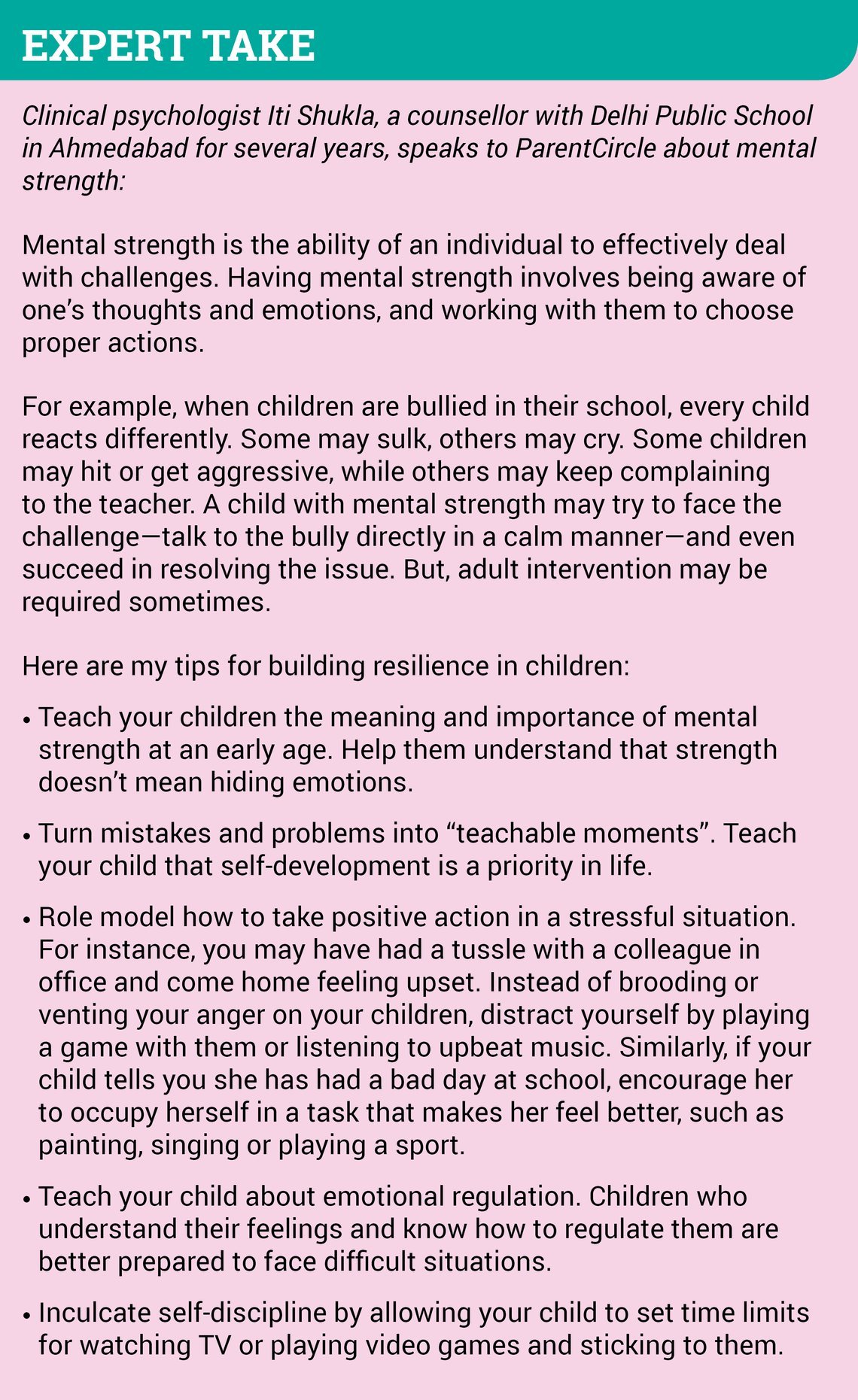
Parents can help their children build mental strength by urging them to persevere and see opportunities even in adversity. While following the various strategies described above, parents need to realize that their unconditional love will make their children feel safe and secure and help develop inner strength.
Parents can also share lessons from their own life—how they overcame challenges. Appreciating the efforts of their children and celebrating their victories, however small, are also important.
In a nutshell
- Mentally strong kids are not those who act tough and exhibit defiance.
- Mental strength is a combination of grit, resilience, self-discipline and problem-solving abilities.
- Letting your child make mistakes and face their fears, encouraging them to think realistically, and guiding them in regulating their emotions are some ways to help your child build mental strength.
What you can do right away
- If your child comes back from play with a twisted ankle, don’t magnify the pain or get anxious. Instead, spray a pain reliever on the site of injury and reassure him that he will be well soon.
- If your child wants to talk to you about a bad day at school, be available to listen without judgment and then encourage her to do some activity she enjoys, like painting or playing a sport, to make her feel better.
- Get your child a journal and ask him to write three things he is grateful for at the end of each day. This will help him develop a positive mindset.































Comments
Edit
Comment Flag
Cancel Update