
Tired Of Time-Outs? Try Time-Ins
Dr Meghna Singhal
Time-outs, when implemented as punishment, do more harm than good. Let's look at time-ins, which offer a better way to discipline your child while you work on your connection with your child

Neelu walks into her bedroom and finds her lipstick smeared all over the floor and on her child's face.
"Oh no! That was my favorite lipstick! Who gave you the permission to touch my makeup? You bad boy!" she yells at her son Akhil in frustration. "Go sit in the corner."
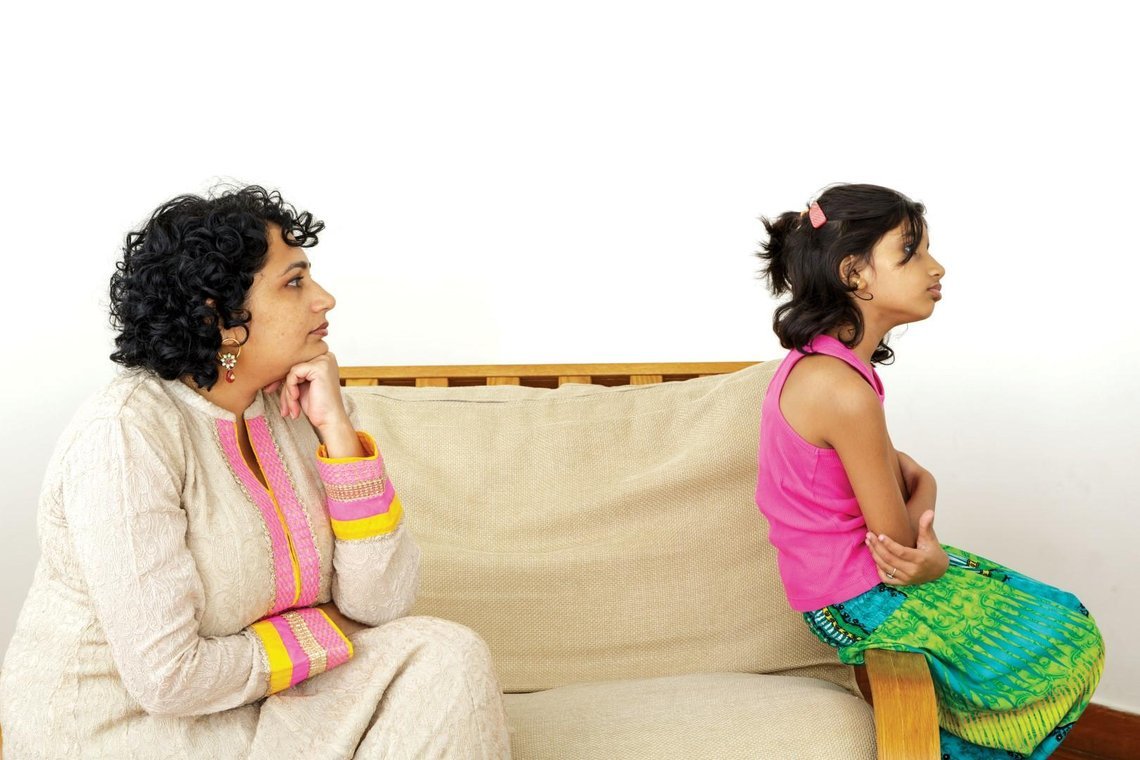
And off she sends her son to time-out, or what they refer to as his "punishment corner" in their house.
Now let's examine what the mother and the child in this scenario might be thinking and feeling.
The mother: "His behavior is so frustrating! I need to be stricter with him. How can he just take out my makeup? He's getting naughtier by the day! Just doesn't listen ... God! At least the punishment corner will teach him a lesson. At least he will learn what not to do!"
The child: "I was just playing ... Mumma got so so mad at me. I really feel scared when she yells at me. I feel she doesn't love me. I feel scared and lonely when she sends me to the punishment corner. I don't like being here. It makes me sad. Mumma is so unfair. I must be a very bad child ..."
While most parents today don't spank their children (for good reason), many still use time-outs as an effective disciplining strategy.
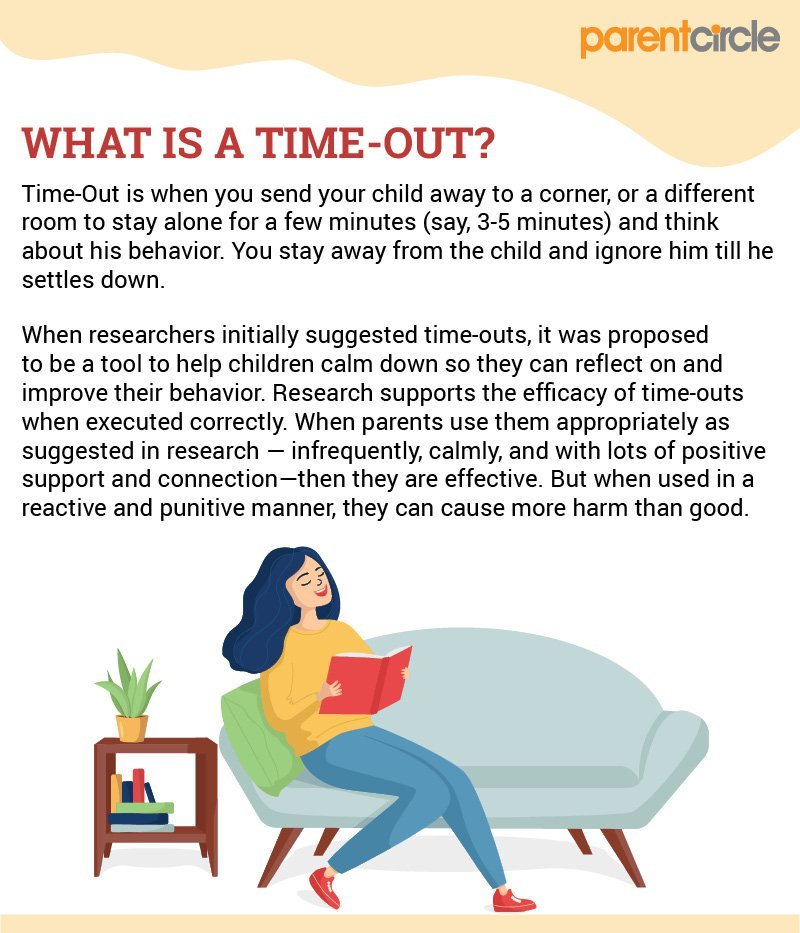
On the surface, a time-out seems like a logical method. It's non-violent and gets the child's attention. It also gives the parent and the child a much-needed break from each other, especially when emotions are running high.
But scientific evidence shows that time-outs, when implemented in a reactive manner, are perceived as punishment and have been shown to worsen the child's behavior. And so, they carry some of the disadvantages of traditional punishment-they make the child feel worse about themselves and they erode the parent-child relationship. Additionally, this is the time your child needs your support to calm their emotions. Sending them away to deal with their overwhelming emotions on their own, which they may not be capable of doing, is unhelpful.
Not surprisingly, time-outs don't improve a child's behavior, not in the long run anyway. You might get cooperative behavior from your child at the moment, but time-outs don't help them learn the lesson any more than shouting at the child does.
Why time-outs don't always work
When a time-out, laced with the parent's anger, takes on a punitive tone, it becomes an ineffective disciplining method. Here's why:
Time-outs make the child feel worse
As illustrated in the situation above, on receiving a time-out, the child, instead of thinking, "I did something wrong" or "I behaved badly," is most likely thinking, "I am a bad boy." The child labeling himself as "bad" seriously harms his self-esteem and this can actually increase that misbehavior. This is a fundamental tenet of human psychology: People who feel bad about themselves behave badly.
Otto Weininger, author of Time-In Parenting: How To Teach Children Emotional Self-Control, Life Skills and Problem Solving by Lending Yourself and Staying Connected, explains in his book, "Sending children away to get control of their anger perpetuates the feeling of 'badness' inside them ... Chances are they were already feeling not very good about themselves before the outburst and the isolation just serves to confirm in their own minds that they were right."
Time-outs don't help the child learn appropriate behavior
You might expect that a time-out will enable your child to think through their behavior, but actually, they may be too angry or upset to think rationally. Their brain is likely in a "fight-flight-freeze" mode, which means they are feeling unsafe and too overwhelmed to "learn the lesson."
When asked why they were given a time-out, children often say, "Because Mom's mad at me." So, if the child doesn't understand what they did wrong, we have lost a learning moment.
Time-outs feel like punishment
Banishing an upset child to a room feels like abandonment to them. A time-out works in making the child "obedient" only because it triggers the universal childhood fear of being abandoned.
If they are sent to his room just when they need you to help them make sense of their feelings of overwhelm, they feel pushed away and abandoned.
Time-outs don't help learn emotional regulation
Sending a child to a room (or a corner) sends them the message that their feelings of overwhelm are not accepted and that they'll be isolated if they express their difficult feelings. They feel that only their pleasant feelings are safe, whereas their difficult feelings-anger, upset, or overwhelm-are unacceptable and unlovable. Because children can't separate themselves from their feelings, the child might conclude that they are unloved.
Over time, this may adversely impact their self-esteem and they may start repressing their difficult emotions, only for them to pop out with more force the next time they feel upset. And this is the exact opposite of what healthy emotional regulation looks like.
Time-outs can fuel power struggles
When you have to drag your child to time-out or force them to sit quietly for a specified amount of time, without allowing them to get up, it's the perfect recipe for a power struggle. It strips your child of the two most fundamental emotional needs humans have-need for connection (time-outs weaken our connection with our child) and need for power (your child feels a loss of control).
So, if time-outs don't help your child learn the right lessons, make them feel abandoned, and erode your relationship with them, what can you do instead?
Try time-ins
A time-in is a positive time-out. When your child does something they are not supposed to do, calmly ask them to sit next to you (yes, this will require you to work on regulating your own emotions first).
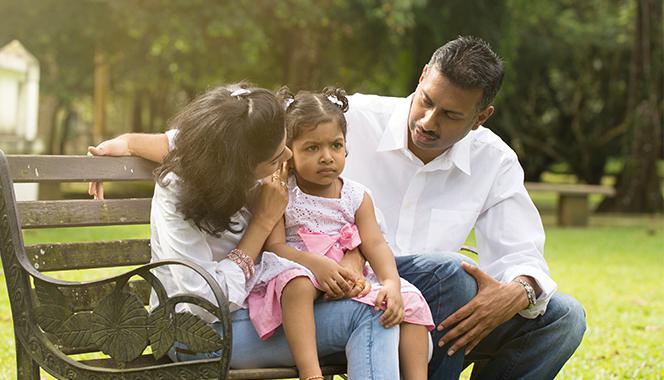
And that's the first difference between a time-out and a time-in. In a time-out, you send your child away to a room or a corner. But in a time-in, you have your child sit next to you in a place that makes them feel safe. You're not sending them out of your sight, you're having them sit next to you (or near you) so that you can help them calm down.
Then, you empathize with your child and connect with their feelings, and hold them, if necessary, to help them calm down. Once they are calm, you talk to them about their behavior and use this opportunity to help them learn appropriate behavior.
Let us look at what time-in looks like, by breaking it down into five steps and exploring the benefits of each step (and also what Neelu, in the above scenario, could have done instead):
1. Take a time-out yourself
When you find yourself triggered by your child's behavior, stop and breathe. Engaging with your child when you've lost your cool is unhelpful.
Instead, focus all of your attention on getting your calm back. Take deep breaths, drink a glass of water, go for a quick walk around the block-whatever works for you.
Neelu finds frustration building up in her as she finds her favorite lipstick smeared all over the floor and on Akhil's face. Her rising frustration is a cue to her; she takes a time-out to calm herself. She goes to the washroom and splashes cold water on her face. She also takes deep breaths to ground herself.
Benefits: Taking a time-out for yourself is actually quite beneficial, as it prevents you from saying or doing anything you might regret later. It also models self-regulation for your child.
2. Help your child calm down
Chances are that your child is emotionally triggered as well. So after you have calmed down, it's helpful to share your calm with your child. Bend down or sit at your child's level and make eye contact. Keep your voice calm and firm. Have your child sit next to you and offer physical affection, such as a hug or a snuggle (but only if they are willing).
Once she has calmed herself, Neelu goes back to her bedroom. She sits next to Akhil and asks if he would like a hug. The boy, thinking that he's going to get a scolding, breaks into sobs, but Neelu doesn't shush him. She gives him the space to cry and continues to soothe him, keeping her gentle calming presence going.
Benefits: Your child begins to calm down and his "thinking brain" (or prefrontal cortex) starts to re-align with the "feeling brain." Now they are in a space where they can openly receive whatever you say. This also signals to your child that he's not alone with his difficult feelings and that they can express them in the safety of your presence.
3. Communicate your empathy
Once your child begins to calm down, respond verbally with empathy. Communicate to them that you understand and accept his difficult feelings. If your child said something to you in anger, don't take it personally, and don't bring it up now.
Neelu says to Akhil, "You're upset right now ... I know, it can be really frustrating that you can't use my makeup whichever way you want!"
Benefits: You're giving the message to your child that his feelings are accepted, even the messy ones. He feels understood and loved. If you consistently show up to soothe him, then they will gradually be able to self-soothe.
4. Help your child reflect
Once your child has completely calmed down (this may take a few minutes or a few hours), describe what you observed using "I" statements. Using "I" statements helps take the judgment and blame off the other person, and facilitates open communication.
Neelu says to Akhil, "When I came in, I saw my lipstick smeared all over the floor and on your face." Her son doesn't respond, so she calmly asks, "Could you tell me what happened?"
Benefits: Processing what happened with your child in a non-judgmental and non-blaming way helps them engage in self-reflection, without getting defensive or being tempted to tell lies.
5. Help your child learn
Once you understand what happened, you can help your child make a plan on how to handle things differently in the future. This is also when you can do limit-setting for your child, such as framing clear rules and deciding on the consequences for breaking them. But don't give in to whatever your child is asking for, whatever started their meltdown in the first place. You can even use this opportunity to help your child learn the required skills.
Neelu then sits with Akhil and together they frame rules regarding touching items in mum's cupboard. They decide that if Akhil requires something, he will go and ask his mum first. Neelu decides to keep some crayons, paints, paper and playdough within Akhil's reach, so if he wants to smear paint, he can do so in an acceptable manner.
Benefits: Shifting the focus from "What did my child do wrong?" to "What can my child learn from this?" is empowering, both for you and your child. The idea is to focus your attention on problem-solving or skill-building.
When you don't give in (i.e., say "No" to the behavior) but continue to offer your loving presence to your child (i.e., say "Yes" to the feelings), you're helping your child develop emotional regulation, while also disciplining her (i.e., helping her learn the expected behaviors).
Remember, your young child needs constant reminders. They too, have big emotions that can overwhelm them. This can make them react and behave in ways that are unacceptable. As a parent, your child needs you to help them deal with these difficult emotions and guide them in their behavior.
The more you'll use time-ins, the more you're likely to build a positive connection and trust with your child.
In a nutshell
- Time-outs, when used occasionally and in the right way, are a good way to calm yourself and your child, when either of you is overwhelmed by anger and frustration. Time-outs today are often used as a "punishment."
- Time-ins are positive time-outs. When your child is misbehaving, calmly ask them to sit near you, so they feel safe, till they gain control over their emotions.
- Time-ins allow you to connect with your child and their feelings. They create moments that help your child regulate her emotions and learn what is acceptable behavior.
What you can do right away
- Every night, before bedtime, thank your child for one thing they did that day that made you happy-he followed a rule, helped you wipe the table, they ate without a fuss ... Why only your child? Thank your spouse too!
- The next time you find yourself getting triggered, take a time-out for yourself.
Also, read:
About the author:
Dr. Singhal is a clinical psychologist. She has a doctorate degree in clinical psychology from NIMHANS (Bangalore) and holds a post-doctorate in parenting from the University of Queensland (Australia).


























Comments
R.Kalaivani Jul 26, 2023
Hi Mam
A Simple and straightforward content .
Thank you for insisting time in is a positive time out.
Edit
Comment Flag
Cancel Update