
Setting Limits For Preschoolers: Positive Parenting Strategies And Gentle Discipline Tips For Parents
Dr Meghna Singhal
Setting boundaries with preschoolers can be tough, but it doesn’t have to lead to power struggles. Learn gentle, effective ways to set limits while keeping your connection strong

Often, limits and rules can become a battleground between you and your child. They can lead to power struggles if you end up losing sight of the correct reasons for setting limits and rules.
Limits and rules are guidelines for behavior to keep your child safe and healthy, teach self-regulation, and help them cope with difficult feelings and situations. Rules and limits also make your child feel cared for and help them learn to take others' feelings into account as well.
In a broad sense, then, rules and limits help children figure out how the world works. So, how can you set rules and limits that work for your child? Let's dive into some dos and don'ts for setting limits and rules for your preschooler.
Do: Set limits based on your child's stage of development
Don't expect your child to do things beyond their stage of development. At the same time, don't do things for your child that they can do themself.
Little Bindiya's parents wake her up every morning for school. Then they brush the 4-year-old's teeth, bathe her, choose her clothes and dress her, fix her breakfast, and take her to school. They feed her during mealtimes and clear the table when she's done.
While a 4-year-old may still need their parents to bathe them and fix their meals, Bindiya's parents need to set limits for tasks she can do herself. Knowing what your child can do by themself and what they can learn at their age is a crucial first step in helping your child learn appropriate behaviors and sharpen skills. After all, one reason why children don't stick to limits is that they don't have the skills they need.
Make it work:
- Choose an age-appropriate task for your child, something your child could do with proper training, not something they're already doing. Start with something they find interesting.
- Make a plan. Determine what you're going to teach and how you'll do it. Think about breaking the task into small steps so that it's easier for your child to master. Explain and demonstrate as you go. For instance, if you're training your child to prepare a sandwich, show them where the bread and jam are kept in the refrigerator, how to toast the bread, and spread the jam on it. Make sure they know the "why" for every little thing you do.
- Invite your child to try it while you watch and guide. Remember, your child will make mistakes along the way, but the idea is to focus on the learning. Keep it light and make it fun.
Do: Set simple, clear family rules
Don't set more than two or three rules at any one time, as they can overwhelm or confuse your preschooler.
Varsha, a 3-year-old, wakes a little later than the rest of her family and comes straight to the table to eat breakfast, without brushing her teeth. Her parents keep telling her to brush her teeth, but she doesn't listen. They serve her breakfast, but continue to nag her to brush her teeth.
Establishing simple, clear rules for daily routine and tasks will help your child understand your expectations. Discuss with your child why you're setting the rules. Whenever possible, involve them in setting the rules. This will make them feel empowered and more willing to follow the rules.
Make it work:
- Brainstorm with your child about what some family rules could be. Set 2-3 simple rules at a time that clearly state the expectation. Write them down to make them concrete. For example, the rule could be a half-hour of screen time per day or brushing teeth before breakfast and after dinner.
- Frame the rules in a positive manner that conveys what to do (rather than what not to do). Have your child repeat the rules back to you to ensure she has understood them.
- Discuss the reasons or values behind the rules.
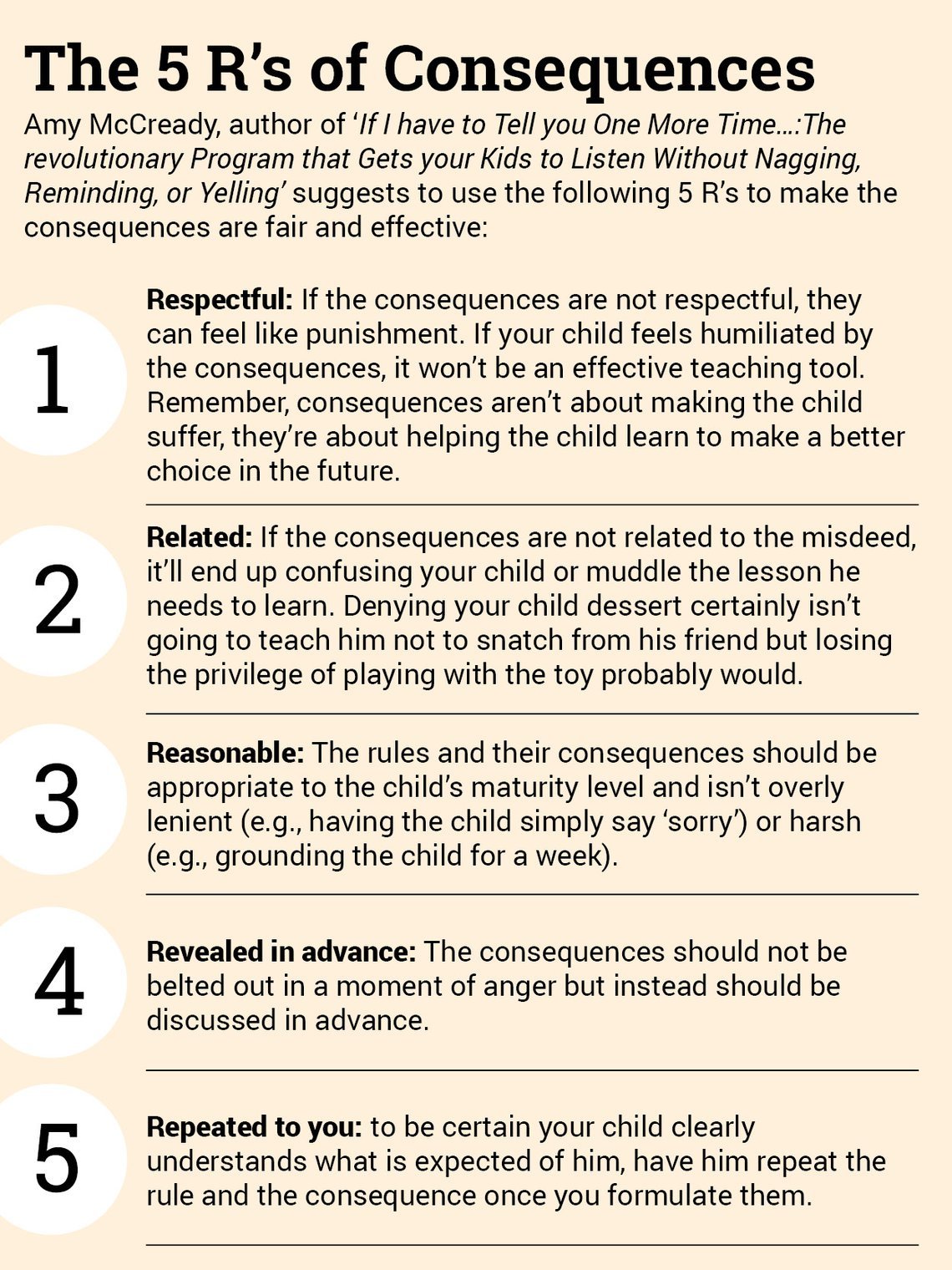
- Agree on the consequences of breaking the rules. These are not spur-of-the-moment punishments, but rather logical, respectful, and mutually agreed-upon consequences ("If you throw your toys, you will lose the privilege of playing with them the rest of the day" or "If you haven't brushed your teeth, you won't get breakfast till you do").
Do: Be consistent in enforcing the rules and consequences
Don't be tempted to break the rules yourself whenever convenient.
Daksh is a 3-year-old whose parents are concerned about his unhealthy eating habits. The family rule is "Only after we finish dinner do we eat dessert." Sometimes they follow this rule as a family, sometimes everyone eats sweet treats before dinner.
It's important to follow your rules consistently. If you follow them one day but break them the next, your child will not feel motivated to stick to them. Having said that, however, consistency doesn't mean you can't make exceptions to the rule. If you're on vacation or sleeping late, eating dessert before dinner is okay. Just make sure you discuss with your child why you're doing things differently now (and your usual rules haven't changed). Discussing this reasoning helps your child learn flexibility and critical thinking skills.
Make it work:
- Give a gentle reminder to your child about the rule. However, reminding your child once or twice is enough. If you keep repeating yourself, your child won't be motivated to remember the rule on their own. Moreover, repeating the same rule in a calm voice is difficult and can easily turn into nagging.
- If your child does stick to the rule, appreciate them by saying thank you, giving a hug or a high five, a gentle pat on the back, or simply looking at them and smiling.
- Remember to follow the rules yourself! Your child is watching you, so if you break the rules, they will, too. Your child isn't likely to refrain from eating sweets before dinner if you don't either. They won't be motivated to clean up if they see you making a mess.
Do: Support your child in sticking to the rules
Don't adopt an "I-told-you-so" approach.
Dhruv, a 5-year-old, watches videos on his dad's mobile phone. Some days, his dad lets him watch videos for 2-3 hours in a row; other days, he takes away his mobile to make work calls.
Support your child in sticking to the rule. Sit with your child and brainstorm ways to help them follow the rule. Avoid using the "I-told-you-so" approach. It makes your child angry and lose focus on learning the lesson.
Make it work:
- If you see your child facing difficulty, ask calmly, "How would you like my help in ensuring you switch off the video after 30 minutes?" Together, figure out the strategies: Would keeping a timer help? Or would planning an interesting activity after screen time help?
- Give your child opportunities to show you that they can be responsible with the rules and limits. If they're able to handle the limits, this means that they may be ready to handle more responsibilities.
- When your child says things like, "You're the meanest mom" or "I hate you," it hurts, but take a few deep breaths, don't take it personally, and don't give in. Their emotional brain is in control, and they're only venting their frustration. She'll soon calm down and come to you for hugs!
It helps to draw clear limits and rules about what constitutes appropriate behavior. However, setting limits can be tough. You might feel guilty about saying no to your child. Or you might want to avoid a temper tantrum that will surely erupt when you remind your child about a limit. But learning how to deal with uncomfortable feelings is an important skill.
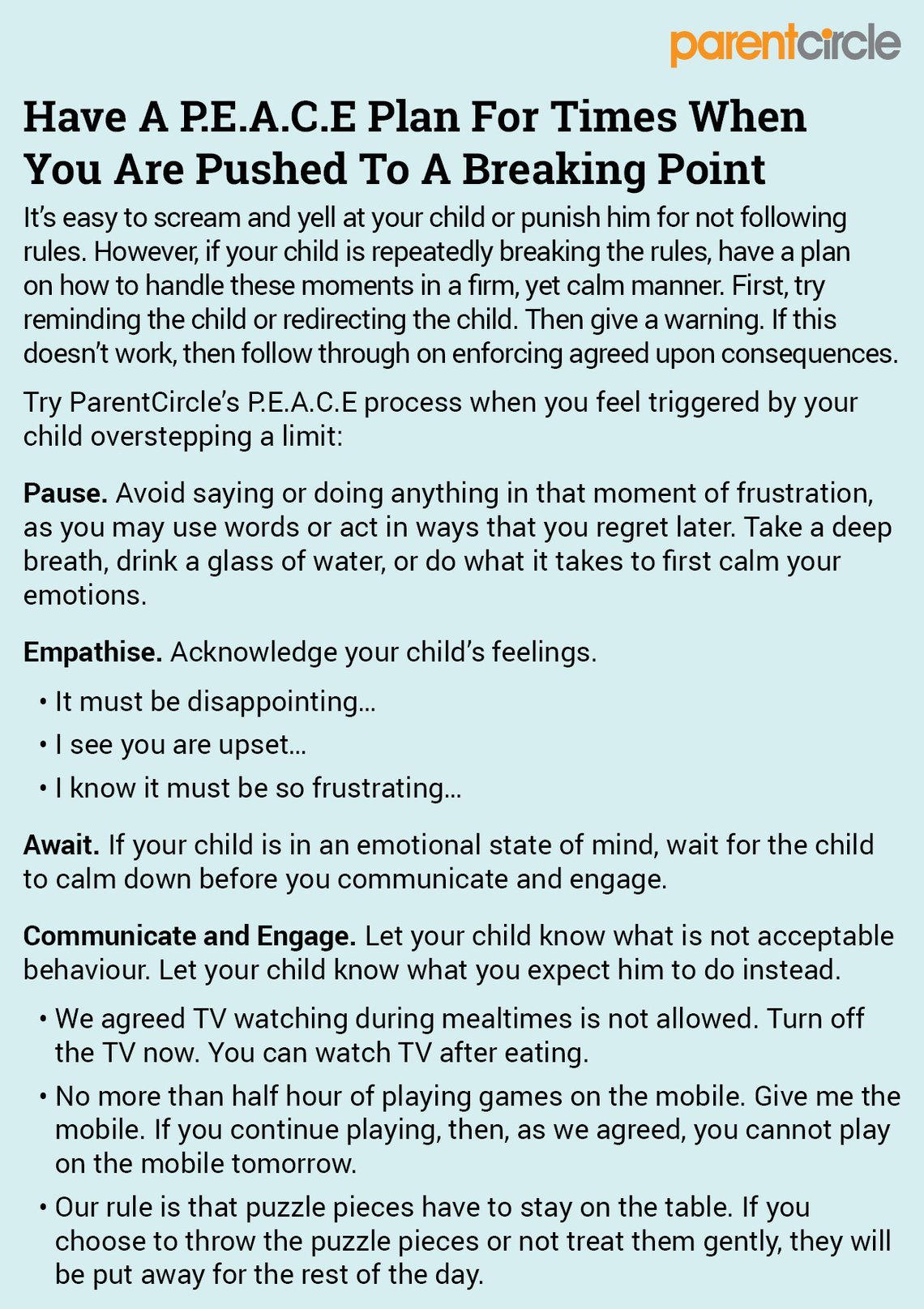
But what if you find yourself fuming when your child pushes a limit and oversteps his boundaries?
Finally, remember that your child is trying to understand the world around them. They're constantly learning, testing boundaries, understanding what works and what doesn't. Change doesn't happen overnight. It takes love, care, and patience, mixed with firmness and consistency, to reinforce acceptable behaviors in your child.
| In a nutshell |
|
| What you can do right away |
|































Comments
Edit
Comment Flag
Cancel Update