
Social Distancing Post Lockdown: Effective Tips To Sail Through This Phase
Sindhu Shivalingam
The lockdown could end soon. But life may not return to the good old days for a while, with no playing in large groups and no unnecessary outings. Get ready to cope, and we are here to help

Let's face it. Life is not going to be the same for the next few months (at the very minimum). Life is going to be all about social distancing. Everything is going to change how we all work, how our children study, how we socialize, how we keep ourselves entertained. The list goes on. For example, some movie theatres are looking at the virtual theatre model, airlines are considering leaving the middle seat empty. Workplaces in India have been asked to bar gatherings of more than five people and work in shifts to ensure social distancing, along with a slew of other measures. These measures are bound to continue for the rest of the year. Even a few weeks ago, these ideas would have seemed ridiculous!
It's tough. And it's tougher for children. However much you try to explain to children the importance of social distancing when they step out to play with friends, they are focused on the game and may forget the social distancing rules. How do you tackle this problem? And how do you explain that they may not be welcome at their friend's place, that they may even be looked at as a threat?
In this article, we prepare you for the inevitable situation. Read on:
How to talk to your child about social distancing
Tell your child that we are all in it together: Here's what you can say:
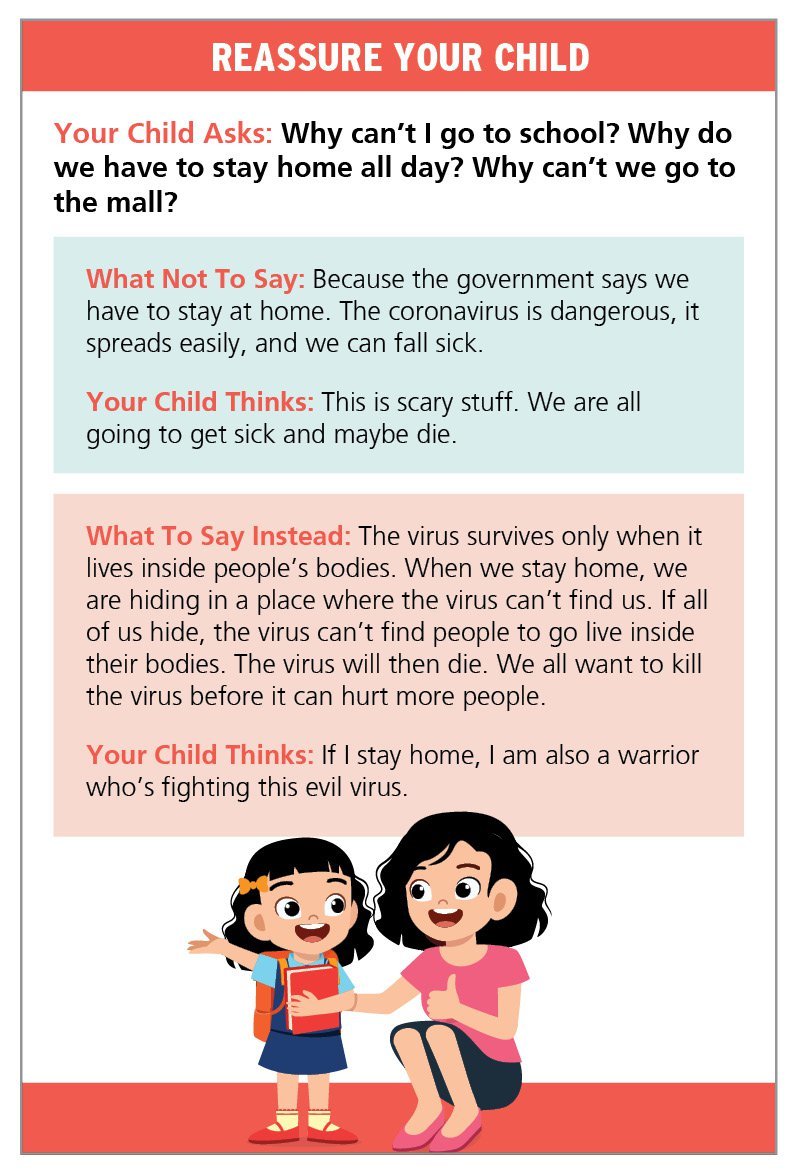
Try to make your own creative, silly story to explain the current situation: How about a silly crocodile that kept going too close to the sick monkey and ended up with a bad cold? Or a jumpy, outdoorsy bunny that tried their best to remain inside its cozy burrow? Here is a fun video of how Cory (Coronavirus) gets destroyed by Soapy, the soap: https://www.youtube.com/watch?v=SQv6F8lAwGw
Highlight all the things that remain the same in their life: Their toys, their books, the fun at home.
Talk about the positives: Social distancing means more family fun time, more reading, more coloring, and possibly more screen time too. Be optimistic and cheery in front of your child and help them look at the bright side.
Turn to helpful online resources: Many children's programs like Sesame Street, are making funny, easy-to-understand videos to help explain social distancing to children. Here are a few of them:
https://www.munsonhealthcare.org/blog/explaining-social-distancing-to-kids
https://www.youtube.com/watch?v=2HTA3ql6uWY
https://www.youtube.com/watch?v=4ex4H6n_s7w
https://www.youtube.com/watch?v=-NHDnpTmUjo
How to breathe normalcy into your child's life
Stick to a routine: Even if schools reopen in June, July, or a little later, there are indications that social distancing may be needed well into the next year. There is a likelihood that your child may be studying at home and you may be working from home now and then. This shouldn't stop you from having a routine. Put up a daily timetable with the help of your child and adhere to it. You will be surprised at the amount of balance and sanity a schedule can bring into your life! Remember, children love routines.
Keep your child busy: Art, games, reading, puzzles, connecting with friends online, and fun family activities ensure your child is not idle. Make a list of all the things your child is interested in and keep rotating the different activities. This is the best way to help your child manage social distancing and be occupied with something they enjoy. Then they will not feel so bad about not being able to go over to their friend's place or missing out on outdoor play with friends.
Make exercise a daily routine: Your child's evening playtime is going to come down drastically. But they need fresh air and exercise and yes, their cherished outdoor time. Make family exercise a norm, for a minimum of 20 minutes. Maybe a family jog in the morning in your community or a nearby ground? Or a quick round of badminton in the evening?
Virtual parties: Remember social distancing does not mean emotional distancing. Virtual get-togethers and online tea parties are going to become the new normal. Let your child catch up with their close friends, grandparents, and close family regularly. You can encourage children to sing, dance, or showcase any other talent they may have by connecting online with family and friends. Or share updates about your child's small achievements and milestones and make them feel loved and appreciated.
Family activities: Your child's contact with the outside world is going to be minimal for the next few months. So, it's only fair that they get to spend more quality time than usual, with their parents and siblings at home. Plan a series of activities that you as a family can enjoy, for at least half an hour every night. It can be a silly game, a puzzle that you can all try to solve together, a movie night, anything!
Can I take my child outside to play?
Physical activity is necessary for children. If you have a terrace or some space in your building, choose a time when you expect the least number of people outside. Let your child cycle or play ball or cricket with you. Make sure you keep a distance of 6ft from anybody else, other than family.
Make social distancing a game
Explain to your child what social distancing is and what measures they need to take when they are outside on their own. (Masks, 6ft distance, washing hands, a beautiful smile instead of a handshake, etc.) Now, create various scenarios and see how you and your child score. Rehearse being outside your house. Keep the rehearsals real, wear masks, and outside clothes, and also carry a bag!
- Walk around the house like strangers entering a supermarket.
- Imagine both of you are best friends and you are back at school, and meeting after a long time.
- You are going out to play in a park.
Is your child's birthday around the corner?
Your child wanted to invite all their friends over and have a dragon-themed costume party. That's not going to happen. However, you can talk to other parents and organize a dragon-themed Zoom party. Here are some activities to do at a virtual party:
- Talk to the other parents in advance, and plan games like a quiz and even a treasure hunt.
- Play music and let the children dance.
- Create your own silly game, for instance, a fun hopping game! Designate fruits for various actions. For instance, tell children that strawberry stands for a jump forward, apple for a jump backward, and banana for a standstill. Once you explain the instructions, go ahead and conduct the game.
- You can also ask parents if they are comfortable preparing a common menu, something simple that all children can eat in their respective homes. You don't have to feel bad about this at all. After all, every parent wants their child to party, and party safe.
Tip: Older children can come up with creative ways to have fun at a virtual party. Don't forget to throw in some music and lights, and dance as a family.
Creative tips to reinforce social distancing norms
Keeping distance from near and dear ones is not something we have taught our children before. This new rule is weird even for adults. Therefore, you will have to reinforce the norms again and again, with patience, empathy, and creativity.
Here are some ideas:
- Create a sticker or a smiley chart and let your child earn one every time they remember to adhere to the social distancing rules.
- Let your child be the social distancing patrol every time you step out together. It is their role to ensure everyone maintains a minimum distance of 6ft from others. Let them give you all a penalty card whenever you slip.
- Make your child the health inspector for your family. Let them make a list of surfaces and objects that need to be cleaned often, the tabletops, the dustbins, and the chair handles. You can do the work together as a family.
Tips on how to talk to your teen
It is most difficult to keep teens indoors or socially distant. After all, friends are most important. Talk to your teen and share your fears and concerns about Covid-19. This will help them realize they are not alone and will also encourage them to share their angst. Have an open conversation. Teens love to pour out when the atmosphere around them is encouraging. So, keep it positive and non-judgmental. Talk to them about the various challenges of social distancing. Then, brainstorm ways to cope with this new life. Talk about how older people (read grandparents) are at greater risk and the need for every person to take responsibility for stopping the spread of the virus (one person can infect hundreds of people if they are not careful). Let your child think through the problem and actively participate in the conversation.
Bring Back the Namaste
You and your child can have a fun discussion, making a list of Indian traditions that can help us stay safe during these COVID-19 times. Here is a starter for you.
- Doing a Namaste instead of a handshake while greeting people.
- Leaving footwear outside and washing feet and hands before entering the house.
- Disinfecting the house every day (our ancestors used cow dung to clean the entrance of their houses).
- Having a light, home-cooked warm meal.
- Not eating from each other's plate, not sharing the same spoon or fork.
Why don't you build on this list and try practicing all of them? When you make hygiene and safety a norm at home, it will be easier for your child to follow suit.
We hope you found this article useful. Let's do our bit to keep ourselves safe until we find a way to tackle this pandemic. Someday, when all this is over, we can pat ourselves on the back about how we've lived through this together!

























Comments
Edit
Comment Flag
Cancel Update