
8 Commonly Confused English Word Pairs Every Primary School Child Should Learn
Team ParentCircle
Help your child avoid common spelling mistakes with these similar-sounding English word pairs. Fun examples and easy explanations make vocabulary learning enjoyable for primary school children

Why do similar-sounding words confuse children?
English has many words that sound alike but have completely different meanings. According to reading and literacy experts, children often spell words by what they hear.
For example, 'lose' and 'loose' are confusing. They may sound similar, but they mean very different things. Helping children learn how to use them correctly improves their vocabulary and spelling skills.
8 commonly confused English word pairs for children
Here are some word pairs that often confuse primary school children, and simple ways parents can explain them.
1. Lose – Loose
- Lose: to misplace something
- Loose: not tight
Example
"I don't want to lose my water bottle."
"My shoelaces are loose."
Fun sentence
If your shoelaces are loose, you might lose the race!
2. Bear – Bare
- Bear: an animal
- Bare: uncovered
Example
- The bear lives in cold regions.
- He walked on the bare grass.
Fun sentence
The sleepy bear scratched its bare tummy.
3. Pear – Pair
- Pear: a sweet fruit
- Pair: two things that go together
Example sentences
- I ate a juicy pear after lunch.
- I bought a new pair of shoes.
Fun sentence
A pair of pears was kept in the fruit basket.
4. Son and Sun
- Son: a male child
- Sun: the star that gives us light and heat
Example sentences
- Mr Rajan's son loves playing cricket.
- The sun was shining brightly in the sky.
Fun sentence
The sun shone as the farmer's son flew his kite.
5. Idle – Idol
- Idle: not active or busy
- Idol: a person you admire greatly
Example sentences
- The machine was idle during the power cut.
- Dr A.P.J. Abdul Kalam is my idol.
Fun sentence
Instead of sitting idle, she read a book about her idol.
6. Pale – Pail
- Pale: light in colour or looking unwell
- Pail: a bucket
Example sentences
- The walls were painted a pale blue colour.
- The gardener filled a pail with water.
Fun sentence
He carried a pail while wearing a pale yellow hat.
7. Hour – Our
- Hour: a period of 60 minutes
- Our: belonging to us
Example sentences
- The movie starts in an hour.
- Our school celebrates Children's Day every year.
Fun sentence
It took us an hour to decorate our classroom.
8. Knot – Not
- Knot: a fastening made by tying something
- Not: used to show something is negative
Example sentences
- Dad tied a knot in the rope.
- I am not feeling sleepy.
Fun sentence
The sailor could not untie the knot.
Why learning through play works
Children learn language best when it is enjoyable. Simple games, conversations, and shared reading experiences help them understand and remember new words more easily.
Fun activities to help children remember similar-sounding words
1. Spot the Correct Word
Write two similar words and ask your child to choose the correct one for a sentence.
Example: "I packed my lunch in one ____."
- hour
- our
2. Create Funny Sentences
Ask your child to make silly sentences using both words.
Example: A pair of pears fell from the tree.
Humour helps children remember meanings.
3. Word Treasure Hunt
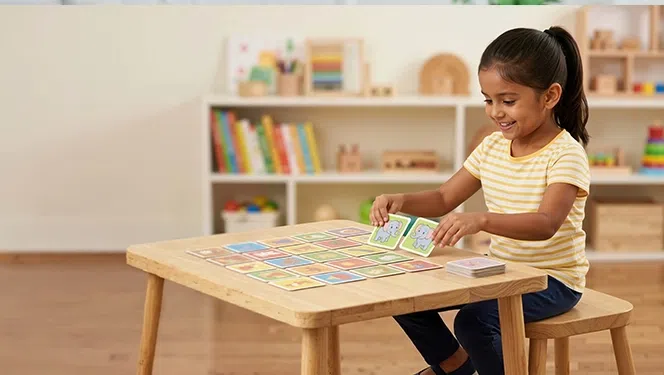
Hide word cards around the house and ask your child to match each word with its meaning or picture.
With patience and practice, commonly confused words become easier to understand and use correctly.
Quick parent tip
|
Learning English can be fun
Learning new words does not have to feel challenging. Through stories, games, and everyday conversations, children gradually understand how words work. A little laughter and regular practice can turn confusing words into a rich vocabulary.
References
- Reading Rockets. Building Vocabulary and Word Knowledge.
- International Literacy Association. Literacy Resources for Families and Educators.
- Oxford Owl. Helping Your Child With Reading and Spelling.
Last updated on: June 17, 2026
The Dot phonics program for kindergarten empowers LKG and UKG students with phonological awareness skills through engaging activities. The program focuses on segmenting and blending sounds, CVC words, and high-frequency words, ensuring comprehensive early literacy development.





























Comments
Edit
Comment Flag
Cancel Update