
Explaining Consent To Children: Why No Means No And How to Teach It With Confidence
Dr Meghna Singhal
From understanding what consent means to recognising body boundaries and respect, this guide helps you explain consent to children in simple, age-appropriate ways, from preschoolers to teenagers, so they learn to express themselves, respect others, and understand that their voice matters

Renu, a 3-year-old, hates being pinched on the cheeks by strangers in the supermarket. They ooh and aah over her cuteness, while her mother looks on, smiling.
Shubam is a picky eater. Mealtime battles are common in his house every day, as his mother forces him to finish his veggies. Sometimes she force-feeds her 6-year-old even when he's full.
Pavan, a 9-year-old, feels uncomfortable giving his grandmother hugs and kisses every time she visits. But his father insists on it, as he's very particular about his son having a close bond with his grandparent.
Neha, who's 13 years old, was watching a movie with her parents when an actor in the movie kissed a woman who tried to push him away. Neha was confused by the male character's behavior and wanted to ask her father about it, but he quickly switched the channel.
What is common across all these situations? They all involve a lack of consent.
It's not easy to talk to your child about consent. It doesn't even occur to us that many situations warrant a conversation about consent, when in fact they do. And when we do want to talk about consent, we often don't know where or how to begin.
However, as our children learn from us in their early years, it's our job to discuss, explain, translate, debunk, and convey the many messages they're getting every day about consent.
Let us demystify consent and see how we can talk to children, from preschoolers to high schoolers.
What is consent, and why does it matter for your child’s safety
Consent is a voluntary and clear agreement between two people about what's okay and what's not. It includes knowing and respecting one's own physical and emotional boundaries, and respecting other people's boundaries as well.
Consent is a universal and basic human right. It's not confined to our body alone; it includes our feelings and our beliefs.
Talking about, understanding, and asking for consent are some of the most important conversations any parent can have with their child. Such conversations can prevent child sexual abuse and lay the foundation for healthy relationships. What's more, consent education can even prevent violence against women and men.
Why it is important to talk to children about consent early
Talking about consent helps your child:
- Take absolute ownership over his body
- Be safe and preserve his dignity
- Understand what healthy relationships entail
- Draw adequate physical and emotional boundaries (and communicate when those boundaries are being violated)
- Respect the boundaries of others
Having discussions about consent is not a one-time event. On the contrary, you need to have open, ongoing discussions with your child in an age-appropriate manner, preferably using familiar situations.
How consent conversations change as your child grows
Talking to your preschooler about consent
- Your child will start learning about consent from you, the parent. Apart from honoring what your child says she's not comfortable with, read your child's facial and bodily cues. If your child is not okay with eating more or being dressed in a certain way, learn to back off (unless it's an emergency or health-threatening situation).
- Help your child understand that her body is her own and that she has the right to make decisions about her body. This includes letting your child decide if she would like to offer or receive a hug or kiss from others, including her own family members.
When grandma insists on a hug from your child but your child looks hesitant, offer alternatives by saying, "Would you rather give grandma a high five or a flying kiss?" - Use cartoons, stories, nursery rhymes, and real-life situations to talk about consent. While watching the movie Frozen, ask questions such as: "Does Anna want to kiss Kristoff? How can you tell?"
- Discuss with your child why it's not a good idea to keep secrets. Some secrets may make them feel good, whereas others may make them feel uncomfortable and unsafe. Usually, children keep secrets because they're told to, or because they're fearful. Discuss the difference between a surprise and a secret. Surprises are kept only for a short time and are harmless. One of the most important things you can do to ensure your child doesn't keep secrets is to lead by example. Don't ask your child to keep a secret, and in turn, don't keep secrets from her.
- Make it a practice to have an open communication policy in your home. Answer questions openly and age-appropriately. Share your own struggles and fears to convey that it's perfectly normal to have all sorts of feelings, rather than making your child believe that feelings are something to be embarrassed about.
- It's not a good idea to tell your child that elders must always be listened to and obeyed. Help them develop assertiveness skills to say: "No, I don't like it," "No, don't do that," or"Keep your hands to yourself" when they feel uncomfortable in a situation. Tell your child that if someone wants to see or touch their private parts (or any other body part), they can get out of that situation by yelling, "Ma, I need help."
- Model the importance of consent by asking your child before showing physical demonstrations of your love, such as hugging or tickling her or roughhousing with her.
- Talk about body parts early. Use the correct names for private parts, such as vagina, penis, vulva, or testes. Help your child understand why these body parts are private, that they're not for everyone to see. Explain that Mommy and Daddy can see them naked when bathing them or for health reasons, but others should only see them with their clothes on.
Tell your child:
- No one should touch them (any part of their body, not just private parts) and take pictures of them.
- No one should ask them to touch somebody else.
- Give your child an actionable plan in case this does happen.
- Help your child build a "Safety Network" of five people (one for each finger on their hand) they trust, who they can go to and report to.
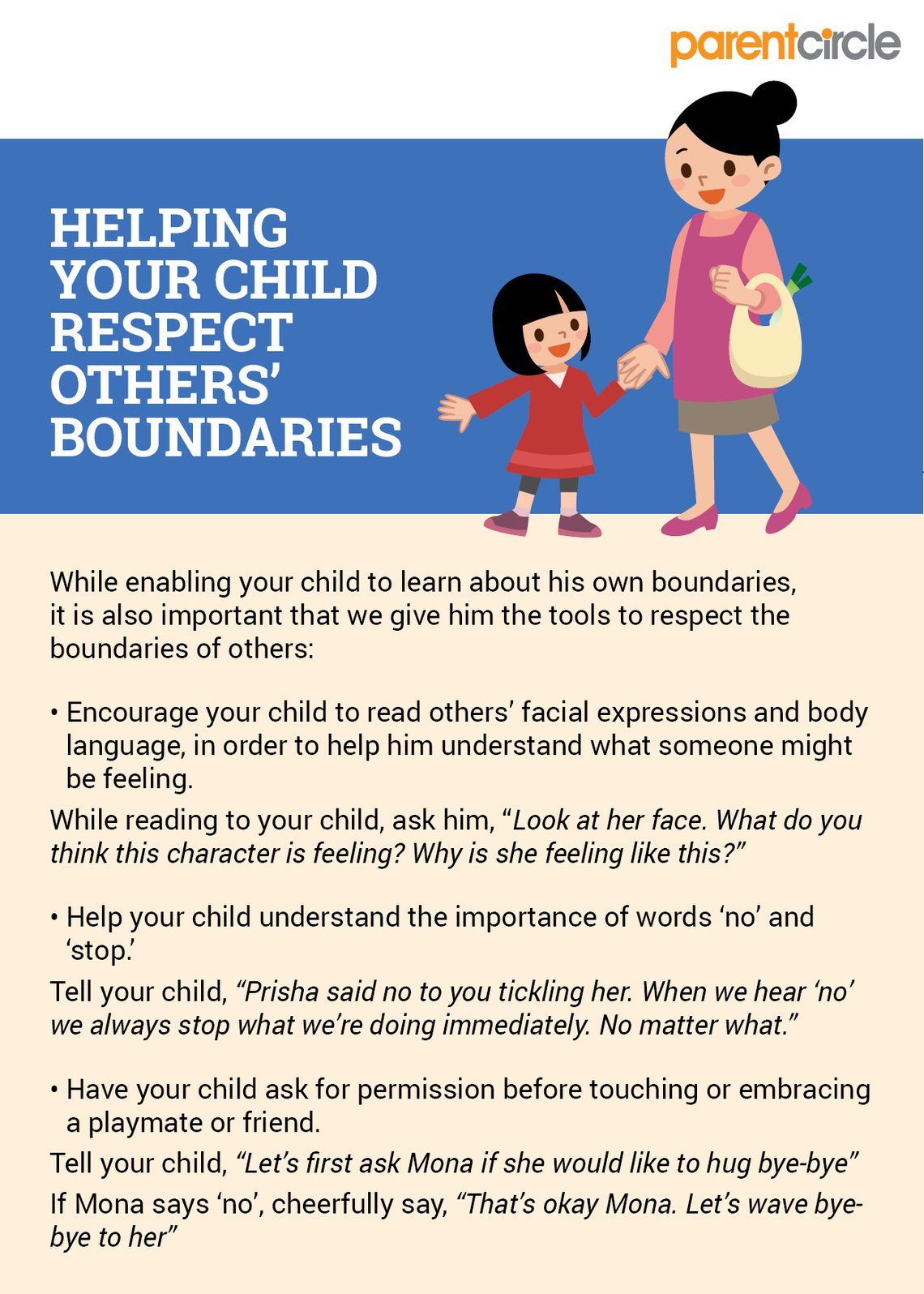
Talking to your primary or middle schooler about consent
- Promise your child they'll never get into trouble with you if they tell you a secret related to their body. Children often don't reveal that they're being abused because they fear that you'll blame and scold them. Tell your child that no matter what happens, when they tell you about their body or when they share secrets, they'll never get into trouble.
- Explain the concept of "safe touch and unsafe touch." Many parents talk about good and bad touch, but touch by a predator may not always feel bad. Tell your child that if someone's (even a familiar adult) touch feels even slightly uncomfortable or unsafe, they should immediately scream "NO" and report to someone in their "Safety Network." Emphasize to your child that if someone violates their body autonomy and privacy, it's never their fault.
- Continue conversations around perspective-taking and empathy. This will help your child understand their own feelings and those of others, and this is foundational to respect.
Ask your child at the playground, "That boy fell off the swing. Look at him. What do you think he's feeling?" - Model what it looks like to be refused physical touch. This helps your child understand that it's okay to reject physical touch, even if you love the other person.
If your child refuses to hug or kiss you, say something like, "I know you still love me even if you don't want to hug me right now."
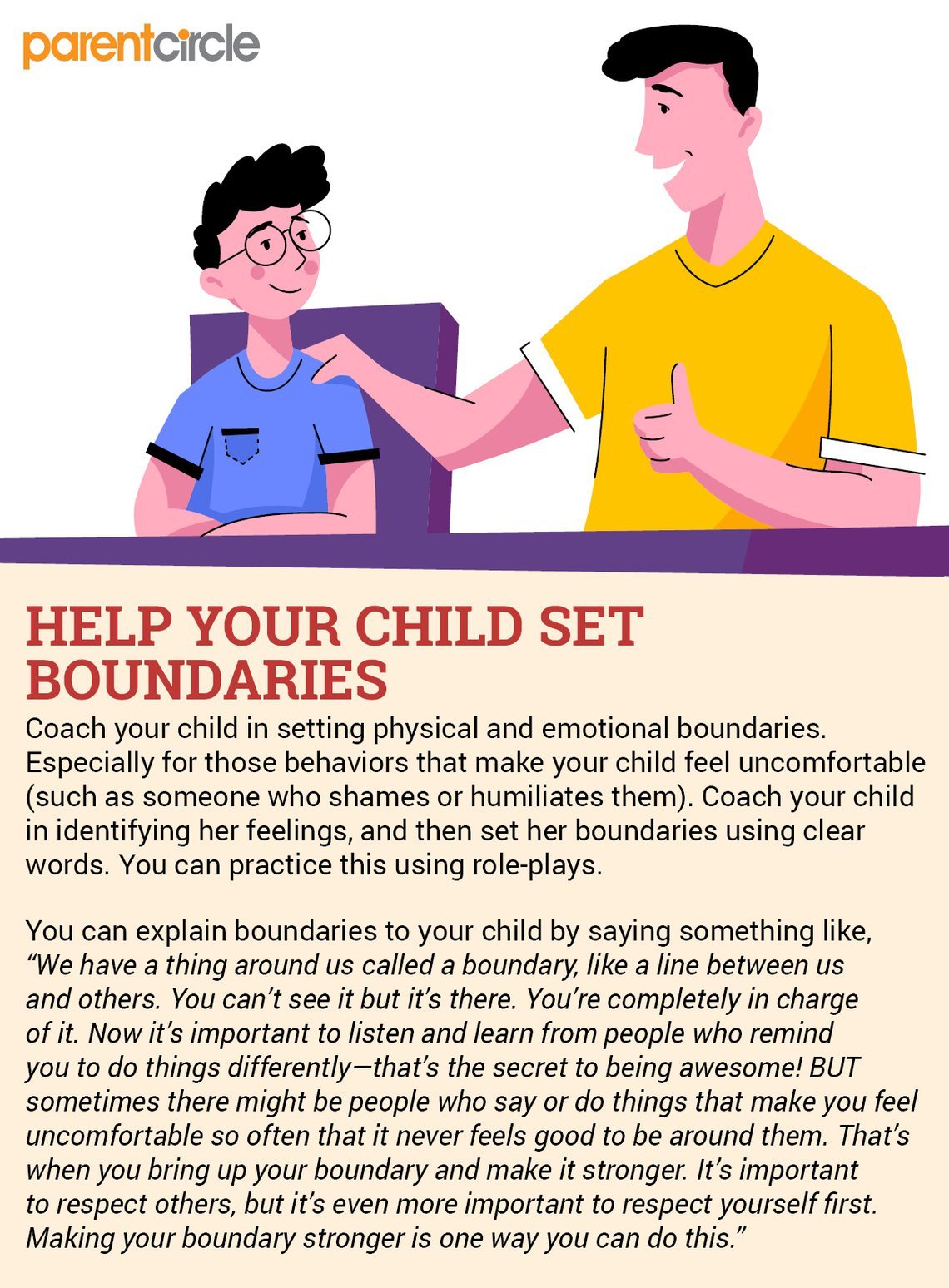
Talking to your high schooler about consent
- As your child becomes a teen, you can discuss a code word they can use when they're feeling unsafe. This can be used at home, when there are guests in the house, or when your teen goes on a sleepover or attends a party. Assure them that if they call or text you and say the code word, you'll come pick them up, no questions asked.
- Help your child understand that ambiguity or silence is not consent. No means no. Yes means yes. No is not a yes. Maybe is not a yes. I don't know is not yes. And silence is not yes. Also, help your child understand that consent is ongoing. This means that even after someone has said "Yes," they have the right to change their mind and say "No."
- It's also helpful to discuss with your teen that sometimes people might not be in a position to say "No" verbally. Help your teen understand that non-verbal cues are equally important. These may include pushing someone away, pulling yourself away, not making eye contact, shaking your head to mean no, not responding, crying, or looking scared or sad.
- Help your teen understand that consent is coherent and voluntary. That is, if someone is intoxicated, unconscious, or asleep, they are not in a state to give consent. Also, consent is not saying "Yes" under pressure.
- Encourage your child to respect differences of opinion. This helps your child learn that two people who love each other can agree to disagree, while being respectful of each other. Explain to your teen how they should never have to offer an explanation or apology to a good friend. A real friend will never make them feel bad about their choices or exclude them just because they don't agree on certain things.
- Encourage your teen to debate your rules, the ones they may not agree with. This helps them practice speaking their own mind and helps them learn to think about how they arrived at an opinion. Questioning your authority helps your child learn to stand up for themself in a safe place (at home) and outside the home, and to say "No" to things they don't like.
- Don't be afraid to say, "That caught me by surprise! Let's chat about this over dinner tonight," when your teen brings up something you aren't prepared to talk about. This gives you time to think about how you want to frame the discussion. Show your appreciation by saying, "I appreciate you coming and talking to me about this," and ensure an open-ended discussion, which steers clear of lectures and leans toward a two-way conversation. The more you display curiosity for your teen's opinions, the more they're likely to share with you.
Talking about consent may not come naturally to you as a parent, in part because you yourself didn't get consent education as a child. However, one of the most rewarding aspects of parenting is our choice to break unhelpful or harmful generational cycles and create new standards.
Here's to empowering our children to build safer, happier, and healthier lives and relationships.
In a nutshell: Key takeaways for parents
- Talking about, understanding, and asking for consent are some of the most important conversations any parent can have with their child. Talking about consent helps the child have ownership over their body, draw boundaries, and respect others' boundaries.
- Emphasize to your child that if their body autonomy is violated, it's never their fault, and that they should tell someone in their "Safety Network."
- Have conversations around perspective-taking and empathy. This helps your child understand their own feelings and those of others.
- Help your teen understand consent by emphasizing that silence or ambiguity is not consent, that consent is coherent and voluntary.
Simple everyday ways to reinforce consent at home
- Give your child agency over what is age-appropriate, such as what snack to have or what to read at story time.
- Let your child talk about their body, without shame. Avoid feeling embarrassed, and say with confidence, "I'm so glad you asked me that. I don't know yet how to answer that, but I want to look into it. Let's talk about it this evening."
- Encourage your child to watch others' facial expressions during play to ensure everyone's comfortable and on the same page.
Last updated on: April 08, 2026
































Comments
Edit
Comment Flag
Cancel Update