
Diwali Then, Now, And Beyond: How The Festival of Lights’ Traditions And Celebrations Have Changed
Vidya Nesarikar
Explore how Diwali traditions and rituals have evolved, blending the beauty of age-old customs with the spirit of modern celebration
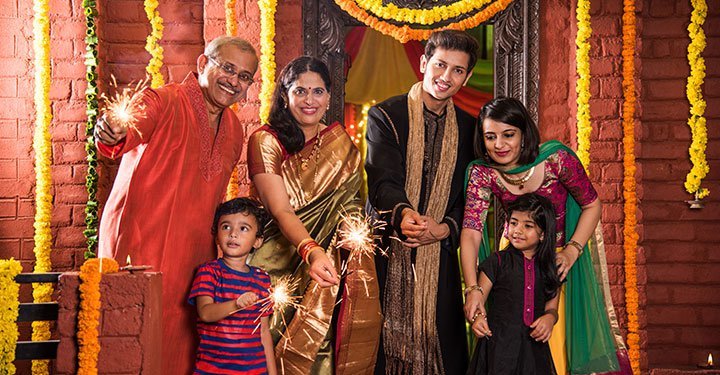
A sky full of fireworks, a mouth full of sweets, a house full of diyas, and a heart full of joy. Wishing you and your family a Happy Diwali.
The festival season is in full swing! Diwali is just around the corner, and the excitement is palpable. You can almost hear the crackers, smell the aroma of ghee-soaked sweets, and see the hoarding - screaming Diwali and the Diwali is here!
This is also a good time to pause and ponder. Do you often reminisce about the time gone by and how households used to celebrate Diwali differently? Or wonder how it would be in the future? Read on to have a roller-coaster ride to the past, then present, and into the future! It's Diwali, then, now, and beyond.
Preparations for D-Day
While old-timers sigh that the festival has become too commercial, let's run you through what parents think about Diwali, the festival that marks the triumph of good over evil.
Here is how even preparations for the festival of light over darkness changed over the years. Let's run down memory lane again
Then:
Many parents agree that things were a lot simpler in the past.
- Sweets and savories were prepared days in advance at home, together as a family
- The family members all got new clothes for the occasion
- Houses were given a whitewash in villages and towns, and old stuff was thrown out. Many believed that Goddess Lakshmi visits only the clean houses, which is the reason a thorough cleaning of the hearth and home was also done
- 'Chits' would be paid in advance to buy a sizable amount of crackers. And children, oblivious of the pollution angle, took great pride in showing off their Diwali firecracker stash
Now:
Diwali these days is all about discounts, sales, mela, and house parties!
- These days, orders for sweets may be outsourced to the nearest sweet mart
- Cleaning services might be hired for a bit of a clean sweep, or maids would be paid extra to do a bit of cleaning
- New clothes are more governed by sales rather than festivals
- Bursting crackers - with all the pollution it creates - many parents are opting out. Some children are even urging parents not to buy any firecrackers at all, as they are becoming more aware of the pollution they cause. Schools also encourage students to observe an eco-friendly Diwali
- Sales deserve a special mention, for this is one thing our generation looks forward to. Be it clothes, home decor, or electronics - Diwali Dhamaka sales are the time to splurge
It's all about the Money
Then:
In the old days, many salaried Indian families looked forward to the Diwali bonus, which used to be a sizable amount. Many big family financial decisions were based and made during the Diwali bonus.
Now:
But these days, bonuses have been replaced with Amazon gift cards or coupons. In global companies, appraisal cycles are different, and Diwali bonuses have become a tokenism - a box of kishmish, sweets, or chocolates by your employer and vendors. But don't be surprised if housekeeping staff in your flat, the doodhwala, and other people you may have never met - show up with bright smiles for Diwali baksheesh.
Family Time
Then:
Diwali is the time for family gatherings and paying social calls to friends and relatives with sweets and savories.
"There were several relatives that you met only once a year - and that is during Diwali. For us, family meetups during Diwali was something to be looked forward to," said Bharathi Aravind, a longtime resident of Chennai.
Now:
Family time has changed over the years. As kids' school holidays are timed along with Diwali, many parents use the break to plan vacations. What can be more exotic than celebrating Diwali in a beautiful destination?
Also, the meaning of family has changed over the generations - with the rise of nuclear families and Indian families scattered across the world - celebrations are not confined to relatives. You find many flats, residential communities, temples, and Indian clubs coming together to celebrate Diwali and other festivals. The best part about this is that people learn about the nuances of other cultures and traditions - how the same festival may be celebrated in Tamil Nadu, Punjab, Bihar, or even Indonesia. It's about opening your heart and mind. Friends can be family too!
Whatever happened to the Greeting Card tradition?
Then:
A big part of the Diwali tradition for many was sending out Diwali greeting cards. The romance of buying cards, writing a personal note, and then the address on top with a stamp in the corner, and finally a trip to the post office no longer exists.
I remember my father at his desk with a pile of greetings cards from Helpage India bought from an Archies outlet - leaning over his desk and writing small notes in each card. He doesn't do this anymore, I miss this tradition a lot, reminisced Geetha Amarnath.
Now:
Phone and the internet have killed this tradition. Initially, there were SMS greetings. A gradual shift to emails was witnessed, and these days, it's only WhatsApp messages. Any holiday season sees a bombardment of holiday greetings on your WhatsApp group - some are creative, cute, and funny - but sometimes it just feels mechanical and impersonal. What goes around, comes around, and it's usually a jaded WhatsApp message.
Diyas or e-Diyas?
Then:
There is no sight more ethereal than twinkling little lights all across houses during Diwali. Lighting little terracotta lamps with a bit of oil and a wick has been a universal festival tradition. It is a tradition that has come down through the ages. It is said that diyas were lit at every house to light the way so that Lord Ram could return with his wife Sita and brother Lakshman safely from Lanka to Ayodhya after defeating Ravana.
Now:
But technology has spread its tentacles here. These days, you have battery-operated diyas - they look like a wick but are actually a little light bulb. Many argue that these new-age lamps are better, as they can withstand the wind as well.
But several parents, activity groups, and even schools are reviving the terracotta lamps' traditions. Diya-making and painting classes are aplenty. Nobody said technology and tradition cannot go hand in hand!
"About the celebrations today - I do not know much about rituals, etc. but for me, Diwali is about family time. Last year my daughter Kavya and I painted 15 clay diyas. She loved the activity and the expression on her face - when we lit up the lamps was priceless. We also had a few battery-operated lamps too!," said Mridul Nath from Pune, parent of two little girls.
Crackers - A cracka-alacka time - or is it?
Then:
No Diwali story from childhood is complete without a mention of crackers. Which other festival has flower pots, buchakaras, sparklers, and patakas? Seriously, what could be more fun for adults and children?
"When we were kids, Diwali was all about crackers. We would wait for the loot to arrive and then spend all day bursting bombs and patakas. There was simply no festival that was as much fun as Diwali. We lived in a hilly and moist region in Arunachal Pradesh called Bomdila - we had to make sure that the crackers didn't catch the moisture in the air," Mridul Nath recollected
Now:
But these days, there is so much more awareness amongst children about the noise, air, and land pollution that crackers cause. And the fright that noisy crackers cause to animals, babies, and senior citizens.
Though there are crackers, such as eco-friendly crackers that emit less smoke, many children have decided to stay clear of buying crackers.
Vidyuth Subramanyam explained that they have taken the middle path. "The noise created during Diwali has a significance. Bursting crackers in the early morning is a tradition for Tamilians after the customary oil bath. It is said the noise drives out evil spirits. I understand that our actions should not harm any creatures or the environment, but to keep up traditions we still do burst a few crackers."
The Why-Why Generation
Then:
It is no longer cool to just accept things and say - 'because we always did things this way', or 'that this is our culture and tradition'. That is so last generation.
Now:
A trend that has been observed is that people (be it adults or children) are trying to understand the reasoning or the science behind each tradition. And there is usually a science or a story behind every ritual. Why are particular foods prepared for a particular festival? Many foodstuffs are consumed according to the season to build immunity. Why do crackers burst? Why are Diyas lit and so on? The internet has made answers easily available for all. Every festival sees storytelling sessions across cities that narrate stories associated with the festival. India has always been the land of oral traditions, and the art of storytelling is being revived. All you need to do is ask why.
What does the future hold, I wonder?
Beyond:
It is the age of technology and gizmos. How will this change our tryst with Diwali? How do you think future generations would celebrate Diwali? Like, say in 2100...
Imagine this:
- Your neighbourhood kids gather together and enjoy digital firecrackers on their tablets, with minimal sounds and no smoke.
- With teleporting, your cousins from the USA are here for the Diwali celebrations for the night; all it takes is pressing the one-touch button for them to travel to and fro.
- With a virtual reality (VR) device, you can watch and feel the Diwali celebrations all over the world.
- No need for elaborate Diwali delicacies, you need to pop a pill that is marked as Diwali special. The medicine would let you enjoy all the flavors of Diwali delicacies and make you full.
- Just before Diwali, you clone yourself so you can be present at multiple venues - no more sulking friends and family. Perhaps ask your clones to go visit your nosy relatives while you chill out with your friends.
- You are playing Diwali special card games on a cloud-based device and earning BITCOINS instead of money.
- You monitor your teen's activities during the Diwali celebration via a micro-mini device planted in his hair. As he is about to indulge in any dangerous activity with a firecracker, it sends a signal to you and gives him a headache as a warning.
Sounds straight out of a sci-fi series from Netflix, right? No harm in indulging in a little imaginary trip? Who knows what our future holds for us?
Jokes apart, has Diwali really changed or evolved? Do the symbolisms, rituals, and stories marking the celebrations hold relevance to the present generation? Is it possible to accept that change is here to stay—and that it is also possible to keep our kids connected to the past and their roots, albeit by embracing a bit of technology? It is important to bear in mind - there is always nostalgia about the past, and though sometimes traditions are carried forward untouched, and that is a beautiful thing, sometimes it is fun to embrace the present and look forward to future innovations.
Whether you are a die-hard traditionalist or a new-age funky monkey - enjoy, play safe with fire, and have a great Diwali!






















Comments
Edit
Comment Flag
Cancel Update