
When Your Child Hates a Subject
Team ParentCircle
When a maths genius discovered her child hated the subject, it was 'painful' to her. How should she react and what can she do to rectify the problem? Read on to know more...

Meera finds a small note under her 11-year-old daughter's pillow. Curious, she begins to read it.
Dear piece of paper,
I heard mum talking to pinni (aunt) over the phone about some bank exams. Please, oh, please let her not ask me to become a banker too. I hate banks, I hate numbers, I hate maths! Remember the time during the party when dad was mad at me because I counted the number of plates wrong twice? And the time when mum rolled her eyes because I filled up my fee challan with the wrong amount? Boo, it's scary. Okay. I'm going to Mansi's house now. Maybe we will chat about it as we do in our comic book. Psst... It's a secret project we are working on.
See ya,
Saha
Meera, a maths whiz herself, is shocked. It takes a moment for her daughter's words to sink in. She decides she needs to talk to her husband, Anand and ensure they don't discourage their daughter. She also realises she has two immediate important tasks to accomplish:
- To find ways to make maths non-intimidating for Sahana.
- To identify her strengths and build on them.
While some parents handle it like Meera, many others pressurise their children to work harder. What we know is that in many households, marks and grades still 'decide' whether a child is intelligent enough or not. But, considering every child's brain is unique and versatile, is it okay to draw conclusions based on the results of one common exam for every child?
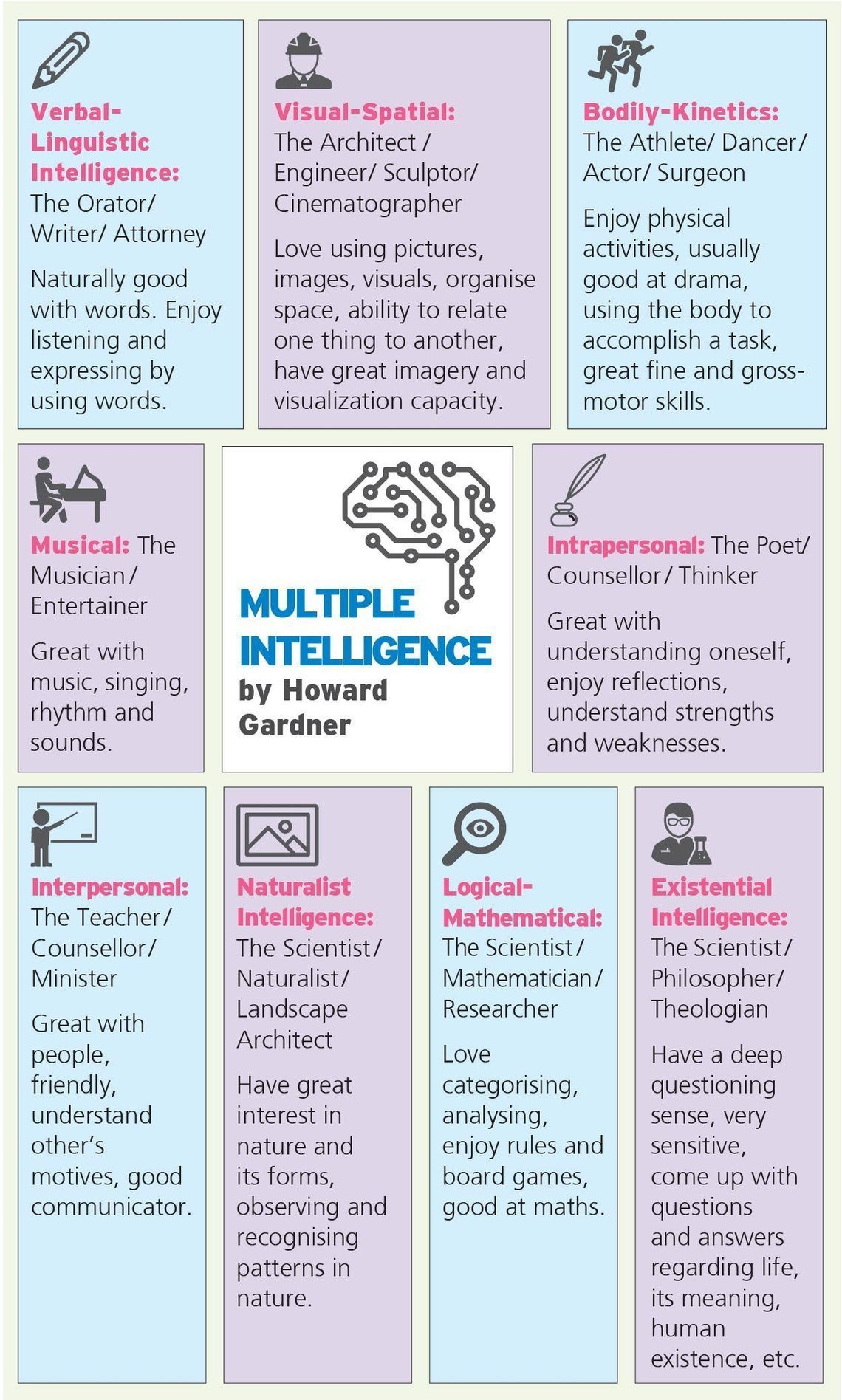
Research conducted between 1983-1990 by well-known American developmental psychologist Howard Gardner provides some interesting insights. Gardner's findings show that there are nine distinct types of intelligence, each having its own value. He calls this multiple intelligence. His study concludes that a person may be great in one or more of these and average in some.
How to know if your child 'hates' a subject
Here are some obvious hints you should be looking out for:
Hint #1: 'Forced' to learn a subject: When your child is forced to study or when the burden of homework is more, she starts hating the subject. You will find that she reserves these subjects to the very end, until the time of exams. This stress adds to the contempt.
Hint #2: Presumes the subject is difficult: Fear or aversion towards a subject is unmindfully created by the people around your child. Parental concerns like "I was never good at maths" or "I put you in a convent because I could never speak good English" creates subconscious doubt and fear towards the subject.
Hint #3: 'Boring' subject: Some subjects are considered boring by for some children. This could also be because of the way it is taught. Subjects must be made more interactive for sustained interest.
For example, reading history only from the textbook may bore your child. A nurturing teacher, who makes the subject fun can make a significant difference. At the same time, a child automatically dislikes a subject when it is taught for the sake of 'scoring well' in examinations.
Hint #4: Fear of failure: When a child performs poorly in a subject, the immediate reaction of most parents is to express disappointment by getting angry. This upsets the child and only makes matters worse. The child, in turn, starts fearing failure instead of working hard to do well the next time. He starts disliking the subject.
Hint #5: Learning disability: Some children may suffer from learning disabilities that can also contribute to 'hating' a subject. This can be resolved with the right training. If you find your child struggling too hard, check with your paediatrician or a counsellor.
Hint #6: When atmosphere at home is not conducive: Poor eating and sleeping habits, disturbances at home, a non-nurturing environment - these contribute to a child feeling stressed and disliking subjects that are challenging.
Hint #7: Difficulty in being organised: Some children have difficulty in maintaining a neat notebook or study material. They may have missed lessons. This disorganised state demotivates them.
So, how exactly can you help your child? It is never too late to help her overcome a problem. Here are creative ways to do so:
Organisation and Time management:
Create a fun study space for your child, which should include
- Comfortable seating
- Brightly lit room
- Live plants
- Cute & colourful stationery of good quality
Help your child become organised
- Put up a board for daily activities
- Create meal plans, shopping lists and budget plans together
- Organise your child's wardrobe together
- Check if the necessary study material is ready on his desk before he begins to learn a subject
Teach your child to create and maintain a schedule
- Help your child schedule his work with breaks in-between for a snack or some play time
- Break lessons to chunks and revise concepts regularly
- A 15-minute study followed by a break would be ideal
Fun ways to reinforce learning:
Play games that will help him develop his skills
- Board games
- Spelling games
- Traditional games
- Other fun games that involve logical reasoning, maths and critical thinking
Make history an exciting journey
- Tell your child stories about historical events and places
- Go for a walk and explore names of roads and streets together
- Stick a world map on the wall at home. Together, learn about different countries, cuisines and cultures
- If you do not have an atlas, it's time you got one
- Explore online map apps such as Google Maps
Teach maths with real life examples
- Use scales and tapes to measure things around the house
- For day-to-day requirements, ask your child to count using fingers
- Measure your child's height against a wall. Ask him to note down the measurement and see the difference each time you do so
- Cook together. Let your child help you measure out ingredients using measuring cups, spoons and weighing scale
Make reading a habit
- Read in front of your child
- Have books available for him
- Visit a library together
- Make reading a daily habit by reading to your young child (under 12 years) every night at bedtime
Help your child build his vocabulary
- Learn novel words with your child and use them during conversations
- Refer to the dictionary to find out the meaning of unknown words. Help your child make it a habit to refer the dictionary
- Encourage your child to make a list of new words he encounters while reading a book
Use tools and aids
- Identify learning games and apps online, and discover them together
- Be mindful of the screen time
Constantly communicate with your child and check how he is doing and what is happening at school.

The five important 'Nos'
No pushing: Do not push your child into an 'urgent mode' and make him study in a hurry just because you have chores to complete. Anything done out of compulsion won't give you the desired result.
No labelling: Remember not to label your child negatively, be it during a game or study. Consciously avoid using phrases like 'you are late', 'whiny' or 'too slow'. Instead, use motivational prompts like 'you were more careful with your work this time', 'you are being a sport', etc. Your child is still learning, so it is always good to encourage her.
As adults, we are not always right. Ensure you do not reflect the fear of your shortcomings and failures on your child.
No negativity: Do not mock or challenge your child's knowledge or ability. Rather, be a source of inspiration. Make sure you don't over-do an exercise.
No comparison: A common mistake parents and teachers do is to compare a child with a peer. This demotivates the child. A deep sense of inadequacy is planted in her when she is compared with someone else.
No doing child's work: When the child struggles or is late with work or projects, parents often step in to complete the work, so the child gets good marks. Allow the child to be proud of his work even it is not to your standards. Let him learn and grow at his pace and ability.
Identify your child's unique talent and nurture it. Equally, don't forget to identify your child's weakness and help him overcome it. Let's raise happy children. Then, no subject is too hard.
You can be whatever you WANT to be!
- Mark Twain, the very beloved writer had very basic schooling.
- Albert Einstein, the genius was a high-school dropout.
- Dr A P J Abdul Kalam, the Missile Man of India, once used to struggle in his lessons at school.
- Shakespeare, the poet and the playwright did not undergo formal education.
You can be whatever you WANT to be when you put your heart and mind into it!
Looking for expert tips and interesting articles on parenting? Subscribe now to our magazine. Connect with us on Facebook | Twitter | Instagram | YouTube






























Comments
Edit
Comment Flag
Cancel Update