
Redefining Learning: How To Make Home Learning An Effective And Engaging Experience
Divya Ramesh
author parentcircle author parentcircle author parentcircle author parentcircle author parentcircle author parentcircle author parentcircle author parentcircle author parentcircle author parentcircle
The concept of learning is being redefined, shifting beyond just the traditional school setting. Home learning has become more important than ever. Here's how to make it happen.

Prerna is worried. Her children's school has suspended physical schooling and switched to online classes till the COVID-19 situation improves. She knows her nine-year-old daughter, Siya, well, playful and talkative. With no friends to share giggles with and no face-to-face interactions, Prerna knows only too well that online learning will not suit Siya. And her 13-year-old son, Dev, has already been struggling with maths and science. Now, with no physical interaction with his teacher, won't he find it extra challenging? Prerna is wondering if she should step in to teach him math concepts that she has been out of touch with for many years. But where is the time? As it is, balancing work, childcare and chores has been a real struggle.
Prerna is not alone. Questions, doubts, and worries about their child's learning are giving many parents sleepless nights. Pause and take a deep breath. We are here with expert tips to help you and your child sail through this situation with minimum stress and disruption.
Preparing for home learning:
Here are some things you can do to make home learning easier for your child.
Create a comfortable learning space: Pick a quiet, distraction-free spot for your child to sit and attend online classes, study, and finish her assignments. If you have more than one child competing for learning space in a single house, make sure each child has a separate space, away from each other, maybe one in the living room and another in the bedroom.
Create a routine: Children usually feel comfortable with a routine. Sit down with your child and come up with a schedule together so your child feels in control of his routine. Make sure you set aside time for play, family bonding activities, reading, etc. A colourful visual schedule displayed prominently is effective for younger children. But remember, while a schedule is definitely helpful, be flexible and allow for changes whenever needed.
Set clear expectations: Be clear with your child on what is expected of her. Complete your homework by 5 p.m. and we will have some fun after that. Keep your expectations fair and flexible. Remember, this is tough for your child. Staying cooped up at home, in front of a computer, away from her friends, is not easy. If your child has put in effort, but falls short of meeting your expectations, that's absolutely OK!
Acknowledge and appreciate your child: Express your word of appreciation each time your child meets expectations. I was observing you while your class was going on. You were quiet and attentive. Well done! Can I give you a hug? You can also reward your child every now and then with small treats like a well-done sticker or a new book.
Keep in regular touch with your child's school: Communicate with your child's teachers on a regular basis about your child's learning and her progress. Discuss challenges openly and do not hesitate to ask for help. Is your child finding it hard to understand organic chemistry? Is the homework given by the school too much? You may not have a separate laptop that you can provide your child. Let the school know. If your child is hesitant about approaching his teachers repeatedly for help, you can step in and let your child's teacher know and even request a one-on-one session.
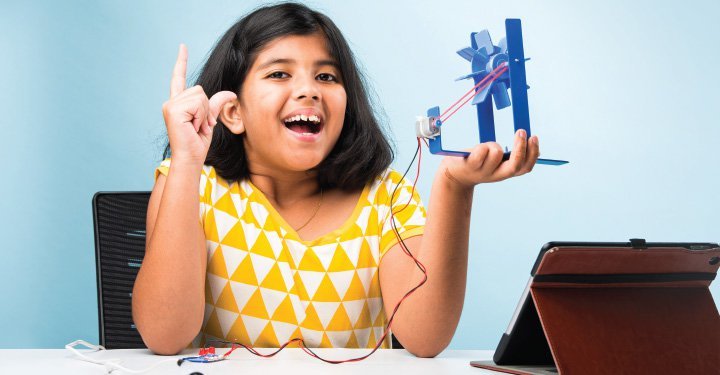
Spark a love for learning: Blend learning into day-to-day activities. For instance, while on a night-walk in the terrace, spend some time stargazing, pointing out the planets, observing interesting patterns formed by stars, etc. Engage in spontaneous word-building or spelling games and math magic card tricks. These activities will gradually help your child view learning as a fun exercise, rather than a burden.
Support your child socially and emotionally: Social distancing can be tough on your child. So, talk to your child openly about her worries, fears, and challenges regularly and problem-solve together. Spend quality time with your child, singing, chatting, cuddling or playing! Also, help your child keep in touch with his friends and family virtually.
Top Concerns of Parents Addressed
Despite taking all the necessary steps to create the perfect learning environment for your child at home, there may still be challenges. Your child may be bored with his online classes, or he may not be taking his online classes seriously. As a parent, what do you do then? Arundhati Swamy, Head Parent Engagement Programme, ParentCircle, address some common concerns:
Q My 10-year-old is very distracted at home and is not able to focus on online learning. I am worried he will lose interest in his studies. What can I do to motivate him to study?
Can't really blame your son, can we?! Nor can you help worrying about him. Online classes can hardly ever replace the excitement and action of a classroom. But you can try and help infuse excitement and fascination into your son's offline learning, and that will slowly help motivate him to study. Begin with your own experience, pick one of your hobbies or interests, think of all the things about the activity that excite or draw you into it, and why it gives you pleasure and satisfaction. Now help your son do the same with one of his hobbies or interests. For example, if it is a game, ask him how to learn a topic as if it were a game he was playing. Or if he loves cinema, he could turn the topic into scenes of a movie. Imagination combined with learning is a sure-shot winner.
Q My son is in Class 9. During an online class the other day, my son and his friends muted the teacher and the teacher did not realise this and kept talking. I have tried talking to him, but these kids are just too naughty sometimes!
We are smiling. Not out of disrespect, but simply because this is an amusing story. Did you feel amused too? Not withstanding the mischievous intention behind the prank, few students can resist the temptation to have fun at the teacher's expense when an opportunity presents itself. One can almost hear their collective thought, Aha, for all the times this teacher has muted us in class, for once we can mute her! The thrill of a harmless online class adventure to boast about! Considering all the challenges and stress the pandemic is putting children through, an occasional scene of comic relief is understandable, as long as your son otherwise takes his classes seriously. You could also start a conversation to help your child draw the line between a light-hearted prank and an insult.
Q My child is in Class 4. She is quite bored with the online classes. She falls asleep, is inattentive, and keeps wandering around the house during the classes. How do I handle this?
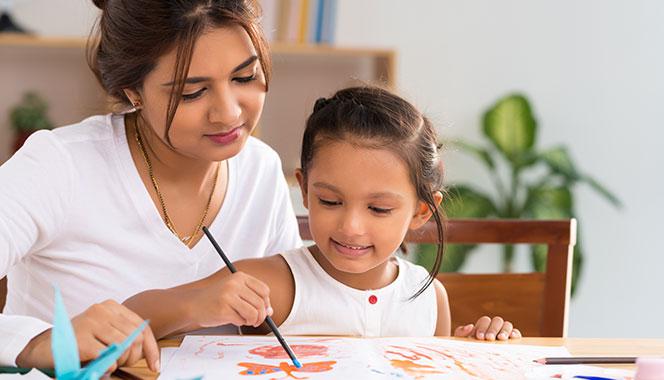
Many young children are not taking well to online classes and it's really not their fault. Staring at a screen disinterestedly or wandering around aimlessly could indicate your child's need to retreat into a peaceful world. Perhaps she is overwhelmed with confusion and mixed emotions. Talk to her, but she may not open up easily to you. To enter into your daughter's inner world, share your own childhood daydream expeditions. This may prompt her to become more aware of her own dreams and what motivates her. For example, if it is adventure that excites her, prompt her to turn a topic into an adventure. Or if it is painting that interests her, ask her to paint the topic she is learning. Watch how this new approach brings out the joy and pleasure of life-long learning.
Q My daughter is in Class 7. Her school has started conducting online tests. I find her and the other children discussing answers on WhatsApp or googling answers. How do I make her understand?
Children are doing this because it is easy and they can get away. Quite naturally, you are concerned. You do want your child to practise honest learning. However, while you are aware of what is going on, know that your daughter could be struggling to cope with the stresses of physical distancing. What we all need right now are large doses of positive emotions. For now, you could try and focus more on the actual learning than on marks and grades. This learning experience could stir your child's imagination and boost her lively curiosity and positive feelings. Challenges will then become exciting. From these wonderful experiences, your child will be drawn into all kinds of learning. You could soon find her digging deep into her studies, more for the love of learning. Effort and good performance will follow naturally. Your daughter will no longer need to rely on friends or Google to pass a test, online or otherwise. Because she would have discovered that the intrinsic joy of learning propels her to work hard and do her best.
Q I caught my 15-year-old watching a movie the other day when her online class was going on. She was attending the class, with the volume kept low. Then she switched tabs and was watching her favourite movie. I am really flustered. It is not possible for me to monitor her all the time. I have my own deadlines at work.
There could be a million reasons why your daughter chose to watch a movie during her online class, but let us look at what is upsetting you. Is it the deception, or the fact that your child is missing the class? Either way, you could address both your concerns through respectful conversations, the aim being to guide your daughter thoughtfully and firmly. Listen to her side of the story. Empathise, yes, I know the class seems boring. Discuss what she could do to be more attentive during class. Ask her to reflect on the strengths she sees in herself and remind her of the times she has solved problems successfully. Then, get her to use these abilities to commit to being a more responsible student. The key is to support her with understanding and unconditional acceptance. It will be worth the time you invest now in building a trusting relationship with your daughter, for her benefit and yours.
Online learning resources
Here are some helpful links that can help both parents and children:
- ttps://www.weareteachers.com/free-online-learning-resources/
- ttps://en.unesco.org/covid19/educationresponse/solutions
- ttps://scratch.mit.edu/
- ttps://www.khanacademy.org/
- ttps://kids.scholastic.com/kids/home/
- https://www.coolmath.com/
- http://bedtimemath.org/
- https://pbskids.org/
- https://kids.nationalgeographic.com/
- https://www.bbc.co.uk/history/forkids/
- https://www.sesamestreet.org/
Remember to always focus on the real learning. Things will slowly fall into place.



























Comments
Edit
Comment Flag
Cancel Update