
How To Make Homework Less Stressful And More Meaningful And Easier For Children
Aruna Raghuram
Homework can easily become a daily struggle for both children and parents. But with the right approach, you can make it a more manageable and meaningful learning experience. Experts say the focus should not be on giving more homework, but on making homework engaging, age-appropriate, and balanced with a child’s emotional well-being

In Part 1, we explored the ongoing debate about homework, whether it improves learning, how it affects children emotionally, and what research and experts have to say about its benefits and drawbacks. While opinions may differ, most experts agree on one thing: homework should support learning without overwhelming children.
In this second part, we look at how parents and teachers can make homework more meaningful, manageable, and less stressful. From creating healthy routines to offering the right kind of support, small changes can go a long way in helping children approach homework with greater confidence and less anxiety.
How much homework is too much?
Irrespective of the ongoing debate about the merits of homework, it looks like homework is here to stay, at least in mainstream schools. In fact, if a school does not give sufficient homework, some parents may feel it is not doing a good enough job.
But what is an appropriate amount of homework?
Dr. Harris Cooper and colleagues recommend the '10-minute rule,' a maximum of 10 minutes of homework per day per grade level. For instance, children in grade 1 would do 10 minutes of homework while those in high school would do around two hours. It has been found that too much homework can stop bringing in academic benefits.
Why homework quality matters more than quantity
Apart from the ideal quantum, the quality of homework is of great importance. If homework assignments are interesting and fun, a child is likely to enjoy them. If it is just repetition and memorization, a child will get bored and feel it is a burden. Homework must encourage the child to understand and apply concepts and learn creatively.
What effective homework looks like
Good quality homework is interesting and relevant. It makes a child think and solve real-world problems. Children could be given a choice and a degree of autonomy to motivate them to do homework.
Why shorter and creative assignments work better
Homework assignments can vary: from fill-in-the-blank worksheets to answering multiple-choice questions to projects and quizzes students have to take without consulting their textbook or notes. Shorter, well-designed assignments are more effective in capturing their interest.
How parents can make homework easier and healthier
Teachers need to give students interesting home assignments that get them thinking. And parents can liven the homework hour so that both you and your child look forward to it!
Before we describe how homework can be less of a chore, let's examine how the parental role and attitude to homework impact a child.
According to Dr Bempechat, the type of parental help in homework matters. She says that 'supportive' help predicts higher achievement, while 'intrusive help' is linked to lower achievement. Also, how parents view homework makes a difference. Children do better in school when their parents are focused on 'mastery'. If parents focus on their child's performance relative to their peers, they are likely to avoid challenges.
Work together with teachers
Parents and teachers need to collaborate to achieve optimal learning outcomes in children. Talk to the teachers if you feel the homework given is excessive. Or, if it is uninteresting and repetitive. Also, ask the teachers how you can help with homework, and how best to reinforce the skills taught in school.
Create a healthy homework routine
Provide structure: Fix homework time in consultation with your child. Some children may want to dive into homework in the afternoon so that they can go out to play in the evening. Others may want to rest in the afternoon, finish playing, and do their homework in the late evening.
Find the right place: Assign a quiet, well-lit spot for homework with minimal distractions. Ensure your child has all the books and stationery handy.
Break up the tasks: Divide the homework into smaller parts with 10-minute breaks in between to prevent fatigue and tedium. Get them started on the difficult assignments first when they are more mentally alert. Give them healthy snacks they like. This will not only serve as a break but will give them the energy to work attentively.
Help without taking over
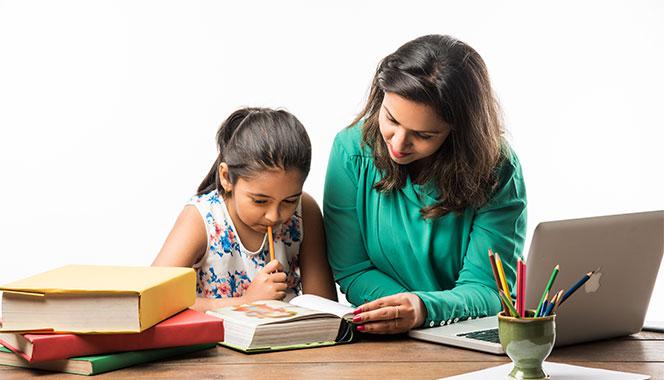
Guide your child to think for themself: Guide them in the right direction if they seem lost, but do not assist more than is necessary or make it too easy for them. That will rob them of a sense of achievement in figuring out a problem on their own. Be available to provide help when your child gets stuck or asks a question.
You could also get learning Apps that could help your child understand concepts they may be struggling with and make homework less intimidating.
Sit with them and do your own work: You can bring your own pending tasks and complete them while supervising your child's homework. This way, they know they are not the only ones working.
Make homework more engaging and fun
Turn homework into a game: If your child finds homework boring, try to make it fun. Experienced teacher Marty Newport's book 'Homework Games' provides tips and games to make learning fun. She aims to make children stop complaining about homework and get them excited about doing it.
Follow homework with a preferred activity: According to the Premack Principle, highly preferred activities are effective as reinforcers for less preferred ones. So, if homework is followed by an activity your child likes, such as a trip to the nearby park, half an hour of watching television, or playing with you, it could motivate them to complete their homework.
Invite your child's friends over: The tedium of homework can be reduced when your child and a friend do their homework together. Of course, you will have to set a few rules so that time is not wasted in distractions.
Maintain a healthy perspective on homework
Maintain a positive attitude: If you tell your child that doing homework will help them learn, they will feel positive about it. However, if you criticize their teachers for giving homework or make it sound like a burden, your child is bound to dislike homework. At the same time, keep it light. Do not make too much of an issue with homework and marks. Your child's overall development and well-being are important.
Expert takeParentCircle spoke with Prof. Rajeev Sharma, former faculty at the Ravi J. Mathai Centre for Educational Innovation at IIM Ahmedabad. He is the author of ‘Not Just Grades: Schools That Educate Differently.’ We asked Prof. Sharma if homework really aids the learning process. This is what he had to say: "I think most schools and parents have no clear idea about the objective of homework, except for engaging children in repetitive mechanical learning. In this situation, homework can have a negative impact. It can take time away from outdoor sports and physical activity, which are necessary for a child's well-being. In fact, games and play help children develop skills and competencies that are important for learning. Second, it can cause a lack of interest in studies. If children do not understand the subject, they may stop enjoying learning itself. My homework issue is that it is all about completing tasks and giving the right answers, not about engaging the children and helping them understand the subject. There are so many children in a class that a teacher is unable to get feedback from their homework on whether the children have understood the concepts or need additional support in a particular area. If children are given freedom, autonomy, and time to think, then homework can be a useful tool that promotes learning. But homework should be designed in collaboration between children and parents for this to happen. Schools and teachers should partner with children in learning and discuss with them the nature and extent of homework to be given. This will make them feel empowered. Homework should help children expand their learning. It could involve field activity or projects, or even watching an educational video." |
Takeaway for parents
Finally, doing away with homework completely may not be the right solution. Instead, homework should be structured to be short and interesting so that it doesn't become a burden for a child.
Homework must support learning, not overwhelm children. Thoughtfully designed homework, balanced with rest and play, helps children strengthen concepts and develop responsibility. But when it becomes excessive or stressful, it can reduce curiosity and joy in learning. The goal, therefore, is not “more homework,” but better homework—meaningful, manageable, and mindful of a child’s overall development.
A parent checklist for healthier homework habits
- Ensure your child has enough free play, rest, and family time alongside homework.
- Observe whether homework is helping your child learn or causing stress and frustration.
- Speak to teachers respectfully if the homework load feels excessive or repetitive.
- Encourage understanding and independent thinking rather than focusing only on marks.
- Create a calm, distraction-free homework routine at home.
- Break longer assignments into smaller chunks with short breaks in between.
- Avoid completing homework or projects for your child.
- Offer support and guidance without becoming intrusive.
- Maintain a positive attitude toward learning and effort.
- Watch for signs of anxiety, sleep deprivation, headaches, or emotional burnout.
Help your child study smarter, not harder! Discover practical tips to make homework easy and turn stressful study sessions into productive learning time.
Last updated on: May 27, 2026






























Comments
Edit
Comment Flag
Cancel Update