
Does your child hate math? Make it fun using mathematical manipulatives
Lakshmi Saravanan
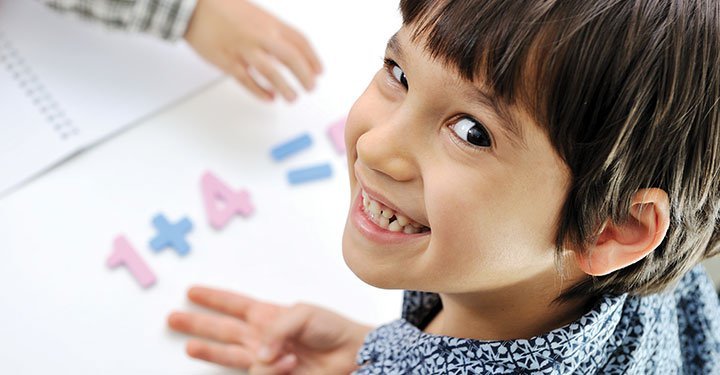
Mathematical manipulatives are objects that make learning math easy and fun. Read on to learn more about the different ways you can make math fun by incorporating manipulatives for different age group
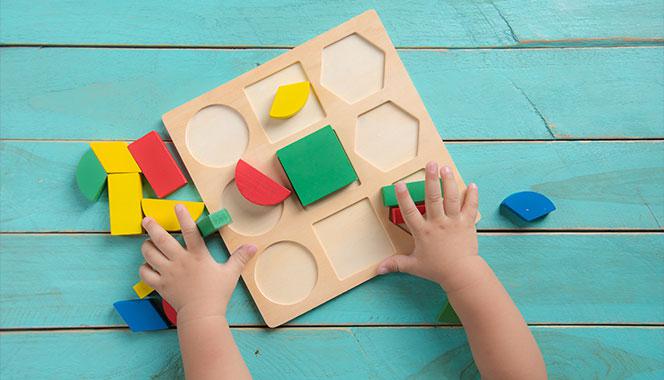
According to Wikipedia, “A mathematical manipulative is an object which is designed so that a learner can perceive some mathematical concept by manipulating it. The use of manipulatives provides a way for children to learn concepts in a developmentally appropriate, hands-on and an experiencing way.” Now, let us look at the many different ways to make math fun by incorporating manipulatives for different age groups.
Toddlers
Developing number sense: For this age group, anything that they can hold with their little fingers, such as grapes and little crackers can serve as a manipulative to learn quantity. The children can be encouraged to feel the number of snacks they have and take pride in the quantity they have eaten. As an example, you can tell the child, “Here are three grapes for you to eat”. Then after he has eaten one, you can add, “So you have eaten one grape. Now you have two more left to eat”. You can also use larger items and say: “Bring me two apples” or “Bring me three spoons.”
Learning shapes and grouping: Cutting out shapes in cardstock or colored construction papers, helps the child in understanding shapes and object comparisons. Sit with the child and have him bring you all the pieces that are similar in shape to the one you are holding in your hand, and you can even mention the shape name. Grouping is thus introduced without the children or parents even realizing it.
Preschoolers
This is a fantastic age to start using manipulatives for teaching math. Simple things like relating every spoonful to their actual age can go a long way in making them understand quantity. For example, when kids refuse to eat, you could say, “How old are you?” and when they reply, use the answer as the number of spoons that they must eat before they say ‘no’ to it. This gives them an idea as to how much quantity is expected from them. Many everyday things can be used as counting tools in this age. These include marbles, buttons, shells, erasers, hard candies, dry beans and old game board coins. Again, shapes can be cut out in different colors and sorting by both colors and shape can be encouraged.
Primary school kids
Anything that they learn at this age serves as the foundation for their future knowledge of math.
Counting: Use beads, snacks or dried seeds or beans to count the numbers. Play addition and subtraction games with your child to figure out how many both of you have altogether or how many are left after you have hidden a few.
Grouping, sorting and comparing: The concept of grouping can be introduced/ re-visited at this age. Have the child group several beads or beans of the same color. Then sort the groups from the smallest to the largest, thus comparing quantities of different sizes. Different kinds of snacks or toys can also be sorted and compared. Sorting also leads to grouping. For example, sorting kitchen toys, stuffed animals, regular animals, etc., and putting similar toys together gives them the idea of grouping. This concept can further be enhanced by having the child arrange toys by way of height, to give them an idea of ascending and descending order.
Basic operations: These are the foundation steps in learning math. Everyday objects ranging from toys to snacks could be used to add to or subtract from the total quantity. Every evening when they put away their toys before bedtime, have the child count the number of toys used that day.
Record this number somewhere for use the next day. Compare the next day’s total number of toys with the previous day’s count and compute the difference.
Money can be introduced to children at this age – monopoly money works wonders. Laminate some of the paper money so that it is durable. This can then be used to teach addition and subtraction. Pretend-shopping games can also be played at home to teach children all the four basic operations.
Fractions: Have the children divide their snacks among friends, and use this opportunity to introduce fractions. Cakes and pizzas double up as great tools to teach fractions and as a delicious meal. When making a fruit salad, enlist the children’s help in measuring the fractional pieces of fruits that need to be added to make it yummy. Involve the children while making food with any recipe, because recipes serve as a classic example of using fractions in everyday life.
Measurement and volume: The kitchen serves as a hub to teach the concept of measurement and volume, starting with how much water or juice the child drinks to the amount of starter yogurt to be added in milk to form yogurt. Measure two different liquids and mix them to introduce the proportions by comparing the two quantities. As an example, have the child measure one cup of curd and two cups of water and mix them. Explain that the proportion of the mixture is one curd is to two water.
Geometry: There are geometrical shapes all around us. Cookies of different shapes can be used to teach shapes. Play a treasure hunt game and have the child bring you rectangular or circular-shaped objects.
This is a good time to introduce the concept of three dimensions, even though the child may not comprehend it fully. This idea of a third dimension is better introduced by showing an actual object that they can hold as opposed to a picture of the object.
In addition to the everyday things that are readily available, several products are available in the market to assist in teaching math concepts to all age groups. Let's have a look at a few of them:
Shape sorters
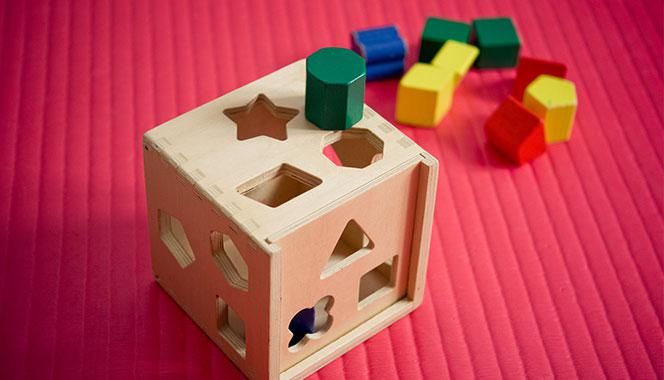
These help toddlers understand the concept of shapes and matching and also give an idea of a third dimension.
Pattern blocks
Pattern Blocks are a tangible way to help you introduce the concept of three dimensions after the child has been introduced to two-dimensional objects like squares and rectangles. These can also be used to introduce fractions and more specifically equivalent fractions.
Stacking blocks
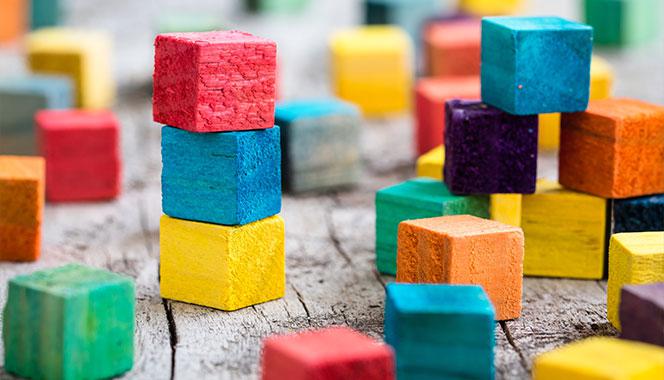 These blocks help to understand grouping, sizes and stacking. They can be used as counting blocks too.
Lego blocks
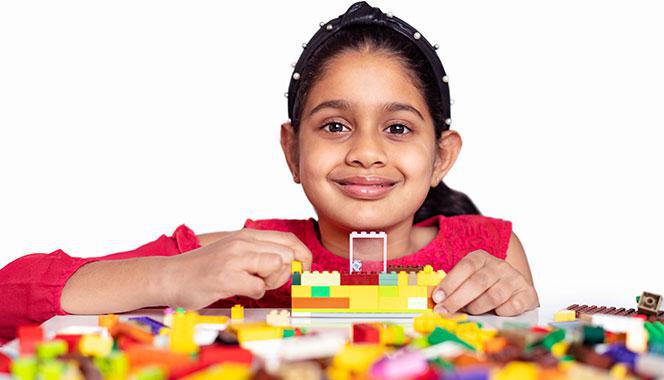
A plethora of ideas can be achieved by using the Lego blocks. These could be used to teach comparisons, grouping, sorting, stacking, adding, subtracting, multiplying and dividing numbers and fractions.
Base 10 materials
Base 10 materials are used to teach numbers and place value concepts. For example, to represent 452, use four flats (hundreds), six rods (tens) and two cubes (ones). Basic operations of addition, subtraction, multiplication and division can also be taught.
Unifix cubes
Interlocking cubes can be used as fun objects to introduce numbers and basic operations, grouping and sorting. The concept of fractions can also be taught using these cubes.
These are just a few picks in the ocean of ideas that are available to us in our everyday life. Give these ideas a go and make math fun for your child!
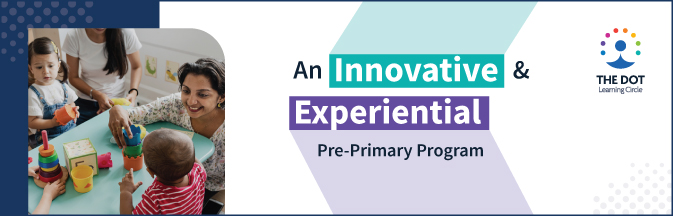
The Dot maths program for kindergarten is based on the learning trajectories of children and builds a strong conceptual foundation in maths. The program nurtures a love for maths in young children.





















Comments
Edit
Comment Flag
Cancel Update