
School Life During The Pandemic: Challenges, Changes, And The Future
Divya
How is the Covid-19 crisis going to impact schooling? How are schools preparing? Will school life be the same again? Take a look.
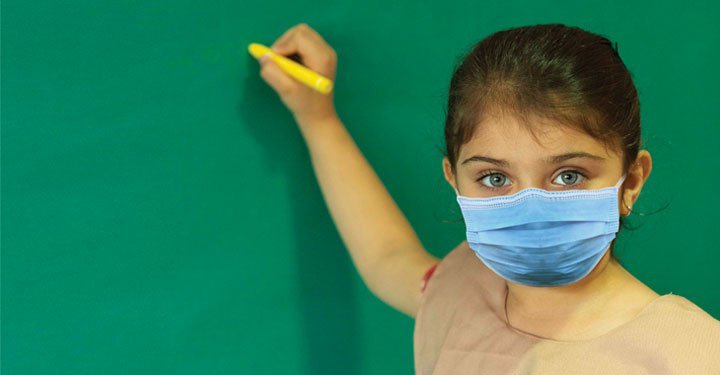
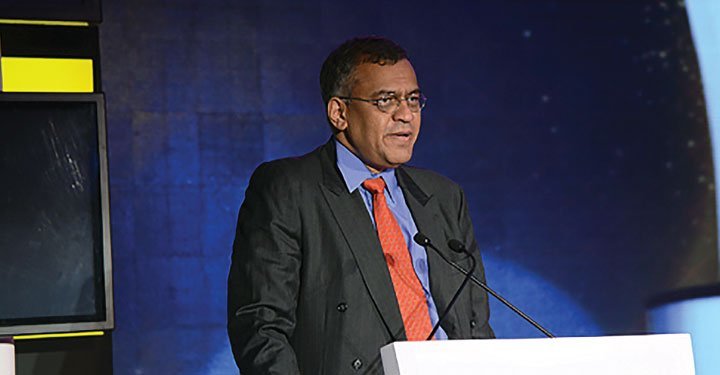
With Coronavirus cases surging in India, we at ParentCircle, organised a national panel discussion on the impact of COVID-19 on schooling. The discussion featured some of the finest educationists from different parts of India. During the discussion which lasted over two hours, the panelists talked about several issues concerning parents right now, including the reopening of the schools amidst the pandemic, challenges in online learning, and so on. From principals to parents, from students to teachers, there are several apprehensions that school life is unlikely to be the same again, at least for the next year or so.
While it's still unclear when schools in India are going to reopen, schools in countries including Germany, Denmark, South Korea, and China have started reopening tentatively. Pictures coming in from some of these countries give us a glimpse of what's in store for our children when schools do resume—children wearing helmet masks in classrooms in Thailand, standing on white squares in a playground in France, attending classes outdoors wearing masks in Denmark, and so on.
Phew, how things have changed! In our cover story this month, we look at how schools are preparing for these challenges, and how all the stakeholders, parents, teachers, support staff, and children can come together to manage the situation better.
First, let's hear from parents and understand their apprehensions:
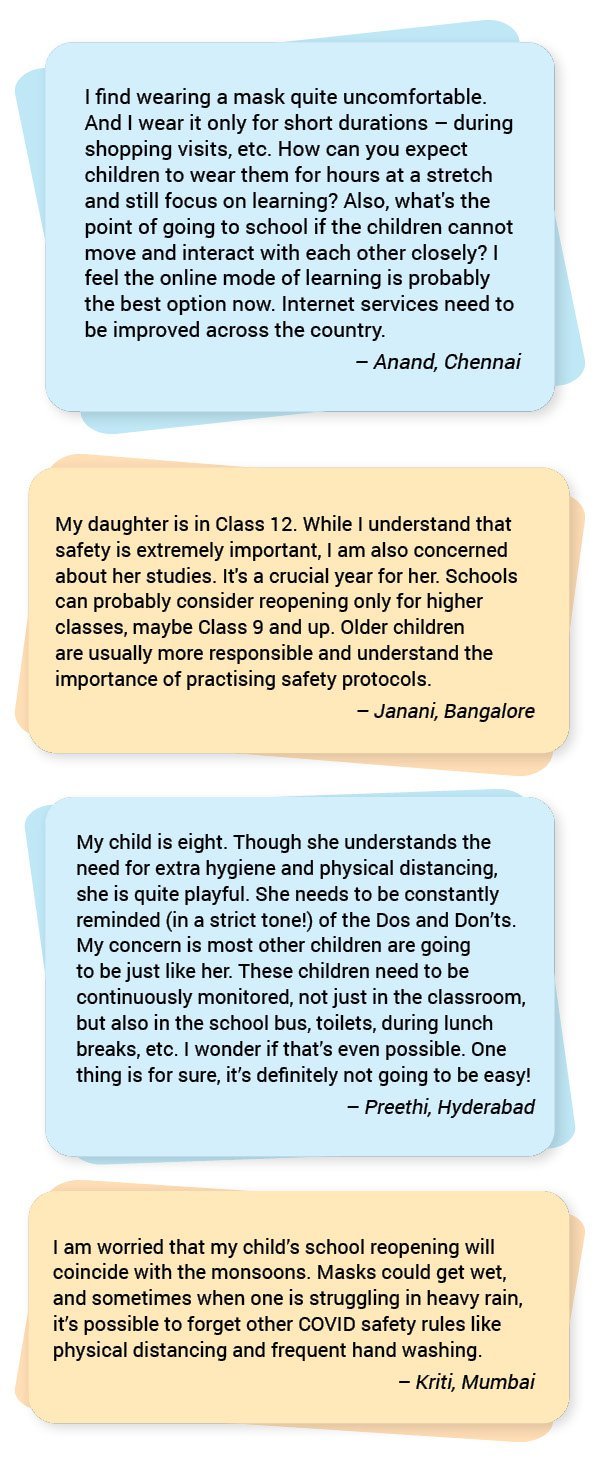
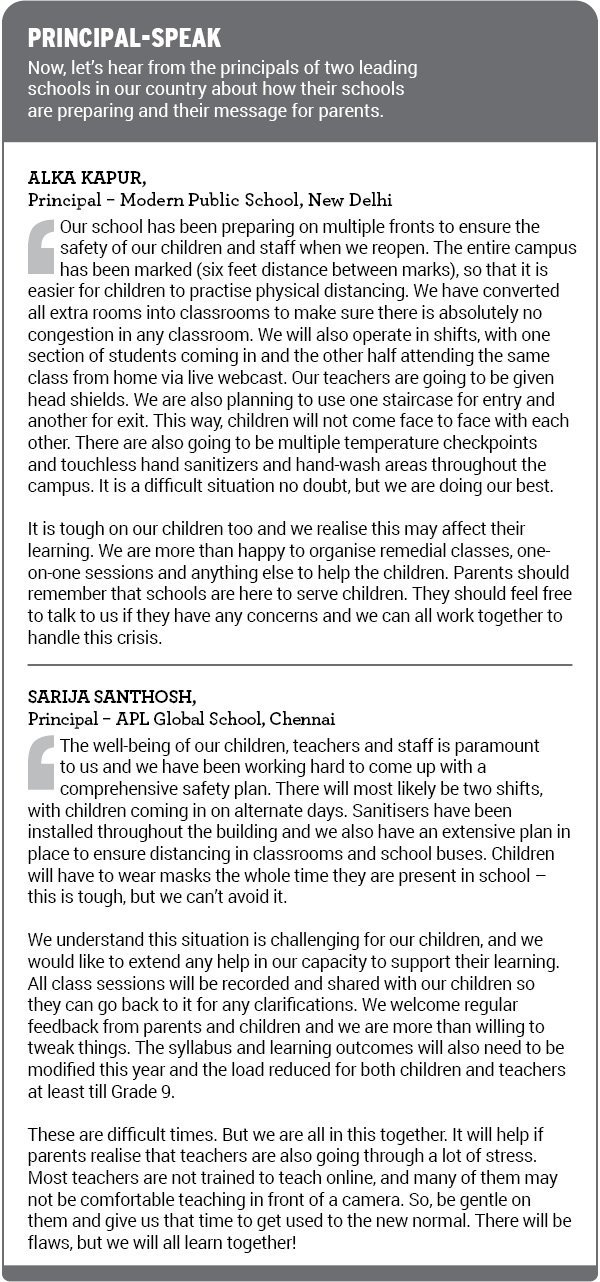
Some understandable concerns there, from parents. Schools are putting in a humongous amount of effort and planning to ensure everyone's well-being when they reopen. So, without any further ado, let's dive in to see how schools are preparing for their reopening.
Steps to reduce infection risk in schools
We spoke to school heads, teachers, and parents and found that many schools are planning the following measures to keep the risks of infection at bay. Talk to your child's school authorities and find out what they are doing.
- Installing temperature screening equipment. However, this doesn't help filter out asymptomatic cases or individuals who haven't started showing symptoms yet.
- Carrying out daily sanitation drives to clean furniture and other facilities.
- Placing hand-wash units and touchless sanitizers at multiple locations across the school building.
- Preparing colorful, attractive posters of the important Dos and Don'ts and displaying them in all the important locations in the building.
- Making it clear to parents not to send their child to school if the child/any member of the family is experiencing COVID-19 symptoms
- Asking children to bring their own masks from home, and making sure they keep them on till they leave the campus.
- Requesting children to carry their sanitizers.
- Informing parents about their responsibility to regularly sanitize their child's personal belongings
- Making sure children always maintain at least six feet of distance from each other. Of course, this is easier said than done!
Now, let's take a look at some strategies that schools are adopting to implement physical distancing in schools.
Physical distancing measures
- Blended learning: There is likely to be a mix of physical and online classes for the rest of this academic year. So, classes may operate in shifts with only a few children in the school at a time.
- Demarcated seating arrangements: Children's seats will be marked with a circle, making sure the seats are at least six feet apart.
- Outdoor lessons: Research has shown that the risk of coronavirus transmission is lower outdoors. So, schools that have considerable outdoor space and trees plan to shift some of their classes outside the classrooms.
- Commute made safe: Schools plan to instruct parents to avoid crowded public modes of transport and limit school van capacity to 8 or 10 students per trip, depending on the size of the van.
- Mealtime/break-time precautions: Mealtimes for children will be staggered if they need to step out of classrooms for lunch. If possible, schools will opt for in-classroom dining so that teachers can monitor and make sure children do not share food. Toilet breaks will be staggered too.
- Group activities/sports: Group activities will be shifted outdoors whenever possible and group size will be limited. While team sports and contact sports are likely to take a backseat this year, children may be encouraged to take up table tennis or badminton, with children bringing their equipment.
- Staggered school start and close times: Overcrowding usually happens outside schools, every morning, with children rushing in to make it on time. Similarly, we know children rush out of their classrooms the moment they hear the bell ring in the evening. So, each class may have a specific start and end time. For example, Class 7- 8 a.m. to 2 p.m., Class 8- 8.30 a.m. to 2.30 p.m., and so on.
Teach children the rules of correct mask use
Studies have shown that masks can help contain infection spread drastically. But masks worn and handled incorrectly can increase COVID-19 risk. Here are some points parents should keep in mind:
- The Centers for Disease Control and Prevention recommend face coverings made of cloth. A tight weave is more effective in filtering out germs.
- The right fit is important. Often, even child-sized masks turn out to be quite big for some children. So, let your child try out different types and sizes of masks before settling for one.
- Ask your child to wash their hands before and after wearing a mask.
- Make sure your child's mask properly covers their nose and mouth.
- Your child will need to remove the mask at school to drink water or during lunch break. Ask your child not to touch the front of the mask, instead touch only the ear loops to take off or put on the mask.
- Wash the cloth masks after every use, and make sure your child carries two extra masks in their school bag in case they drop/lose one.
- Finally, reiterate to your child that wearing a mask does not mean they can temporarily forget the six-foot rule. Physical distancing is essential even with masks on.
Online learning is here to stay!
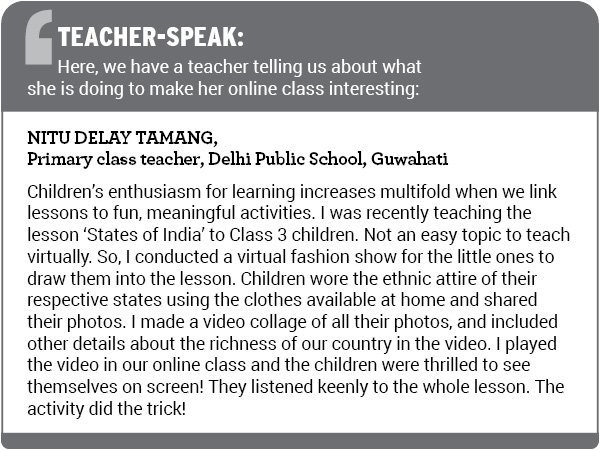
Even if schools reopen, the coming year is going to see a mix of online and classroom learning. So, how can these online classes be made interesting and effective? Here are some thoughts from educators:
Gamification: Children can never say no to lessons that have games built into them. Word puzzles, math challenges, or competitive quizzes allow children to participate in teams and have fun.
Opt for short sessions: Long lectures are tough. So, breaking the class sessions into two parts and squeezing in an activity between the sessions can help. For instance, if the duration of a class is 40 minutes, teaching can happen for 15 minutes while the remainder of the time can be used for fun activities and overall revision.
Take advantage of technology: Putting technology to effective use can help children grasp their lessons much better. For instance, teachers can record their teaching sessions and share the videos with children. Crisp PowerPoint presentations or attractive flashcards can also help because long, dense text is difficult to read on screen. They can also be shared with the students later.
Allow time for social interaction: Children love face-to-face interactions with their friends. While that's not possible now, virtual social interaction can partially help fill that void. They can also help make online classes lively and interesting. Dr Sheela Rajendra, Director of PSBB, Chennai, in our recent panel discussion on COVID-19's impact on schooling, stressed the importance of having e-birthday celebrations and free social interactions. She also highlighted the importance of giving opportunities to children to display their talents during a virtual class.
Avoid note-taking during online classes: In a school classroom, children are used to taking down notes from the blackboard. Replicating the same practice online may not work. For older children, PDF notes can be shared. For younger children who need writing practice, screenshots/photographs of the notes can be shared, and the children can take down notes in their notebooks after the online session ends.
Involve all children: Teachers always try to do this. But in an online class, it is easy to overlook the quieter children. So, a conscious effort from the teacher to involve all the children regularly will help children feel valued and enthused about the class.
The three-minute rule: Classes need to be interactive, more so if it's an online class. A study shows that classes are effective if children have something to say every three minutes. It could be a simple Q&A session, a short group discussion, or a quick recap of previously covered topics. Children can also be asked to take turns to explain a particular topic to the rest of the class.
Investing in a good internet connection: This is understood, but we will still put it out there. Children get restless and lose interest if their video keeps buffering. So, a good internet connection is an absolute must!
Helping children re-adjust to school mode:
Your child has been staying home for so long. They may have gotten used to the relaxed atmosphere at that home. That's okay. But when school reopens, they may need some support in getting back to the school routine. Prepare your child for the new routine a couple of weeks before school reopens.
Your child may have also become used to having their way in the last few months at home. That's going to change now. Not a pleasant feeling for your child! Empathise and respond positively to their concerns and fears. If your child is not too keen on returning to school, try to have an open conversation with them at their level and find out what's bothering them. Do not belittle or dismiss their worries. Talk cheerfully about the things they can look forward to in school. In a nurturing environment, your child will gradually feel better and learn to cope.
Schools can also help by being conscious about the socio-emotional challenges that many children are likely to experience and taking extra care to foster a supportive environment for the children. Giving children time to settle down, making an effort to re-acquaint with them, organizing one-on-one sessions between the teacher/counselor and children, and letting children talk about their lockdown experiences, challenges, and fears can help.
Help children ease into school life gradually. Do not be in a hurry to get moving on the academic front to make up for lost time. Remember, this is unlike any other back-to-school moment!
How can parents help?
- Train your child not to take their hands near their face and let handwashing become a regular habit. This will happen gradually and has to start at home.
- Social distancing does not come naturally to children. Think of different scenarios that your child is likely to encounter at school, and ask them how they would respond. For example, what if a friend walks towards them in the school playground, or when they need to use the toilet at school? Make social distancing a game and rehearse these scenes at home regularly with your child.
- Your child will find it difficult to start wearing a mask to school. So, create safe opportunities for your child to wear a mask, like a walk around your apartment. You can also create attractive masks for your child with their favorite cartoon character, one that they would love to flaunt to their friends! Discourage your child from running while wearing a mask. It can put pressure on the airways and lungs.
- When it comes to learning, your child may need your support more than usual, till things become normal. Here's a helpful link: https://www.parentcircle.com/taking-online-classes-how-to-help-children-learn-from-home-effectively/article
This academic year sure is going to be unique and challenging. Even as the education boards come up with specific guidelines about changes in curriculum, regulations for online learning, and more, let's all help each other and rise together to fight this crisis. Here's wishing schools, teachers, parents, and children the very best!



















Comments
Edit
Comment Flag
Cancel Update