
How To Raise Environmentally Responsible Children Through Everyday Family Habits
Team ParentCircle
ParentCircle empowers parents to raise successful children through holistic parenting.
Discover the importance of environmental education for children and how small everyday actions can shape lifelong values. This article shares practical parenting tips for environmental awareness and simple ways to start raising eco-friendly children who care for people, communities, and the environment
The bad news first…
- Every year, millions of hectares of forests are lost worldwide due to human activity
- More than 2 billion people still lack access to safely managed drinking water.
- Air pollution remains one of the leading environmental risks to human health and contributes to millions of premature deaths globally.
- Climate change is increasing the frequency of extreme weather events, affecting communities, wildlife, and ecosystems worldwide.
- Mountains of electronic waste continue to grow each year, placing enormous pressure on the environment.
These are not distant problems. These are challenges that today's children are already growing up with.
Now, the good news…
Young people today are very well informed about climate change; they spearhead campaigns for endangered species; they vociferously protest against tree-cutting by the civic authorities. When the young Greta Thunberg stood up against the most powerful political and business leaders with a stirring campaign, the world stood up and took notice. She became an overnight sensation, and not without reason. She awakened an entire generation.
However, awareness alone does not create change. What truly matters is whether awareness translates into action.
Awareness is not enough: Turning concern into action
A long way to go
We are all ever so keen to see change in the world, but are we taking the requisite measures to make small changes happen at home?
- Do we try walking, cycling, or taking public transport to reduce fossil fuel use?
- Do we abandon the use of plastics that choke our land and water?
- Do we segregate garbage?
- Do we reduce, reuse, recycle?
Did these questions hit you? Unless environmental action and activism are about ME, MY RESPONSIBILITY, and MY ACTIONS, environmental education (EE) has little meaning.
The term ‘environmental crusader’ has been aptly chosen for this article, for ‘crusader’ means ‘one who wages a long and determined attempt to achieve something that they believe in strongly.'
Whatever path your child chooses in life, the real question is this:
- Will they make decisions that consider people, the planet, and future generations?
- Will they act with fairness, responsibility, and respect for natural resources?
- Will they use their influence to create positive change?
If the answer is yes, you will have succeeded in raising an environmental crusader.
The values every young environmental crusader needs
Understanding fairness and shared resources
Environmental concerns have a deep moral underpinning. For instance, the notions of justice and equity—the concept that individual actions have consequences for others, and hence I need to be mindful:
- If I use more than my share of water, someone else has less.
- Natural resources are public goods.
- If I pollute the air, the policeman and pedestrians are paying for it.
Learning that humans are part of nature
- The concept that the earth and its resources are not made for human exploitation.
- That all life forms depend on it.
- That we all depend on each other.
- That we are woven together in the web of life.
- And so, humans have no right to destroy it.
6 ways to raise an environmentally responsible child
1. Build eco-friendly habits from an early age
Habits are a key part of resource use and conservation. And these are best formed at a young age, from closing the tap while brushing teeth, to not littering, to not wasting.
2. Develop empathy and an understanding of interdependence
It is quite easy for your child to get carried away in the urban lifestyle we are all so accustomed to. Secure life in gated communities, moving around in AC vehicles, studying in AC classrooms, drinking packaged water, can make life and the environment seem so healthy.
Does your child understand the challenges of day-to-day living of the less privileged across the world? What does it feel like:
- Not to get water in the tap
- Not to have a toilet at school
- Not to have electricity 24x7?
How can parents develop this empathy in their children?
Maybe the next time you go to town:
- Use public transport or carpool.
- Resolve to use the AC less often.
- Consider volunteering at an orphanage or an old-age home.
Humans depend on each other, more so than ever in today’s world:
- If people upstream pollute the water, people downstream suffer.
- If one person draws too much groundwater, the others suffer.
Choose whatever works for you and your family, but remember what you are trying to achieve: building EMPATHY.
3. Encourage cooperation instead of competition
Inherent in this interdependence is the need for negotiation and conflict resolution.
Try motivating the children in your neighborhood to take up the task of convincing all the households to segregate waste. The children will have to convince the indifferent and cynical people they come across to cooperate. To do this, they will have to clearly explain the benefits of segregation, composting of organic waste, recycling, and so on. They will have to convince their neighbors of what a big difference a little effort on their part can make.
4. Develop critical thinking skills
It is important to understand that EE does not advocate a particular viewpoint or course of action. Rather, it teaches individuals how to weigh various sides of an issue through critical thinking and how important environmental considerations are in this decision-making. This will make children ask questions and weigh alternatives. If your child talks about electric cars or emission norms, you can rest assured they are environmentally conscious.
5. Having regular environmental discussions at home
Your child may be studying the benefits of the Green Revolution in science. Somewhere else, about the harmful impacts of chemical pesticides and fertilizers, and elsewhere, the increase in inequity brought about by the very same Green Revolution. Discussions at home could help piece these various bits of the jigsaw puzzle together and get a proper perspective.
6. Family projects that make environmental learning meaningful
Children learn best when they can see environmental concepts in action. Simple family projects can make abstract ideas more meaningful.
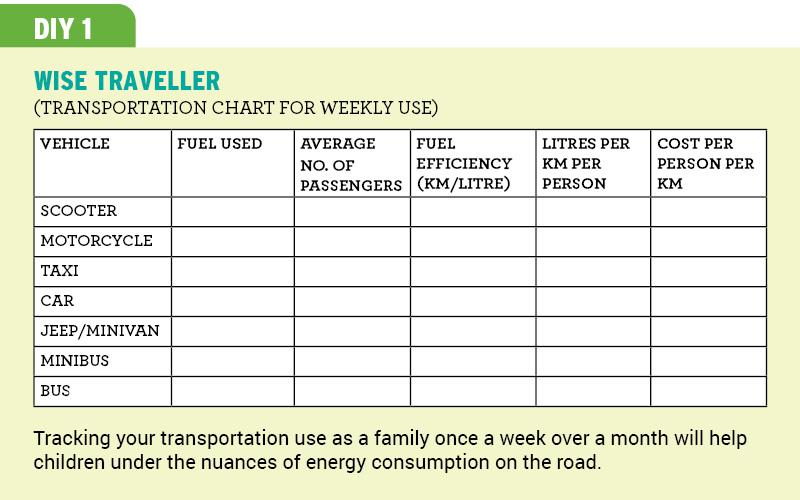
Tracking your family's transportation use once a week over a month will help children understand the nuances of energy consumption on the road.
Parent experience: Learning from nature every day
Parent speak
"As parents, we let our children learn from what they observe. We take our kids to our farm regularly, where they learn about natural farming practices and water conservation. We let our kids grow like a banyan tree on a farm. We don’t restrict them too much. They get the fundamentals of eco-friendly living from what they see around them."Raghu Venkat, father of 15-year-old twins, who spend time on their farm regularly
What success really looks like
Remember, the fundamental purpose of EE is to create a generation of young people who will make the right decisions for a better world. Not just in their personal lives, but as professionals and responsible citizens.
You would have succeeded in raising an environmental crusader when your child:
- Grows up to be a corporate honcho who integrates environmental concerns about people, planet, and profit, rather than just the financials.
- Becomes a social entrepreneur supporting less polluting technologies.
- Becomes a bureaucrat who safeguards natural resources and the public good.
- Becomes a politician who fights for environmental concerns and emission norms on the global stage.
- Is a citizen who fights for equity, fairness, and justice.
Parent checklist: Are we raising an environmentally responsible child?
- Model eco-friendly habits at home.
- Discuss environmental issues in age-appropriate ways.
- Encourage your child to ask questions and think critically.
- Teach children to conserve water, electricity, and other resources.
- Practise waste segregation and recycling as a family.
- Reduce single-use plastics wherever possible.
- Spend time in nature regularly.
- Encourage empathy for people, animals, and the environment.
- Involve children in community or environmental initiatives.
- Focus on action, not just awareness.
Raising children who care for the future
To sum up, Environmental Education is good education, one that impacts the HEART, the MIND, and the HAND.
Environmental education makes a difference in how we live our lives and the world we will leave for the generations to come.
Take action today and say no to plastic! Join us in embracing sustainable activities to avoid plastic.
Last updated on: June 01, 2026

























Comments
Edit
Comment Flag
Cancel Update