
Lessons From Electricity for Parenting Challenges: What Physics Can Teach Parents
 Kalaivani R 7 Mins Read
 Kalaivani R
Parentcircle Author...................................
What can electricity teach us about parenting? Explore the physics of parenting through five simple ideas about behavior, growth, pressure, emotional heat, and connection. See how electricity and parenting can offer surprising lessons that help you practice parenting with patience, understanding, and a calmer response to everyday challenges

Every parent has lived through a morning that feels like controlled chaos.
One child cannot find a shoe.
Another refuses fruit because it was cut the ‘wrong way.’
Someone is crying over a missing pencil box.
Someone else has somehow managed to draw on their own face with a marker.
Modern parenting advice can sometimes be hard to comprehend. One of the simplest ways to understand family relationships may come from physics, more specifically, electricity.
The movement of electricity through a circuit offers useful metaphors for what happens, from the behavior we see on the surface to the resistance we encounter, the emotional heat that can build up, and the connection that keeps relationships strong.
So, let's follow the current.
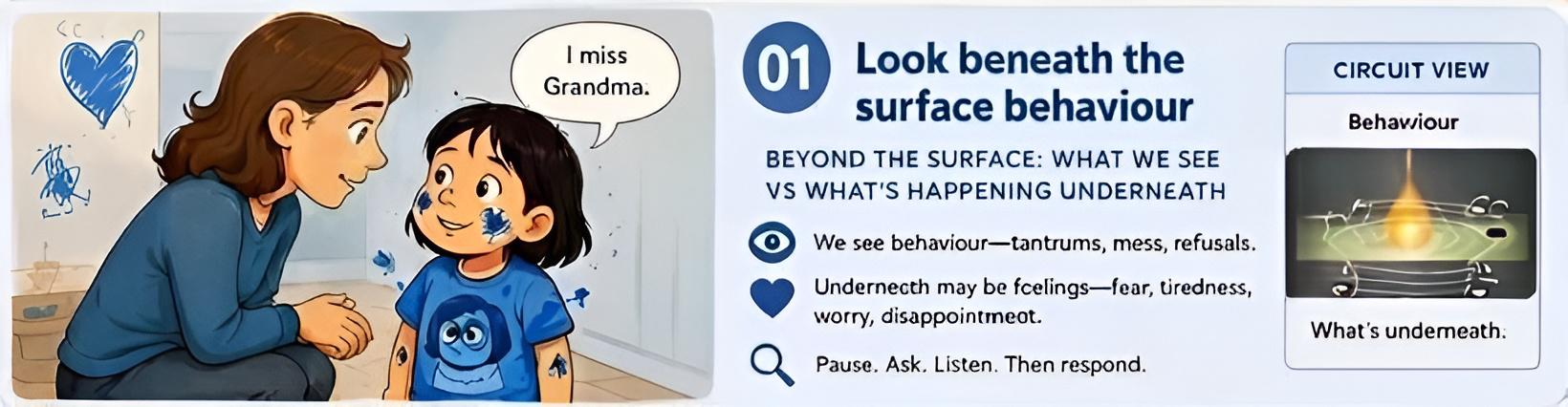
When we see a tantrum, refusal, or disobedience, we tend to react immediately:
“Stop shouting.”
“Listen to me.”
“How many times do I have to tell you?”
But what we see on the surface is rarely the whole story:
A child may be angry because they are tired.
A preschooler may melt down because a transition feels overwhelming.
An older child may snap at a parent after a difficult day at school.
Sometimes a seemingly small incident is the final trigger in a child who has been carrying frustration, disappointment, or worry for hours.
This is where the visual's idea of ‘what we see’ versus ‘what's happening underneath may be useful.
We see the behavior. But underneath it may be a feeling, a need, or an experience that we haven't noticed yet.
This doesn't mean that every difficult behavior has a hidden emotional cause. Understanding a feeling doesn't mean allowing inappropriate behavior.
A child can be upset and still need a boundary.
The difference is in how we respond.
Instead of thinking about how to stop a behavior, we can pause and then ask:
“What is my child trying to communicate?”
That small pause can change the interaction from immediate correction to curiosity and connection.
Parent takeaway: Pause. Ask. Listen. Then respond.
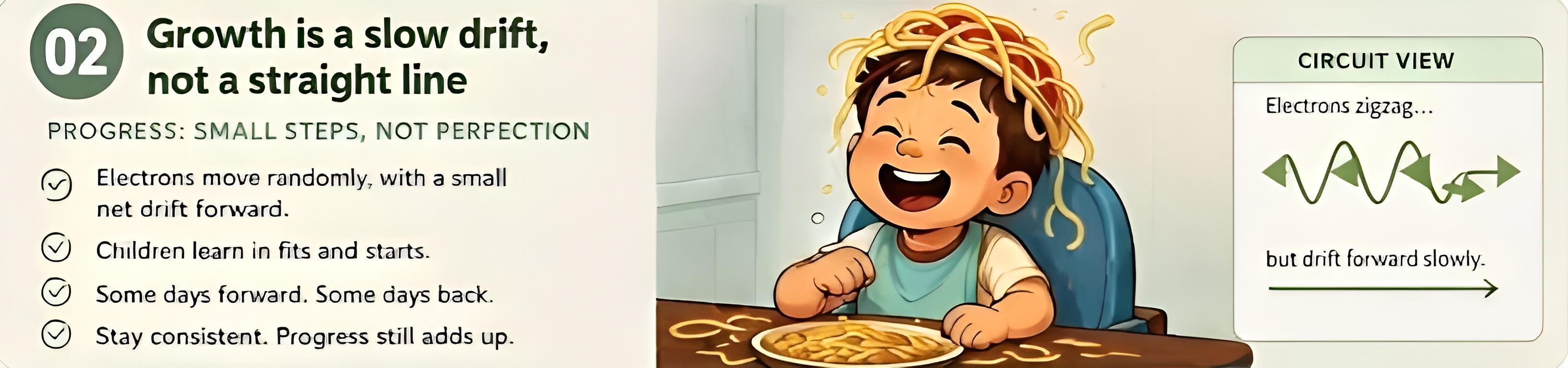
Parents often believe that progress happens in a straight line.
What really happens:
- Your child finally remembers to put away their toys. Great! Three days later, the toys are everywhere again.
- Your child has learnt to manage disappointment. Until one evening, they burst into tears over something seemingly trivial. Does that mean they haven't learnt the skill? Not necessarily.
The physics concept of drift velocity gives us an interesting metaphor. Electrons move within a conductor, showing a small overall drift in one direction.
Children's development can be much the same.
They learn, practice, forget, try again, and sometimes seem to go backwards. Progress depends on the child’s age, temperament, experience, context, and even how tired or overwhelmed they are on that day.
A child may manage something independently one day and need help with the same thing the next day. That doesn’t necessarily mean that progress has stopped.
So instead of expecting constant improvement, we can look for the small overall movement forward.
We usually think, “Why can't my child get this right yet?” Instead, try:
“What skill is my child still practicing?”
This shift can make parenting feel like helping our child grow.
Progress adds up over time, even when you cannot see it day to day.
Parent takeaway: Be consistent with love and boundaries. Over time, small steps forward lead to progress.
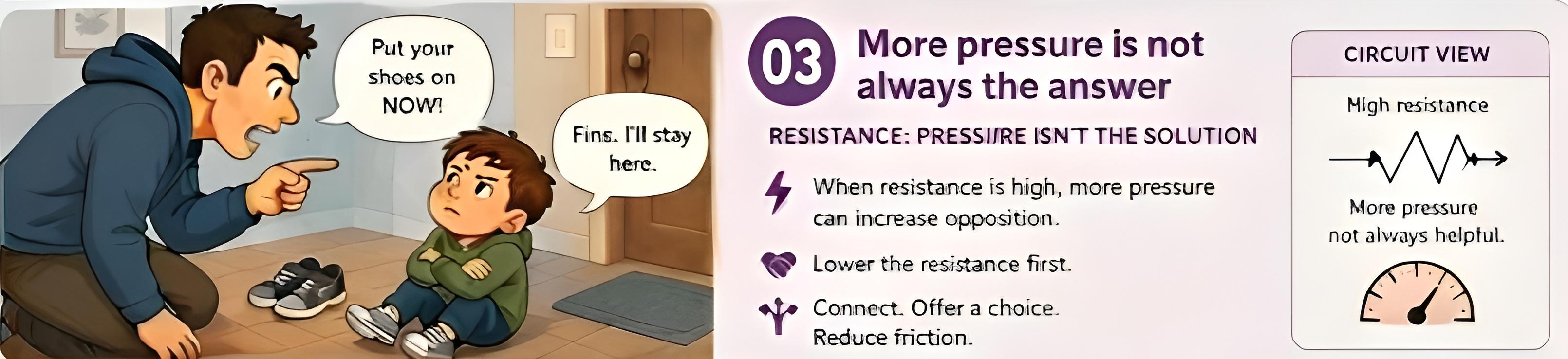
Ohm's law describes the relationship between voltage, current, and resistance.
What if your child refuses to put on their shoes when you're already late?
You repeat the instruction.
Then you raise your voice.
Then you threaten a consequence.
Your child resists even more.
Now both of you are frustrated.
Because when resistance is already high, more pressure may not be the best solution.
Instead, try to understand what is creating the resistance.
Is your child tired? Distracted? Struggling with a transition? Wanting some control? Finding the task difficult? Or simply refusing because they don't want to do what you've asked?
Sometimes reducing the friction can help.
Instead of using a threat:
“Put your shoes on NOW, or we're leaving!”
Try being supportive:
“Would you like to put your shoes on yourself, or shall I help you?”
Your child still needs to put on their shoes. But the limited choice gives them some control, and you still keep your expectation.
However, offering choices won't make every child cooperate because parenting has no formulas or guaranteed results.
But when resistance is high, is more pressure helpful, or does it create more opposition?
Parent takeaway: Lower the resistance first. Connect. Validate. Offer a choice. Reduce friction.
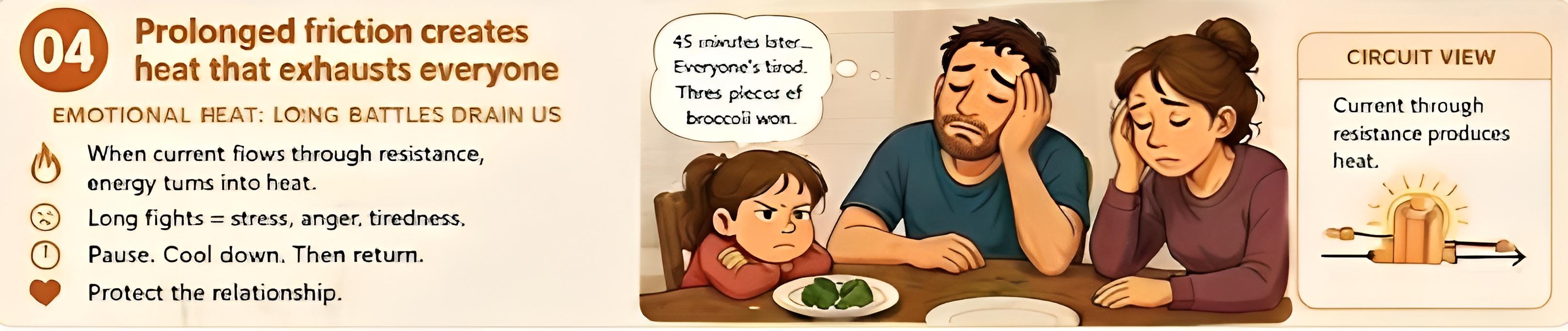
Have you ever had a five-minute disagreement with your child turn into a 45-minute battle?
Everyone is exhausted, voices are louder, and the original issue seems almost irrelevant.
The visual draws on Joule's heating law, which describes how electrical energy turns into heat when current flows through resistance.
As a parenting metaphor, it means that prolonged friction can leave everyone emotionally exhausted.
Rather than avoiding difficult conversations or giving in to a child’s protests, it means recognising when the battle is no longer helping. It’s about choosing our battles wisely while protecting the relationship and the boundaries.
Often, the most effective response is to pause and return to it when everyone is calmer: “We're both upset. Let's take a break and talk about this in a few minutes.”
Is the emotional heat worth the battle?
Parent takeaway: Pause. Cool down. Then return to the issue. Protect the relationship.
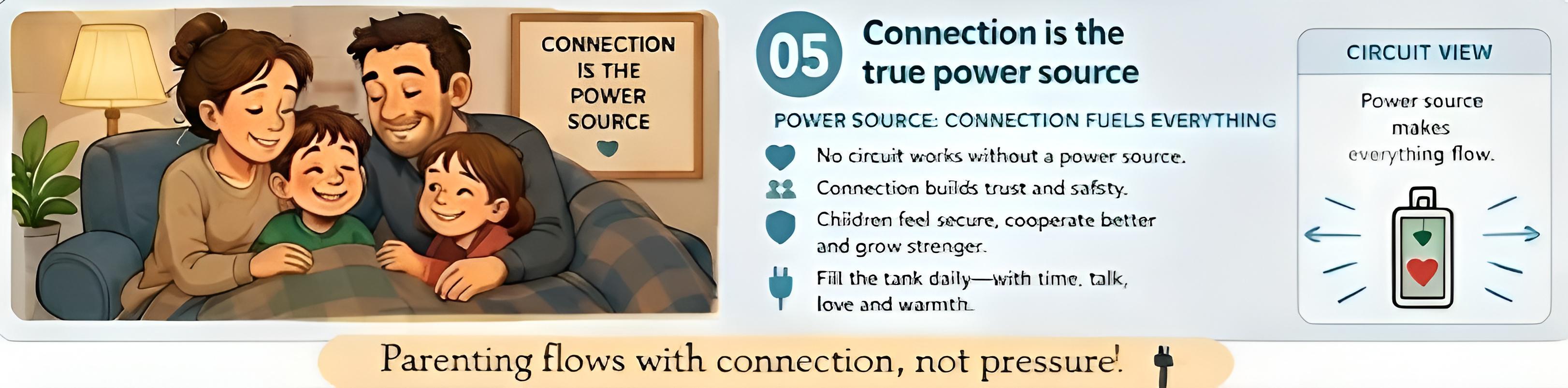
We’ve talked about resistance, pressure, and heat. Here’s the most important part of the circuit: Connection.
A circuit needs a power source for electrical energy to flow.
In family life, connection isn't literally a power source. But it is a useful metaphor for what helps children feel safe and supported.
Connections among family members are built in small, simple moments that build trust:
A conversation at bedtime.
A hug after a difficult day.
Listening without immediately correcting.
Sitting beside your child while they struggle with something.
Laughing together.
Saying, “I can see that you're upset. I'm here.”
These moments may seem small, but they build trust over time.
And connection doesn't mean saying yes to everything.
A parent can still understand feelings and maintain the boundary:
“I know you're angry, but I won't let you hit your sister.”
“I understand that you want more screen time, but the agreed time is over.”
“You're disappointed, and that's okay. The answer is still no.”
Parent takeaway: Fill the emotional tank daily with time, talk, love, and warmth. When children feel safe and understood, they're more likely to accept guidance.
Parenting will always have messy mornings, forgotten shoes, spilled food, homework battles, and tears over fruit being cut the ‘wrong way.’
The lesson electricity offers us is simple: What happens in one part of a system can affect the whole.
When we look beneath the surface of behaviour, reduce unnecessary pressure, pause, and connect, we can change how we move through the situation, together.
R Kalaivani holds an M.Tech degree and has over a decade of experience teaching Physics, Mathematics, and Science. As both an educator and a parent, she blends scientific principles with everyday parenting, showing how concepts like balance, inertia, and energy can bring calm and resilience to family life.
Need more information on Parenting? Trusted resources:
- UNICEF India – All About Positive Parenting
- American Academy of Pediatrics — What’s the Best Way to Discipline, My Child?
- American Academy of Pediatrics — Communication Dos and Don’ts
Is your child throwing frequent tantrums? Discover How To Handle Your Child's Temper Tantrums and turn challenging moments into opportunities for connection and positive parenting.
Published on: September 22, 2026


























Comments
Edit
Comment Flag
Cancel Update