
Important life skills that the pandemic is teaching our children
Aruna Raghuram
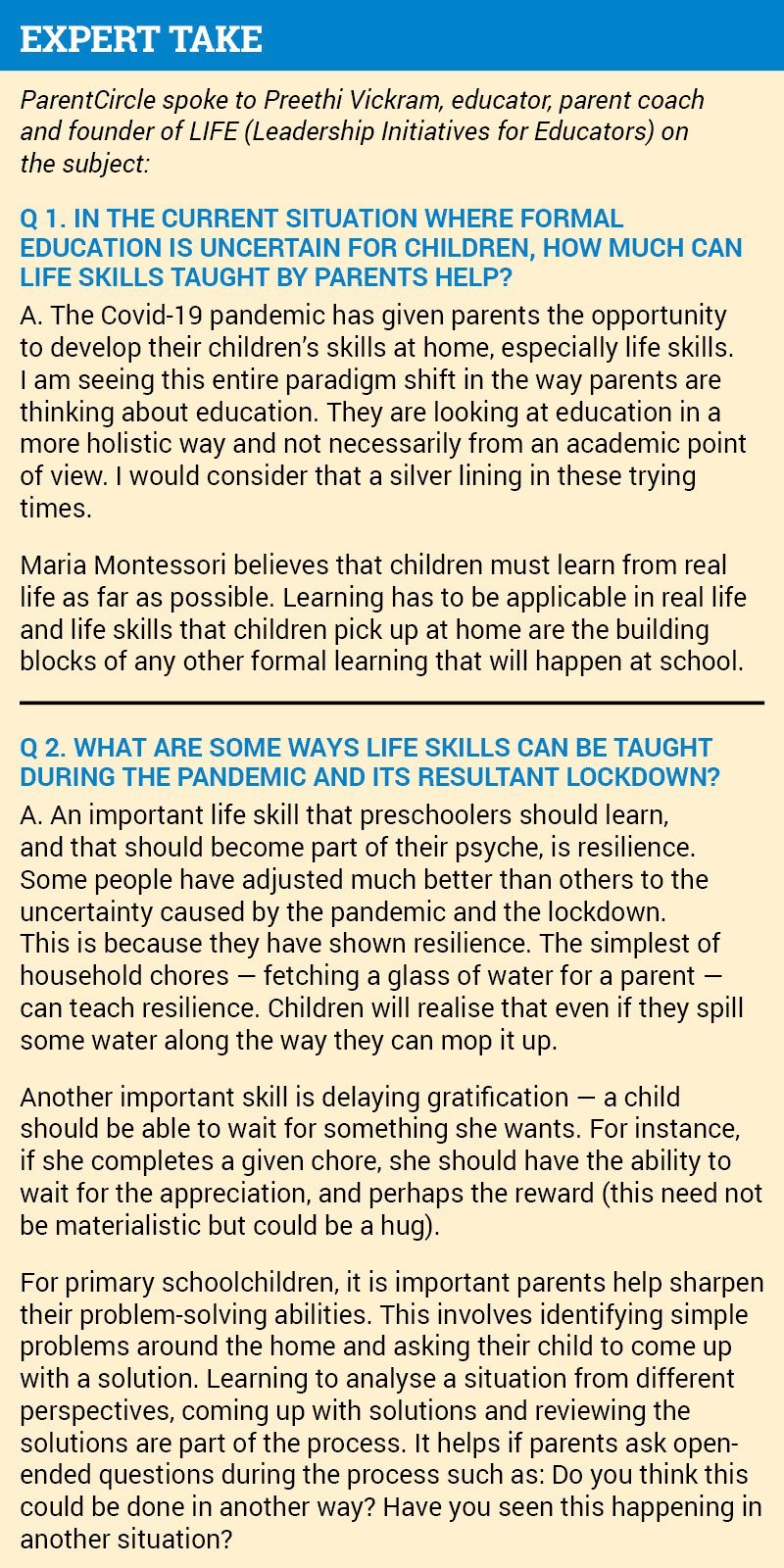
COVID-19 has thrown life into disarray. However, being responsible, valuing money, and bonding with loved ones are a few important life skills you can help your child learn in these uncertain times. Something to cheer about!
Nobody was prepared for something so life-changing. The Covid-19 pandemic and the resultant lockdown have affected us and our children in ways we never imagined before. Wearing masks, physical distancing from people, work from home, and no school has become the new normal. Giving a lot of importance to practicing hygiene and staying home as much as possible is the new mantra.
"All children want to see themselves as response-able, powerful, and able to respond to what needs to be done. They need this for their self-esteem, and for their lives to have meaning." - Dr Laura Markham, parenting expert and author
However, keeping children occupied when they are stuck at home without formal schooling and unable to play with friends is a huge task. But, a silver lining is that the pandemic is creating opportunities for our children to learn some very important life skills, which we can hone.
Why life skills are important |
According to the Harvard University Center on the Developing Child, core life skills are crucial for learning, development, and making healthy choices. "These core capabilities support our ability to focus, plan for and achieve goals, adapt to changing situations, and resist impulsive behaviors. No one is born with these skills; they are developed over time through coaching and practice," it says. |
Life skills children can learn in this pandemic
Formal education helps children acquire knowledge but may or may not equip them with essential life skills.
However, situations like the Covid-19 pandemic provides children with an opportunity to learn about life. Here are five important life skills that your child can learn during this lockdown with your help.
1. Dealing with uncertainty
In life, there will be several situations beyond our control, which bring us face to face with a great deal of uncertainty. Take, for example, the COVID-19 pandemic. We have no idea how long it will take for a surefire medical breakthrough to emerge in the form of a vaccine or successful treatment plan. Meanwhile, there's the fear of falling sick.
Here are three ways you can help your child deal with uncertainty:
- Set a routine: With the lockdown in place, there's no morning rush to go to school and there are no friends to play with, in the evenings. In fact, children's daily routines have changed. So, bringing some structure into their lives is important. Establish a routine that includes some study time and recreation, apart from exercise, healthy meals, and a fixed bedtime. If storytelling or reading to your preschooler is a bedtime ritual, ensure you maintain this practice. The certainty which a routine brings can help children cope with the overall uncertainty of the present time, and make them feel safer and less anxious.
- Focus on what can be controlled: Explain to your children that there are certain things they can control. For instance, they can protect themselves from contracting the disease by practicing hygiene. They could do this by washing their hands with soap and water, or by using a hand sanitizer frequently. Staying indoors and maintaining physical distance from friends is another way they can protect themselves.
- Practice mindfulness: Dr Jerry Bubrick, a clinical psychologist at the Child Mind Institute, suggests that parents should regularly practice mindfulness with their children. Mindfulness is all about focusing our thoughts on the present moment. Exercises that you can teach your children to promote mindfulness include being conscious of their breath; eating mindfully, that is paying attention to the smell, appearance, and taste of food; and coloring or listening to music with complete awareness and concentration.
2. Building resilience
Children, both young and old, can be affected by stress and anxiety brought on by the present situation. While older children may feel stressed listening to the news about the pandemic or talking to their friends, younger children may pick up anxiety cues from their parents. One of the important life skills children need to tide over adverse situations is resilience.
According to the American Psychological Association, building resilience the ability to adapt well to adversity, trauma, tragedy, threats, or even significant sources of stress can help our children manage stress and feelings of anxiety and uncertainty.
Here are three ways you can help your child build resilience:
- Books and play: Introduce your child to books and stories that deal with the concept of illness, death, and grief in a sensitive and age-appropriate manner. For instance, Charlotte's Web by EB White relates the story of a friendship between a pig and a spider. The Invisible String by Patrice Karst reassures children who are afraid of losing a loved one that there's an invisible string that connects us to those we love even when we're not near them.
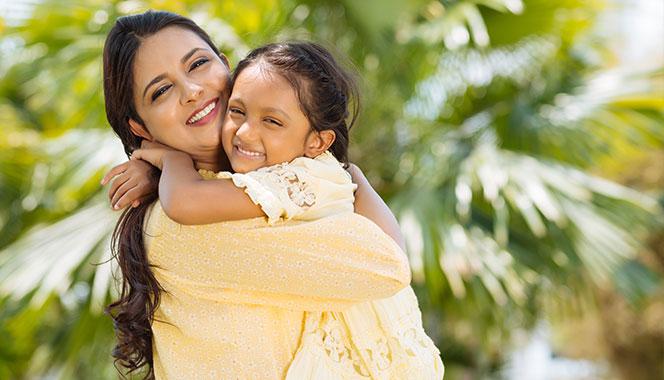
- Sense of security: During stressful times, it's vital that parents connect more with their children to make them feel loved and safe. Young children may express anxiety through pretend play and art. If you find your child showing signs of anxiety, connect with her by offering hugs and snuggles. Give her some special time during which you tune out all distractions.
- Positive outlook: Remind your child of the obstacles that he has overcome in the past. And the strength this has given him to handle future challenges. Also, help your child cultivate an optimistic outlook about the future, even in grim circumstances. Teach him to believe that this too shall pass. While it's important to give your child positive information about the pandemic, avoid empty reassurances. Get him to count his blessings. If you feel that belief in a higher power gives support during times of adversity, you could teach your child to pray.
3. Being responsible
A vital life skill your child needs to be independent is a sense of responsibility. So, stop doing things for your child when she becomes capable of doing it herself. For instance, resist the urge to put the buttons on your preschooler's sweater just because she takes time to complete the task. Allow your older child to cook a simple dish, even though she may make a mess in the kitchen, and make sure she's involved in clearing up as well. To ensure that your child feels accountable for her actions, tell her that there will be consequences if she shuns responsibility. Explain to her how being responsible involves keeping her promises and completing the tasks assigned to her.
Dr Laura Markham, parenting expert and author of Peaceful Parents, Happy Kids, in an exclusive conversation with ParentCircle, says: "All children want to see themselves as responsible, powerful, and able to respond to what needs to be done. They need this for their self-esteem, and for their lives to have meaning."
Here are three things you could do to make your child more responsible:
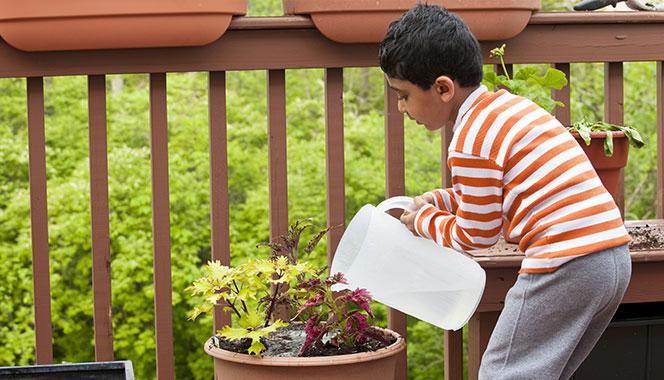
- Giving chores to do: You can teach your child to be responsible around the house by giving him age-appropriate chores. For instance, a preschooler could be asked to set the table, water the plants, fold clothes and help put away the groceries. Primary schoolers could help with cooking, doing the dishes, and helping with the laundry.
- Aiding self-reliance: You may be busier around the house in the absence of domestic help. So, seek help from your child. Some of the tasks you can ask your preschooler to do on her own include brushing her teeth, putting away her toys, and tidying up her room. If your child is studying in a primary school, you could ask her to try and make a snack for herself and develop the habit of independent study.
- Developing social responsibility: You can inculcate in your child a sense of appreciation for community members who are working to help others stay safe and healthy. These include doctors and nurses, policemen and security personnel, and people manning shops or delivering items to homes. Encourage your child to say a prayer for these helpers or make cards to post on social media.
In addition, you can help your child develop empathy and compassion by telling him about those less fortunate, who are struggling to cope with the pandemic. These include the homeless, the migrant workers trying to return to their native place, and the street vendors who have lost their livelihood.
4. Bonding with friends
While children are now spending more time with their parents, they are missing out on playing and interacting with their friends. In times of social distancing, maintaining friendships becomes a challenge. And this is a cause for concern for parents of shy children. Parents feel worried that staying away from peers can affect their children's socialization skills and make them withdrawn.
According to Dr. Nithya Poornima, a clinical psychologist from NIMHANS and a member of the ParentCircle Advisory Board, "Exposure to social situations is key to a child's social development, particularly for children who may have some vulnerabilities in terms of being shy or being hesitant for social interaction."
Using technology: You can help your child interact with her friends through phone calls and video calls. While excessive recourse to social media has its negative aspects, in the current situation, relaxing the rules a little would help keep friendships going and make your child feel connected to her peers. Here are three solutions:
- Closely supervised playdates: Parents have different views about how much time they want their children to spend interacting with other children. If you're okay with it, you could organize a play date at the park where your child's friends and their parents come for a walk, while maintaining a physical distance.
- Becoming their friend: Be available more than ever to talk and play with your child to help her deal with loneliness. In the current situation, when there are restrictions on peer play, you can step in and try to fill the vacuum. You can pretend to play with your child or make a video about your family. The idea is to help your child use her imagination, burn off her energy and keep herself in good shape, physically and emotionally.
5. Valuing money
During the Great Depression, children learned to become careful about spending. The pandemic may do the same. Some children may see their parents facing job uncertainty, and feel financially insecure. Because you don't want your child to link financial uncertainty to fear, reassure him, but give a realistic picture. Here are three simple financial lessons you could teach your child at this time:
- Distinguishing between needs and wants: Children can be taught this difference from an early age. Ask your child to make a list of her needs and wants (or give her a Needs Vs Wants coloring sheet). While you buy her what she needs, you can ask her to review her wants after a week. By then, she may not want a particular toy or dress. This way, she could learn about spending judiciously.
- Understanding the value of saving: Involve your child in making decisions such as cooking at home instead of ordering food. You could also buy him a piggy bank and tell him stories from books such as Bunny Money or The Berenstain Bears Trouble with Money. This will help him learn the importance of saving.
- Living within your means: Your child should know that she should be careful about spending money, especially during uncertain times, as it may be needed in the future. To teach her how to spend and save, you could involve her in preparing a weekly budget and playing board games like Monopoly.
Parents speak
Aarthi Prabhakaran is a mother to a 12-year-old and an 8-year-old, and a consultant enabling content strategies for start-ups.
"We helped our children pick up three life skills during the lockdown.
Sharing domestic chores: I insisted that the entire family get involved more actively in cleaning the home and doing the laundry and the dishes.
Sustainable and minimalist living: Lockdown gave us the time to review our buying and consumption patterns. Our purchases have been minimal, only essentials. Restaurant orders were almost negligible. The kids learned to reuse (worn-out clothes as cleaning towels) and recycle (segregate plastics). We also experimented more with our home garden to source our own food.
Online etiquette: As many schools have now started online classes for all ages, we had to gear up to learn and teach our children the basics of online etiquette. We had to learn to navigate applications such as Microsoft Team, Google Meet, and Zoom and understand the nuances of using headsets/speakers, how to mute/unmute appropriately, etc."
Archana Mohan, the mother of a 9-year-old and a 4-year-old, and co-founder of a children's content company, Bookosmia (Bengaluru), shares her experience of teaching her children to find joy in doing nothing.
"As parents, we are constantly reminded to keep our children meaningfully engaged during the summer vacation. So, from February, I had my children's vacation all planned out. There was to be a cricket camp, a book club, art and swimming classes. With no classes to attend and nowhere to go, my children learned that it's okay to do nothing.
Mornings meant gardening and fighting over whose hand-painted T-shirt was better. My children were suddenly hooked to the MasterChef tv show and wanted to take part in cooking. Sometimes, the dishes were done by tiny hands. What fun it was to feel the soapy bubbles and running water! Watching birds fly by, doing a goofy dance with cousins on a video call all these moments of doing nothing brought the joy of something. The joy of a repository of precious memories that no fancy skill-building class can ever match."
For now, your little ones are stuck at home. Instead of agonizing over how to keep them occupied, take this opportunity to inculcate important life skills in them.
In a nutshell
|
What you could do right away
- You may be busy juggling domestic chores with work from home. Still, set aside some amount of time every day to become your child's playmate.
- Stop tidying up after your child. Involve your children in cleaning up by playing games or making up fun challenges (I bet you can't put all the blocks in the basket faster than me!)
- Get your child transparent containers in which he can keep his allowance for spending, saving, or giving to someone who needs it more.


























Comments
Edit
Comment Flag
Cancel Update