
Lockdown Effects: Your Child Doesn't Want To Socialize? Here's What You Can Do
Team ParentCircle
Children are having a hard time socializing because of the social isolation during the pandemic. Arundhati Swamy, family counselor and head of Parent Engagement Programme at ParentCircle, offers guidance on how you can help your child build social skills
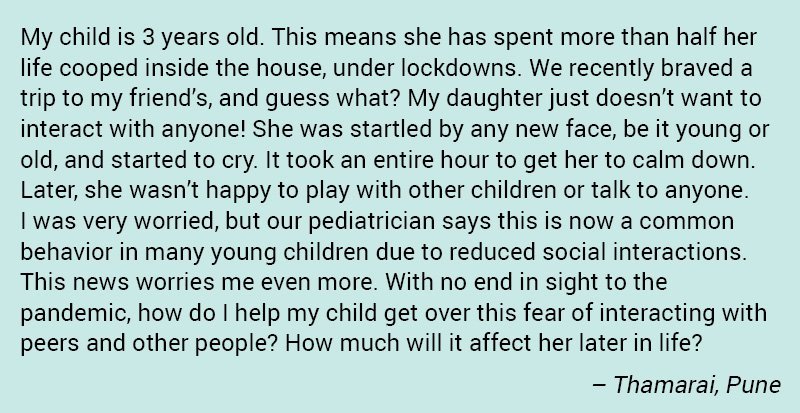
Thamarai, visiting a friend after a year-and-a-half of social distancing must have filled you with anticipation and excitement. There was so much to look forward to—the joy of having a good time and your child playing with other children. Little did you expect to return home disappointed and worried. Why did she have such a hard time? Why did she have to cry so much?
Perhaps the answers to these questions will emerge as we try to understand what has been happening to children because of safety norms and social distancing. For instance, the last time you took your child out, she was probably around 2 years old. At that age, in the company of people, she would normally have learnt to:
- Imitate older children and adults
- Play alongside but not necessarily with other children
- Become more aware of herself around other people
From 3 years onward, your child would have been able to:
- Separate easily from you and make friends
- Feel affection for a friend
- Feel worried when a friend is hurt or upset
- Understand the differences between me and you, and mine and yours
Deprived of these normal developments, it's hard for children to suddenly adapt to new social situations.
Introduce family and friends to your child through photographs
Here are a few interesting activities to help your child bridge the gaps in their social development:
Begin at home
- Enact social scenarios to help your child learn how to greet people. Here are some simple statements that eventually lead to conversations:
- Hello, my name is__________. What's your name?
- Can I play with you?
- May I use the washroom?
- Play simple games that involve taking turns. Your child will learn social skills, such as following the rules, being patient while they await their turn, and being cooperative.
- Introduce family and friends to your child through photographs. Mention their names, say something striking about each person to help your child remember them.
- Have regular video calls with family members and friends with kids. Even if your child doesn't interact, ask her later what she thought of the people in the video. This will help her observe how people interact with each other in friendly ways.
Prepare your child for a new social visit
- Talk to your child about what to expect and who they'll be meeting. Show pictures or have a video call to familiarize her with the people you will be visiting. Talk about the different things your child can do during the visit. You can discuss how to greet your host. Reassure her that she can be with you till she feels comfortable mingling with other people.
- Prepare your host. Discuss your upcoming visit and share some of your child's interests with them, such as the toys she may like and what she likes to eat or do. Help them with tips on how they can approach your child.
- Encourage your child to talk about the previous visit. Talking about it in her own little way will let you know why she felt uncomfortable. Validate her feelings of fear and awkwardness.
- Take walks in your neighborhood. Draw her attention to the children and people while describing what they're doing.
- Take your child for a social visit when you sense that she's becoming comfortable with new people.
- Reassure your child that you'll accept whatever she chooses to do during the visit, that you understand she needs the time and space to feel comfortable.
Allow your child to take gradual steps to connect with people—smiling at people, greeting them, moving away from you occasionally, going up to another child to watch them play, and returning to you frequently.
Be supportive during the visit
- Give your child time to get used to the new physical environment and the people.
- Allow your child to feel comfortable, even if it means letting her stick to your side all the time. Let her watch the interactions with people.
- Stay connected with your child. Make eye contact with her often, hold her hand, and smile at her.
- Be attentive to her. Ask her if she needs anything— a drink of water, something to eat, or to use the washroom. It shows you're being supportive.
- Allow your child to take gradual steps to connect with people—smiling at people, greeting them, moving away from you occasionally, going up to another child to watch her play, returning to you frequently. You never know when she might start conversing with someone.
- Keep the visit short. Ask if she's ready to leave or if she wishes to stay a little longer. Respect her decision. It helps build her trust in you.
- Help your child talk about the experience when you get back home—what she liked and did not like about the visit.
Children are resilient. Given the right support, they'll make up for the deficit in their social skills. Curious and social by nature, children will seek opportunities to meet their basic need for human interaction. Thamarai, we do hope your child and all other children will soon look forward to having playdates and more!





























Comments
Edit
Comment Flag
Cancel Update