
Raising A Confident Child: Seven Things Parents Do That Can Hurt Their Child's Self-esteem
 Arundhati Swamy 6 Mins Read
 Arundhati Swamy
Mother, grandmother, family and school counsellor
Sometimes, your well-intentioned words and actions harm your child's self-esteem. This article explores seven common parenting behaviors that may hurt your child's confidence and offers practical tips to nurture a strong sense of self-worth

A festival story: How criticism can hurt a child’s confidence
14-year-old Anu, excited about the upcoming festival, is enthusiastically helping her mother prepare some goodies. Although there isn't much conversation between them, the festive air, with things to be done, creates a warm atmosphere. Anu's mother rolls the dough into perfect circles, carefully folds, and presses down the edges after placing the stuffing on one side. Anu uses the cutter, attempting to give it a neat edge. Tch, tch, tch, come the sounds of disapproval from her mother. You must make it perfect. It looks out of shape. Let me do it. In that split moment, Anu's heart sinks as she mutters, "I can never get anything right." With a tone of despair, she asks, "Why should everything be so perfect?" Her mother quietly continues to do her task while Anu, who is now fearful of making more mistakes, continues to help her. The harmonious atmosphere is destroyed by memories that trigger a flood of emotions, as Anu recalls similar instances of criticism throughout her growing years. She now feels low and inadequate.
What started as an enjoyable experience for mother and daughter ended up being stressful for Anu. For the mother, the quality of the task became more important than bonding with her child.
What self-esteem really means for children
Self-esteem is a broad term used to describe how confident we feel about ourselves in terms of our worth, abilities, and attitude towards ourselves.
Early childhood: Building blocks of self-esteem
In the early years, the foundation for good self-esteem is laid with the building blocks of experiences and emotions, and how your child makes sense of them—what your child thinks and feels about themself. These thoughts and feelings become cemented with adult and peer responses—what others think and feel about them.
Why your approval shapes your child’s emotional growth
Simultaneously, your child is experiencing some very important emotional developments. They are beginning to know what guilt and shame feel like because they now seek your approval and acceptance. They're getting to know what is important to you and do things to please you. Your attitude toward other children or siblings, competition, and achievement will further determine how your child's self-esteem develops. Experiences with adults and peers at school also strongly influence your child's self-esteem.
How children form beliefs about themselves
From now on, their goal is to master their world by learning new things, understanding and becoming familiar with people and tasks, and above all, feeling capable of functioning well. They are developing deep-rooted beliefs about themself, based upon the emotions they experience when you and others interact with them.
The role of positive experiences in brain development
Beliefs are the soil in which the roots of self-esteem are nourished. A positive belief in self (for example, I sing well, I am a helpful child) develops when your child experiences joy, comfort, acceptance, and appreciation during an event or experience. A negative belief forms when they experience sadness, humiliation, and embarrassment in front of other people (for example, I am stupid, people make fun of me).
These beliefs continue to play out in your child's life. Young children are more likely to accept and believe the comments others make about them because their reasoning abilities are just developing. These experiences alter the structures in her brain. Each experience activates neurons, thus building more connections between various parts of their brain. That's how their brain is getting rewired. Encouraging words and appreciating her every effort will show her that she is loved, trusted, and believed in, thus wiring their brain with positive neural networks and positive beliefs.
Core beliefs that strengthen a child’s self-esteem
Self-esteem is the result of experiences that help your child become resilient, optimistic, and ready to seize opportunities. Self-esteem in your child is built on the following beliefs:
- Capable: I can - I am learning to do many things on my own. I know my parents will always help me learn.
- Efficient: I try - Good things happen when I work hard at something. I learn how it works. I feel nice.
- Acceptance: I am safe - I like myself because my parents and teachers like me, and I like them. They take care of me. They help me too.
Parenting with love and boundaries to nurture confidence
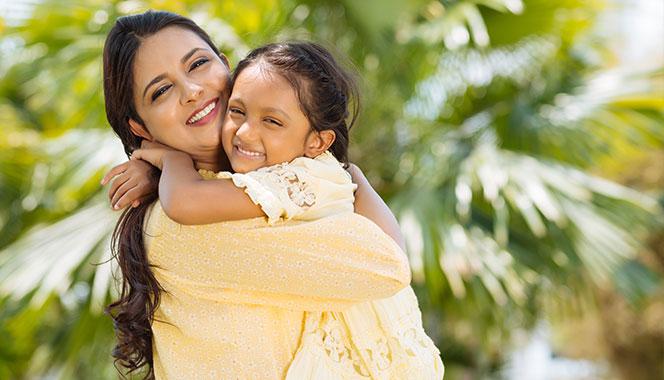
Your love and attention nurture your child's growth. How these are expressed can either make or break their self-esteem. Parental love and attention must enable a child's growth and abilities. The physical, emotional, social, and cognitive boundaries drawn by you must expand as your child grows. This process allows your child to feel a sense of adventure and challenge, experience setbacks, and take reasonable risks—all of which contribute to building self-esteem. Self-confidence grows when they overcome hurdles, see the rewards of their efforts, celebrate victories, and accept defeats.
The harm of overprotective or controlling parenting
However, you could end up hurting your child if you are overprotective or too controlling of your child. When you overprotect your child, you cause them to feel fearful and anxious, which makes them timid and vulnerable to bullying. As a 'controlling' parent, you could make your child feel suppressed and frustrated, and become passive and irritable. These negative feelings rob your child of enthusiasm and the courage to explore, learn, and experience new things.
7 common parenting behaviors that damage a child's self-esteem
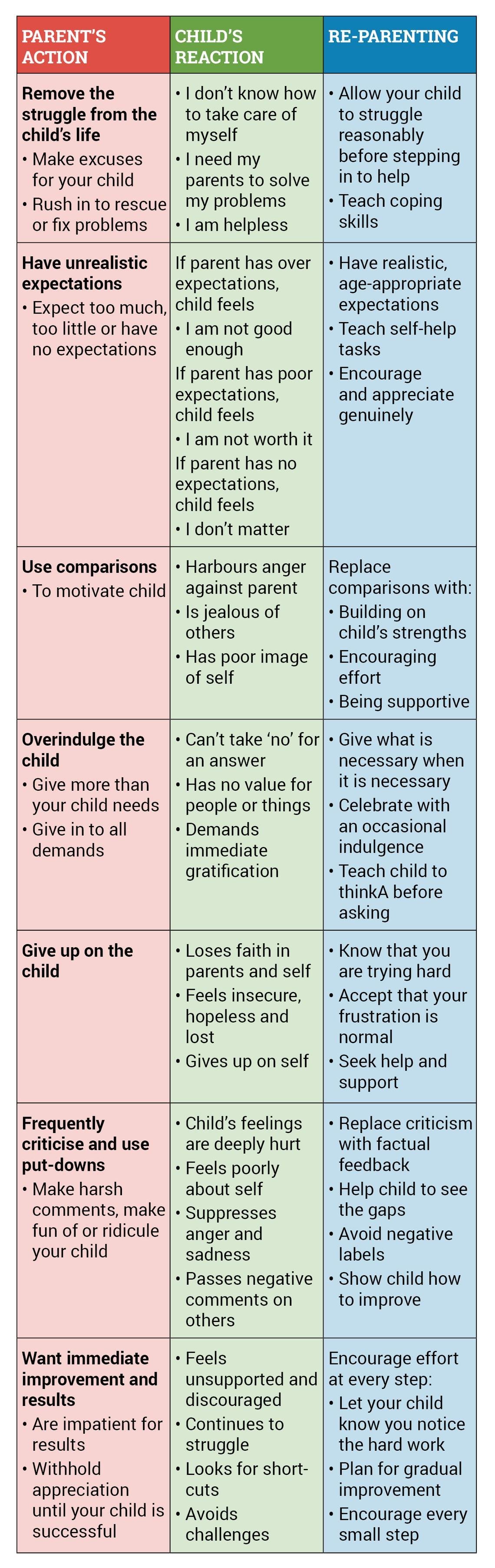
Why strong self-esteem sets children up for success in life
When children feel good about themselves, it sets them up for success in school, in friendships, and in life. Positive feelings like self-acceptance and self-confidence help them try new challenges and cope with mistakes, and more willing to try again. Taking pride in their abilities and accomplishments helps them do their best. Although children may show reluctance and resentment while being corrected, reprimanded, and guided, they depend on you to do what is in their best interest. So, do the right thing with respect, compassion, firmness, and most importantly, with help from your positive self-esteem.
Last updated on: September 17, 2025
The Dot social emotional learning program is designed to help each child feel emotionally safe and ready to learn. The program also helps children learn how to manage their emotions and behaviours in different situations. The SEL program builds self-acceptance, confidence, resilience, and a growth mindset in young children.


























Comments
Edit
Comment Flag
Cancel Update