
‘The Games Families Play Connect Them’: The Impact Of Traditional Games On Children And Adults
Team ParentCircle
ParentCircle empowers parents to raise successful children through holistic parenting.
Vinita Sidhartha of Kreeda has made it her life’s mission to recreate traditional games for today’s generation because she believes it’s the games we all play as children that help us bond better with our families and also help us grow into sorted adults
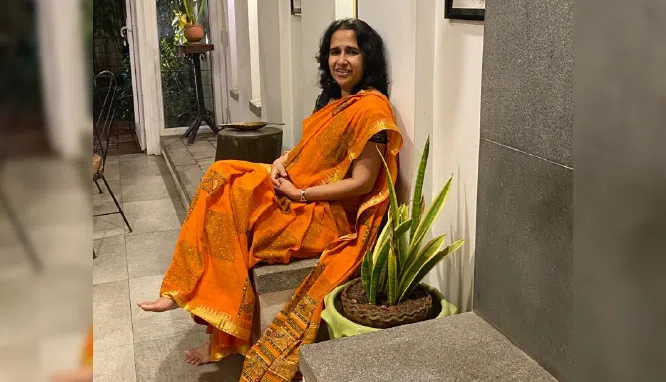
It’s a busy day for Vinita Sidhartha. Her phone’s ringing incessantly as we wait for our cameraman to set up the lighting. With a wry smile, she tells us it’s “one of those days” in her office where she has to deal with too many things. But she pauses her battle with office crises as she puts her phone firmly away, and we begin to chat.
We come to know that Vinita was almost at the top of the corporate ladder when she decided she wanted to do something more meaningful and took a break. A mother of two, Vinita is not just the founder of Kreeda, an organization dedicated to reviving traditional games, she has also conceived and runs the Petralthan Pillaiya Trust (in Tamil, it means you don’t have to give birth to have a child, all children are our children), a joint effort by award-winning actor Kamal Haasan and Hello FM’s Rajeev Nambiar. It is an initiative to help children.
Vinita has also worked with many international NGOs like the Richard Gere Foundation, Save the Children, and Care India, and works for a medley of causes such as women’s empowerment, children’s education, craft preservation, and the environment. All this is apart from heading the marketing and HR of an IT solutions company, and researching and recreating traditional games! Whew, no wonder her phone’s ringing off the table!
“But,” she smiles, “Kreeda is my passion. Who knows how many forgotten games are out there, waiting to be discovered? Who played them? Why? How? All this is so exciting!”
Thus begins our hour-long conversation about traditional Indian board games, her book on the same subject, and how playing together as a family is the key to a happy family. Here are excerpts from the conversation.
Q: Traditional games are rather unique to specialize in. How did it all start?
A: I think it all started when my grandmother began to babysit my children. My husband and I used to head off to work, and there she was, our kids’ great-grandmother, with an 80-year age gap between them, effortlessly keeping them engaged with games. Our children loved to visit her—they enjoyed playing with her. And then I did a series of articles for The Hindu on traditional games, and people started calling me, asking, “How to play this game?” or “Have you heard of this one?” I was at a crossroads in my corp comm career, so I decided to take a break and see what was next. To keep myself busy, I decided to research and recreate half a dozen traditional games. I didn’t think anyone would buy them, but they were a hit, and Kreeda was born.
Q: You have also written a book 'Just Play', which is full of insights into how playing traditional games impacts children and adults.
A: The book is about life lessons one can learn from these traditional games. Our ancestors, who created these games, put a lot of thought into them—a fact I realized when I started researching these games. Just Play is about how to play these traditional games, the rules, etc. But it’s also about why these games of yore are very relevant today and why we must preserve them for future generations.
Q: So, you are saying that just by playing these traditional games, children and adults can learn a lot of things?
A: That’s true of any game, not just traditional games. Traditional games, of course, have their inherent advantages.
Q: Such as?
A: All games are responses to the environment in which they are born. For example, if you were to take Monopoly, it’s a response to people’s need to build, construct, and own property, say, a hundred years ago. Today, there are video games that are fantasy-driven, giving in to the need to escape from the daily world. But the traditional games came at a time when life was much simpler. There were fewer trappings, so they reflected basic human desires, feelings, and elements. This is what makes traditional games special and different—their elemental qualities like the desire for good to triumph over evil, to win something simple, like a race, or who got there first. To play and win such a game, it doesn’t matter whether I’m educated or not, or what language I speak.
During the recent Chess Olympiad (2022) in Chennai, we showcased our games, and people from different countries, many of them not speaking the same language, were able to play the games together, and that’s what makes these games very special. Also, when I say traditional Indian games, it does not necessarily mean these games are unique to India. It just means they were played traditionally in India. If you were to research, you’ll find that there have been similar games in other parts of the world. Did they get exchanged via trade routes? Or did they spring up individually in other parts of the world as well? We will never know, and this makes it even more special because people in different cultures have played the same type of games with similar rules and goals and have been enjoyed, too. Our food, clothing, language, and lifestyle are all different, but the games we play are the same. We are united by our games, and that to me is an extraordinary thing.
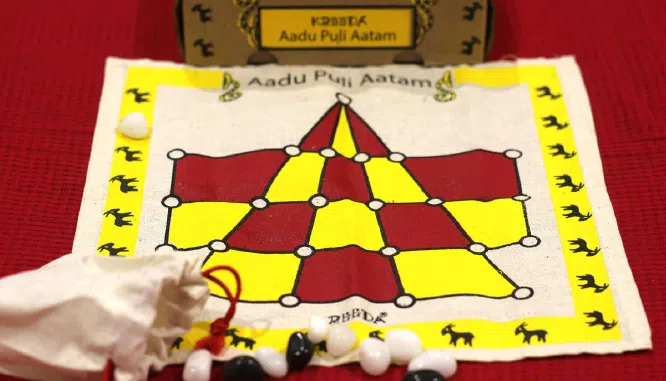 Picture courtesy: https://kreedagames.com/
Q: Today, in popular toy stores, games are categorized by age group. Is there something like that for traditional games? Like, say, one game is meant for 5-year-olds while another is for adults.
A: I don’t think anything like that ever existed. Traditionally, families played together, and that automatically included people of all ages. Maybe some games were more complex, but the children were sitting right there, watching. Some games may have been meant for children, but adults were right there, telling the child “Don’t do this” or “Play like this.” And most of these games were above age classifications. Of course, there are some games that a very young child may not be able to play, some games the teen may find a little silly, but at the end of the day, it depends on your nature. I see 5-year-olds playing chess today, and if they can play chess, they can play most of our traditional games.
Q: In your book, you speak about life lessons one can learn while playing these traditional games. So, what are those life lessons exactly?
A: There’s a whole range, it goes from simple things like making decisions and deciding how you are going to approach the game to team building, goal setting, and social interaction. The best part is, when you play a game if you make a mistake, there are no lasting consequences, whereas if you make that same mistake in life, there are lasting consequences. So, games give you a temporary space where you can experiment, try different approaches and strategies, and see how comfortable you are with different things. And that hones your ability to think and plan even in day-to-day life. I think that’s what these games give you—the ability to jump into the world of the game, focus, play the game, and win or lose. And if you lose, you can revisit the exact same scenario again and again, till you get it right and win!
Q: But how does a parent or a child know that they are learning life lessons while they are playing the game? Is there something that the parent has to do while the child is playing? Do you merely observe them making mistakes, or intervene?
A: Some of the best lessons are those that are not taught but learned intrinsically. That’s true of the games as well—most of these games build something into you intrinsically. There’s no reason to intervene, or say, “Oh, you learned this.” But you can always draw parallels later, as you talk as a family, to a certain game, and how the same strategy can be applied to a real-life scenario. It’s like telling a child a story without harping on the moral, letting them discover the moral for themselves. Our forefathers did not sit with a rule book to play these games—they just created and played, and many things were learned along the way.
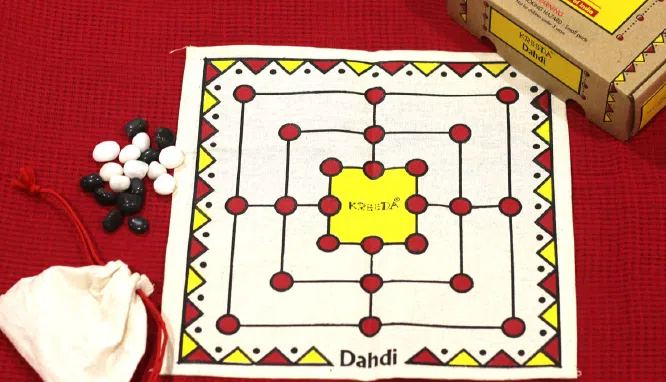 Picture courtesy: https://kreedagames.com/
Q: So, how important is playing in a child’s life to learn these kinds of concepts?
A: Play is very important not just in a child’s life but in everybody’s life, and sadly, adults have forgotten how to play. Also, in today’s world, even children’s play is too structured. A child plays a great game of chess, and they are immediately bundled off to chess classes, or they hit two good balls and it’s cricket coaching for them. I’m not saying those games don’t have their place. I think unstructured play, where you just sit and have a ball, is very important, too. It doesn’t matter whether you play by the rules or modify the rules. Some kids will even cheat a little, and someone will catch them—all this is a part of growing up. Today, we ascribe too much importance to some of these things, like if you cheat today, you are going to be a cheater in life. No, that’s how you experiment with life, and I think unstructured play is critical to everybody’s life goals.
Q: Board games, video games—all these bring out children’s competitive streak. Do you think that’s okay?
A: What’s wrong? Children live in a competitive world, we can’t shield them from competition forever. And just because I lose at one thing doesn’t make me a bad person, and that’s the most important lesson that today’s children should learn. There’s this poem called ‘Sportsman’s Prayer’—a beautiful poem that says if I win, let it be deserved, and should I lose, let me stand by the road and cheer as the winners go by. Such a lovely lesson for children. And this is the beauty of traditional games—if I lose here, I can win somewhere else because there’s a game for everyone. There are games based on mental strategy, physical prowess, skill games based on concentration, and dice games for the dexterous … And since these are mostly played in informal family settings, there’s always the next round to win! Knowing this encourages healthy competition.
More than the children, today’s parents freak out if their children lose at anything. The parents and the system they grew up in are to be blamed for this. Everyone can’t be a Viswanathan Anand a Sachin Tendulkar or a Lionel Messi. Even they have made mistakes. Look at Morocco in the FIFA World Cup 2022—they lost, but everyone cheered for them because they played a fabulous game. So, there’s honor in being a good loser as well, and parents should know it’s okay if they didn’t get that job or the promotion, or if their child lost a simple game of cards.
Q: So, yes, play is important for children’s development. But what about families playing together?
A: Psychologists believe that shared experiences build better rapport, and foster bonding and interpersonal connections. A game played together is a shared experience. It’s not the same as doing other things—let’s say you go to a movie together as a family. Your enjoyment of the outing as a family is defined by the movie once the lights are out. But let’s say we choose to play a game together—if I play with you, I enjoy it differently, if I play with my grandmother or son, it’s a different thing altogether. So, the way you enjoy a game changes with who you play it with. And that’s what makes playing a game together a part of a very unique relationship. It’s a memory that will be forever with you.
Close your eyes and think of a memory of play —I’m sure all of them will be about having fun, laughing, teasing, or fighting, with a friend or a cousin, sibling, father, or mother. This memory will connect us wherever in the world we are. Many parents tell me, “Oh, my son is always on the computer. If I give him this game, he won’t play it.” I always tell them, “Don’t give it to them, saying ‘Go play.’ Say, ‘Come and play with me.’” It’s easier to plop our children in front of the TV when it suits us, but then we complain they’re watching too much TV. Just like we introduced them to mobile phones, iPads, computers, or television, it’s up to us to introduce them to other fun things.
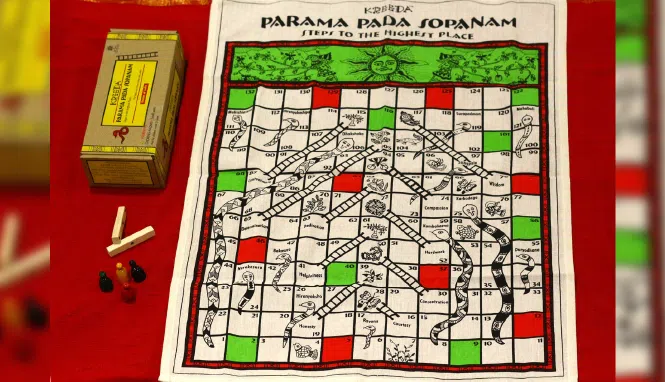 Picture courtesy: https://kreedagames.com/
Playing a game with your child also makes them realize their parents are not always old and wise—the child starts to think, “Oh, my parents fight like me, they play like me.” This makes you more approachable, and more open. It’s true for other family members, too. So, yes, playing together is critical to family bonding and deepens their love for each other.
Q: So, playing together can open up conversations, and make it easier for families to stay connected forever.
A: Of course. You yell at your kid in the morning and then you play with the kid in the evening, and the child forgets that yelling. We must remember, we are all villains in our children’s eyes sometimes. So it’s good to have those good times to set off the “villainy” that we practice as parents (laughs).
Vinita’s vintage picksShe professes equal love for all the games in Kreeda’s collection, but we get Vinita to pick a few for our readers. For family bonding: All traditional games For strategic thinking: Aadu Puli Aatam (also known as Bagh Aur Bakri, The Tiger and the Goat) For a 5-year-old: Parama Pada Sopanam (a traditional version of the Snakes and Ladders game). In the traditional game, every snake represents a vice and every ladder, a virtue. As you play, you narrate different stories. This game has many versions—in Andhra Pradesh, they call it Vaikuntapali, up north it’s known as Gyan Chaupar. The higher you go, the more virtues you gather. For mental development: Dahdi. It’s a three-in-a-row game (like Tic-Tac-Toe or Nine Men’s Morris in the West). Dahdi is fairly complex—you have to get multiple sets of three in a row. The game requires the players to look at the big picture and strategize, as once you get three in a row, you also get to remove one game piece of the opponent. The players have to parallelly process multiple things. |
























Comments
Edit
Comment Flag
Cancel Update