Explore traditional Indian games for children. Build fitness, focus, and social skills while keeping heritage alive through fun, engaging play
We have all played a few Indian traditional games when we were young. But, how many traditional games of India do our children play or know about?
Sadly, in today's age, children are constantly glued to the television and electronic gadgets. Let's learn about a few traditional Indian games, how to play them with your child, and their benefits.
1. Pallanguzhi
History
This game is believed to have originated during the Chola dynasty in South India. It is also referred to as Channe Mane in Karnataka.
This two-player strategic game involves counting pieces (stones, seeds, or beans) and placing them into holes/cups on a board or pits in the earth. The pallanguzhi board consists of 7 holes/cups in 2 rows. In both rows, the cup at the center is called Kasi.
The objective of the game is to capture as many pieces.
How it is played - From their collection of shells, players fill each cup with 12 shells except the Kasi, which remains empty.
- The player who starts the game picks all the shells from a cup on their side of the board. They then drop 1 shell in each cup, moving clockwise.
- Once they have finished dropping the last shell, they pick the shells from the next cup and repeat the process. If the last shell falls in the Kasi, then the shells in the cup next to the Kasi are earned by the player.
- The player then continues to play by picking up the shells from the next cup.
- If the last shell falls in a cup with only 2 shells, the player's turn is over, and the next player's turn begins.
- Once a round is over, the players take shells from their collection, fill the cups with 12 shells, and begin again.
|
Benefits
- Helps children learn to count
- Boosts memory and observation skills
- Improves hand-eye coordination skills
2. Pachisi
History
This is a very old game, believed to be India's national board game. It finds mention even in our history and mythology, with a legend indicating that the Pandavas and the Kauravas played this game in the Mahabharata.
The name Pachisi is based on the number 25 (called pachis in Hindi), which is the highest score a player can earn in the game.
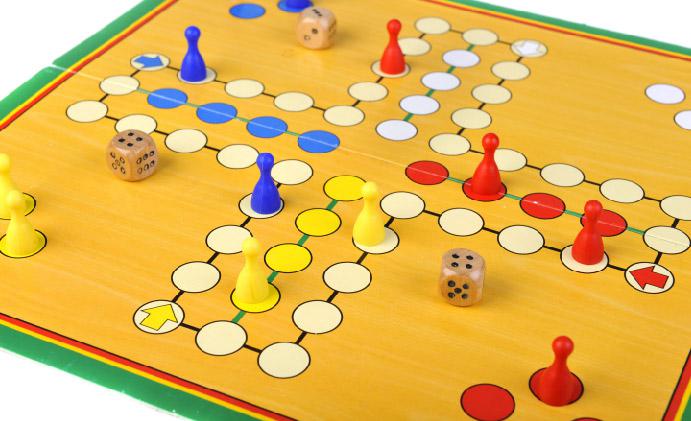
The game is played with 4 players, with 2 players on each team. The partners sit opposite each other. The Pachisi board has 4 arms that meet at the center. The center is called Charkoni.
On each arm, there are 3 rows of 8 squares. One square in each row has a different color to indicate that this is a Castle. The game is played with shells or pieces of different colors. Each player has 4 pieces; so, there are a total of 16 pieces among 4 players. Partners can take pieces of the same color or different colors.
The teams aim to move their 8 pieces through the arms of the board and then re-enter the Charkoni.
How it is played - The players begin the game by keeping their pieces in the Charkoni and rolling the dice.
- The first piece is moved to the number indicated on the rolled dice.
- To move the remaining 3 pieces out of the Charkoni, the players should land on number 6 on the dice. This number is also called Grace.
- Pieces of partners can occupy the same square. However, a piece cannot occupy the Castle if the opponent's piece is already there.
- If a piece lands on a square occupied by the opponent, then the opponent's piece is captured and placed back in the Charkoni. A captured piece can come out only with the roll of a Grace. A player who captures a piece gets to roll the dice once again.
- It is not compulsory to move a piece after throwing the dice, especially when the piece is in the Castle. A piece can wait in the Castle of the third arm until the number 25 is scored by rolling the dice. This would allow the piece to enter the Charkoni straightaway.
- A piece can go around the board a second time if the player wants to help their partner. But to do this, the piece should not enter the Charkoni.
|
Benefits
- Gives children a chance to make meaningful choices
- Fosters team spirit
- Teaches strategy-building skills
3. Ludo
This game is believed to have originated in India in the 6th century. It is derived from Pachisi. It is also depicted on the walls of the Ajanta caves. It was a favorite of many Mughal emperors, notably, Akbar and Babar.
Ludo is a game played by 4 players split into 2 teams, or by 2 players. Team members sit opposite each other.
The ludo board has 4 bases of different colors (1 base for each player). The board also has 4 arms that meet at the center.
On each arm, there are 3 rows with 6 squares (similar to Pachisi). One square touching the base is a different color to indicate that this square is a Castle. It is also the starting position from which a piece begins its journey around the board.
How it is played - The players begin the game by keeping their pieces on their respective bases and rolling the dice.
- If a six is rolled, a player moves their piece out of the base and places it in the starting position, or the Castle.
- When a six is rolled, a player gets the chance to roll the dice again.
- The first piece is moved to as many squares as the number indicated on the dice.
- If a piece lands on a square occupied by the opponent, then the opponent's piece goes back to the base. This piece can then come out only when a six is rolled with the dice.
- If a player lands a piece on one of their own pieces, then that square gets blocked. The opponent cannot land their piece on that square or bypass it.
- To win, a player must take their pieces around the squares on the board and bring them home to a triangle at the center of the board.
- A piece can be moved to the 'home' only when the roll of the dice throws a number that is equal to the number of squares a piece must go to reach home.
- The first player to take all four pieces home is the winner.
|
4. Snakes and Ladders
In ancient India, this game was called Mokshapat. Records show that this game was played around 2000 years ago.
This is a board game with squares numbered from 1 to 100. Some of the squares have ladders and snakes with ends reaching another square. The objective is to begin at the first square and reach the last one, taking ladders for shortcuts and avoiding the snakeheads that swallow your piece and bring you down to its tail end.
How it is played - All the players place their pieces on the first square and roll the dice.
- A player moves their piece forward the number of spaces the dice rolls.
- If a piece lands in a square that has the base of the ladder, then it climbs to the top of the ladder.
- If a piece lands on a square with a snakehead, it slides down to the square where the end of the snake's tail rests.
- The first player to reach the end is the winner.
|
Traditional Indian outdoor games and their benefits for kids
1. Lagori
Although there is no specific reference to the history of this game, Lagori is a traditional game that is believed to have been played for generations in rural India.
How it is played - Lagori is played using a softball and seven flat stones, in a large outdoor area.
- The players form two teams - seekers and hitters.
- The flat stones are piled up at the center of the ground, and a player from the seekers hits the pile with the softball.
- Now, the seekers try to collect the scattered stones and pile them up again, while the hitters use the softball to hit the seekers.
- If a seeker gets hit by the softball, they're out of the game. The hitters try to get as many seekers out this way before the stones are piled up.
- A seeker can avoid getting out by touching any of the hitters before being hit by the ball.
- If the seekers collect all the stones before being all out, they win. If the hitters hit out all the seekers before they collect all the stones, they win.
|
Benefits
- Makes your child a quick runner
- Improves your child's precision skills and hence
- Enhances concentration skills
2. Kancha
History
Kancha is a traditional South Asian street game played with glass marbles, also known as golis (about half an inch in diameter), in different color combinations.
How it is played - To start with, a shallow hole is made in the ground. A line is then drawn, three feet away from the hole.
- Each player stands behind the line and aims to throw their marble into the hole.
- After all the players do this, the one whose goli is closest to the hole gets to play first.
- The first player takes all the marbles and throws them again towards the hole.
- They have a second marble that they use to hit the other marbles.
- The other players choose a particular marble that the first player must strike.
- The first player now throws the marble in a peculiar style. They hold it tight between the two index fingers. They place the left thumb firmly on the ground and stretch the left index finger backward, with both index fingers still holding the marble. This looks more like a bow-and-arrow position. Now, as they release the right index finger, the marble is shot.
- If it strikes the selected marble, the player takes it.
- The next player then takes their turn.
- The player who gets the most marbles wins the game.
|
Benefits
- Sharpens presence of mind
- Improves aim and focus.
3. Gilli Danda
History
This game, remarkably similar to cricket, is believed to be more than a thousand years old, dating back to the Mauryan Dynasty.
How it is played: - The game is played using a short wooden peg (3 to 6 inches long) with tapered ends, called the gilli, and a wooden stick (2 to 3 feet long), called the danda.
- The players are divided into two teams with no restriction on the number in each team.
- A team can opt either to bat or field by winning the toss.
- A small circle is drawn on the ground, and a little crater is made in its center.
- The batsman stands inside the circle, while the players of the fielding side spread around in various positions.
- The batsman places the gilli just above the crater in the circle, hits it hard with the danda, and as it rises, strikes it again.
- The spot where the gilli falls is marked, and its distance from the circle is measured using the danda. The batsman gets one point for each danda length.
- The batsman is out if they fail to strike the gilli in three consecutive attempts or if the gilli is caught by a fielder.
- The next batsman comes in to bat. The game continues till all members have had their turn.
- The points scored by each batsman are added up to get the team's total score.
- The team batting next will try to chase this target to win the match.
|
Benefits
- Improves hand-eye coordination
- Sharpens judgment skills
4. Kith-kith
History:
This traditional game is similar to hopscotch and dates back to the 17th century.
How it is played: - The game requires two or more players.
- An 8-square grid (2 columns and 4 rows) is drawn on the floor using chalk.
- The players choose a button, shell, or stone as their markers.
- The game starts with one player standing at the starting point and tossing their marker into the first square.
- They then hop across all eight squares, turn around, and hop back to the second block.
- They pick up their marker from the first square and toss it to the second block.
- They then continue the hopping cycle until the marker reaches the eighth block, ending their turn.
- The next player takes their turn.
- If a player loses balance and touches the ground mid-way through the game, they give up their turn.
|
Benefits
- Enhances balance and rhythm
- Strengthens the muscles
- Improves motor skills
- Builds spatial awareness
Note: Parental supervision of young children whenever small items like pebbles, marbles, and wooden logs are used.
Parent checklist
- Introduce your child to at least one traditional Indian game every week
- Choose games based on your child’s age and interests
- Set aside gadget-free family playtime regularly
- Join your child and play together instead of only supervising
- Encourage teamwork, patience, and fair play during games
- Use safe play materials and child-friendly equipment
- Supervise games involving marbles, stones, wooden sticks, or small objects
- Play outdoor games in open and safe spaces
- Focus on enjoyment and learning rather than winning
Last updated on: May 14, 2026



























Comments
Edit
Comment Flag
Cancel Update