
We Are Moving Toward The Amazonization Of Education: Dr G Balasubramanian
Jyothi Prabhakar
What is the future of Indian education? How will our future generations learn? How will technology impact the education ecosystem? A visionary educationist holds forth
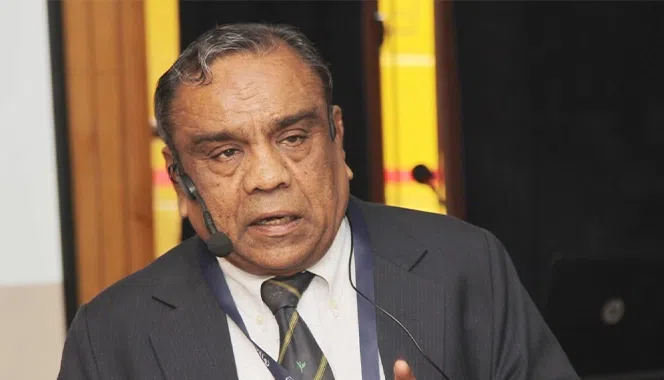
Despite being a revered educationist with mile-long accomplishments that follow his name, this is how Dr G Balasubramanian, former director (academics) of the Central Board of Secondary Education (CBSE), introduces himself: “I see myself as a parent of three children who has graduated and settled in life.” But then, who else would know about children and how their education must progress to make them successful other than a parent who was also a teacher once? “I started my career as a teacher way back in 1970. I taught in Kendriya Vidyalaya, before moving to DAV Gopalapuram (Chennai), and subsequently, I became the principal of Hindu Senior Secondary School at Triplicane (Chennai) in 1978,” says Dr Balasubramanian, fondly called Bala Sir by everyone.
Dr Balasubramanian joined the CBSE in 1984 as a joint director, and in 1997, he was promoted to the director (academics). “I was in charge of various departments and was also designated the chief zonal officer,” he recalls. Dr Balasubramanian retired from the Board in 2006, but “the experience at the Board gave me an opportunity to cut across various educational models all over the country, right from Nagaland to Gujarat and then from Kashmir to Kanyakumari. I have visited almost all the states in the country and interacted with their education system. I have also visited about 11 countries to see how the Indian education system is positioned at the global level,” he adds.
But while most retirees choose the path of rest and relaxation, Dr Balasubramanian chose to continue doing what he does best: Educate everyone about the importance of empowering future generations with the right education and skills. And this is what we speak to him about in this two-part interview, where he tells us why preschool is one of the most important learning environments for our children, how the transformation of Indian education is happening right here, right now, and what parents should expect from their children’s schools.
Excerpts from part one of the interview
Thank you for agreeing to this interview. Here’s the first question: What made you continue your journey in the field of education even after retirement?
I wanted to contribute something to education, and teacher training and principal training are my passion. I’ve been assisting various organizations more on a philanthropic basis, and I think I’ve covered about 7,200 training programs for teachers across the country and about 150 programs outside the country. I’ve trained 75,000-plus teachers on various topics to date, because I really believe that a good teacher is a great asset to the nation. And the moment you make an impact as a teacher, you’re impacting a generation, and I think that’s the contribution I’ve made and, by God’s grace, continue to make.
You’re well-versed in the National Education Policy (NEP) 2020. Why the need for a new policy when we’ve always been told that the Indian education system is one of the best in the world?
Education is a very dynamic subject. It’s impacted by socioeconomic, political, and cultural factors, and by advancements in science and technology. So, when you look at the dynamics of education nearly 50 years ago when I started as a teacher, the curriculum and the little bit of information available in the textbooks were good enough to be taught for a decade. When I became a principal, I learned that the curriculum was being changed—so now, instead of every 10 years, it was down to seven. As a joint director, I discovered that the curriculum was now changed every five years. But when I became a director, I realized that there was a need to change the curriculum every two years.
Maybe in today’s times, you’ll have to change it more frequently because the speed of knowledge is something that is haunting us. Alongside the speed of knowledge, the skills required are also changing. So, we cannot afford to provide education that is not contextual, not relevant, and not futuristic enough to these children. If we do so, they won’t have the confidence and conviction to face the challenges of the future with courage and wisdom. So, the education policy goes on changing.
How have these changes shaped Indian education so far?
The first impact was in 1966 after the government constituted the Kothari Commission (1964–1966), headed by Dr DS Kothari. It introduced the idea of the 10+2+3 pattern of education. At that time, India needed a large labor force, skilled and unskilled. So, it was surmised that if students have basic education till Class 10, then they can diversify into technical education to become skilled employees and support industries and businesses. It was assumed that 70–80% of the students would go for skill training and the rest would go to academic institutions, colleges, and universities. But what happened was the reverse—85% went to college and the rest opted for technical institutions. The concept of vocational education was not accepted in India, because people equated vocational education with inferior socioeconomic status. This stamping killed the spirit of vocational education.
And then what happened?
In 1986, the first National Policy on Education was introduced. Till that time, there were only surveys and commission reports to enable the formation of broad guidelines. This policy stressed the importance of ICT because it was just then that computer education entered school education. So, the focus was on ICT—the integration of technology, paperless examinations, and the like. Many new ideas were talked about at that point in time. So, the policymakers worked on integrating technology with school education. Then, in 2000, the National Curriculum Framework (NCF) was formulated. The idea was to prepare our students for the global scenario because, at that time, many students who graduated from engineering colleges were going abroad. So, the focus was on the globalization of Indian education so that students could contextualize themselves. But the idea of globalization itself was not very successful back then, as only a few countries that were economically sound were able to go with these futuristic ideas.
And now, 20-odd years later, we have the NEP 2020 …
Yes, and this policy views India’s education holistically. The need for a new policy was felt because in recent times, technology has impacted the learning process a lot. All around us, we see informal learning dominating formal learning. We talk about the impact of artificial intelligence (AI), augmented reality, and more, so the very idea of curriculum, the methods of pedagogy, and the learning styles are fast changing. We need a policy that is not only cognizant of all this but is also liberal, and which facilitates customized learning that will help the learner meet the education acquired, 20 years from now.
“I only wish and pray that parents provide the necessary support to the school as well as to their children so that they are able to see their children blossom into adults who can face life, rather than people who just carry a certificate and struggle in life
So, are we looking at the transformation of education in India right now?
There are two terms we use in this context—change, and transformation. Change may not be desired by the user, as it’s often a forced top-down approach. But transformation is an organic process. It starts at the bottom. So, transformation affects the entire system of education and the way it operates. And what is happening today is a transformational process. The NEP 2020 is all about new approaches to educating our children. It highlights the importance of experiential learning and mathematical thinking. Learning mathematics is of no use unless the learner develops mathematical thinking. This is because you need mathematical thinking in every facet of your life. There is math in music, in the measurement of ingredients, in color combinations of a painting … everywhere. So, through this policy, we want our approach to understanding mathematics to change.
Ditto for scientific temper. We are immersed in science every day without even understanding the basics of science. Similarly, if we talk about art appreciation, our mind immediately goes to paintings, but there is so much art in life, in every minute of our existence. But unfortunately, we don’t celebrate the arts. So, this means that we missed a substantial part of our life’s journey.
We are looking beyond marks, so to speak.
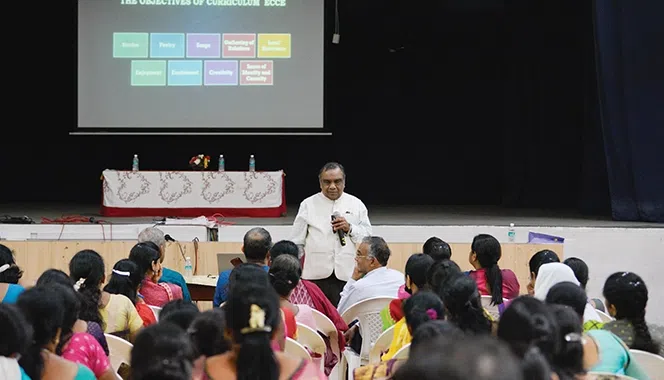
Well, education is not merely to prepare you for a job, neither is it solely for scoring marks. Education must give you cognitive, emotional, hands-on, social, interactive, and spiritual competencies. The Delors Report by UNESCO lists the four pillars of learning, which can be considered the objectives of education:
- Learning to know
- Learning to do
- Learning to get together
- Learning to be
Yes, knowledge is important, but you cannot use knowledge alone, hence learning to do—skills are important. Along with skills, you need to be a team player because you can’t be alone and work independently in modern society, hence social development. Finally, you need to give back to yourself, be comfortable with yourself, to just be you. And I think the NEP 2020 addresses all these four pillars of learning.
So, now what?
You see, the policy has done its job, but to me, what’s more, important is who are to get the output. Is it the school? Is it the teacher? Is it the parent? Sadly, what is happening today is that to satisfy the needs of some parents who want their children to be competitive from the day they step into an educational institution, both schools and the parents do everything absolutely wrong from LKG onward. This policy is for teachers, for parents. It’s designed to facilitate the assessment of the learner, not to judge the learner. Currently, we are only issuing a judgment, we are not assessing students to facilitate progressive learning. I only wish and pray that parents provide the necessary support to the school as well as to their children so that they are able to see their children blossom into adults who can face life, rather than people who just carry a certificate and struggle in life.
With this transformation underway, what will the next decade of education in India look like?
Very challenging, and very confusing. The other day, I was talking about ChatGPT with a couple of children who told me all the things they can do with this AI tool.
Interestingly, a couple of years ago, I was in a school in Meerut, talking to 11–12-year-olds. After my speech, a student asked me a question that had me quite upset. He asked: “Sir, where do you buy your milk from?” I told him this had nothing to do with the topic at hand, but he insisted. I told him that I buy from the milk booth. Again, he asked: “Sir, where do you buy your medicines from?” “From the chemist,” I replied. “And your cosmetics?” he asked. “I go to the mall,” I said. Do you know what he asked me next? He said: “Sir, when you want milk, you go to the milk booth, for medicines to the chemist, and to a mall for cosmetics. Then why do you want me to go to the same school to study physics, chemistry, and biology?”
So, we are moving toward Amazonization (in marketing parlance, this means the customer is the most powerful) of education. This is a time when knowledge can be tapped, purchased, or serviced from any quarter with the click of a button. So, now, the question is, what will be the schools of tomorrow? Perhaps, they might be knowledge kiosks where children come just like they go to Starbucks—go there and have snacks and talk. It would be about peer learning and collaborative learning. Experiential learning will be the learning of the future and not this top-down approach of stuffing formulas into children’s brains.
(Next month, don’t miss the concluding part of this interview, where Dr Balasubramanian discusses how parents can support their children’s education, align themselves with NEP 2020’s vision, and along with the school and teachers, help children succeed in life.)
Connecting the dotsHow are new curriculums like the Dot Learning Circle going to be an integral part of India’s education transformation? Several initiatives are being launched in the field of education. There is no one defined method of learning. There are four types of learning: Formal, informal, incidental and accidental. There are many other types, too. What is necessary is that any curriculum, pedagogy should facilitate the learner to think. The focus of the future is to create thinking, experiential classrooms. So, anything you take to the child, they must ask, ‘why do I learn what I learn’?, ‘Why do I do what I do’? I like the word dot, where you say, connecting the dots—this is very important. Life is all about connecting the dots, learning is all about connecting the dots. So, the entire learning environment is learning to join the dots. But then, you’ve got to create an environment to do that, that’s why the NEP 2020 talks about integrated learning, interdisciplinary learning and multidisciplinary learning. There is no one module of knowledge today—every module is getting integrated and divergent at the same time. So, we should celebrate knowledge as it is and let the children open up. There is this famous story of the 10 blind people who identify different parts of an elephant differently. Well, that’s how children learn, too, but we need to help them understand the elephant in its totality, too, isn’t it? This makes the process of learning more important than the tools of learning. |





















Comments
Edit
Comment Flag
Cancel Update