
Shy Kids: How To Support And Develop Social Skills And Confidence
Saakshi Kapoor Kumar
author parentcircle author parentcircle author parentcircle author parentcircle author parentcircle author parentcircle author parentcircle author parentcircle author parentcircle
By learning about shyness and introversion, you can better appreciate your 'quiet' child's qualities, and help them develop social skills and confidence to deal with new people and new situations.

"Meera, let's get ready fast, we have to reach your friend's birthday party by 4 p.m. Why don't you wear that lovely dress with sparkles? You will look so pretty!" says 6-year-old Meera's mother.
"My stomach hurts! I don't want to go," replies Meera.
"She's your best friend! Are you sure you don't want to go?" asks her mother.
"Yes, Mumma," says Meera.
Meera avoids birthday parties, and even when she goes, she prefers to play alone. She usually finds a corner and stays there for most of the time. Naturally, her mother is concerned.
Just like Meera's mother, we all worry when our children don't want to talk or socialize. We would like our child to be outgoing and chatty and be the center of attention. Yes, some children become the center of attention as soon as they enter a room- they make friends instantly and come across as jovial and vibrant. On the other hand, some children are quiet and would prefer to play by themselves. We immediately label them as the 'shy' ones. But are they really shy? Let's read on to find out.
Understanding your child's social behavior
Sociability or being social is considered a natural human instinct. The Greek philosopher Aristotle said, "Man is by nature a social animal." Because the world places so much importance on the ability of a person to socialize, we think of an outgoing child as being confident and admirable. On the other hand, we tend to label a quiet child as 'shy' and consider shyness a weakness. This is a key reason why parents of a quiet child constantly worry about how their little one will thrive in a world that wants people to be friendly and talkative all the time.
In the above situation, where little Meera doesn't enjoy going to parties or mingling with people, we immediately begin to label her as being shy. But is she really shy? Or is she an introvert? Are shyness and introversion one and the same? Let's find out.
Understanding shyness
Contrary to popular belief, shyness is a behavioral issue and not a personality trait. A child isn't born shy. A shy child may like to be with people, but they tend to feel anxious and uncomfortable in a social setting. The shy child is nervous around people because they worry about the responses and judgments of others. In the book, The Shy Child: A Parent's Guide to Preventing and Overcoming Shyness from Infancy to Adulthood, the authors Philip G Zimbardo and Shirley Radl write that shyness "predisposes people to be extremely concerned about the social evaluation of them by others. As such, it creates a keen sensitivity to cues of being rejected." The child may fear being made fun of and may think too much about what other people think about them. Shyness is something that children can outgrow over a period of time, when given the right kind of support. However, if a child faces extreme social anxiety that affects all aspects of their life, they may need professional help from a counselor or clinical psychologist.
Understanding introversion and extroversion
Many people think that introversion and shyness are the same thing. But the fact is that an introverted child may not actually be shy. Introversion, like extroversion, is a personality trait, not a behavioral issue.
An introverted child needs alone time to re-energize. They like to be with close friends and people they like. Being around people constantly can be a drain on them. On the other hand, an extroverted child needs to be around people to feel energized. If they are not around people, they can feel lonely and depressed. No one is a complete extrovert or a complete introvert. We all fall somewhere in between on the introvert-extrovert spectrum.
An introvert isn't necessarily afraid or nervous around strangers or in social situations. They just like to take their own time to get comfortable with people, they like to observe more than participate, and they like to listen more than talk. An introverted child often finds fulfillment and solace in quietly observing the world around them. They may feel more comfortable hanging out with one friend, rather than playing with a large group of friends.
Unlike shyness, introversion isn't something a child can outgrow. It's inherent. However, you can always help them manage social situations better. Interestingly, an introvert may not be shy at all! It's just that they are not interested in socializing all the time. Introverts are deep thinkers. Some well-known introverts include Mahatma Gandhi, Albert Einstein, Bill Gates, and even former US President Barack Obama.
In the case of little Meera, she just may be an introvert who likes playing with her friend one-on-one. Large groups of people may make her uncomfortable. That may be the reason that, though she has a good friend, she's reluctant to go to her birthday party. Her parents need to understand that. They need to prepare her beforehand on what to expect and allow her to entertain herself in a way she feels most comfortable in large social gatherings. And yes, they can encourage her social life by inviting a couple of her friends over for playdates.
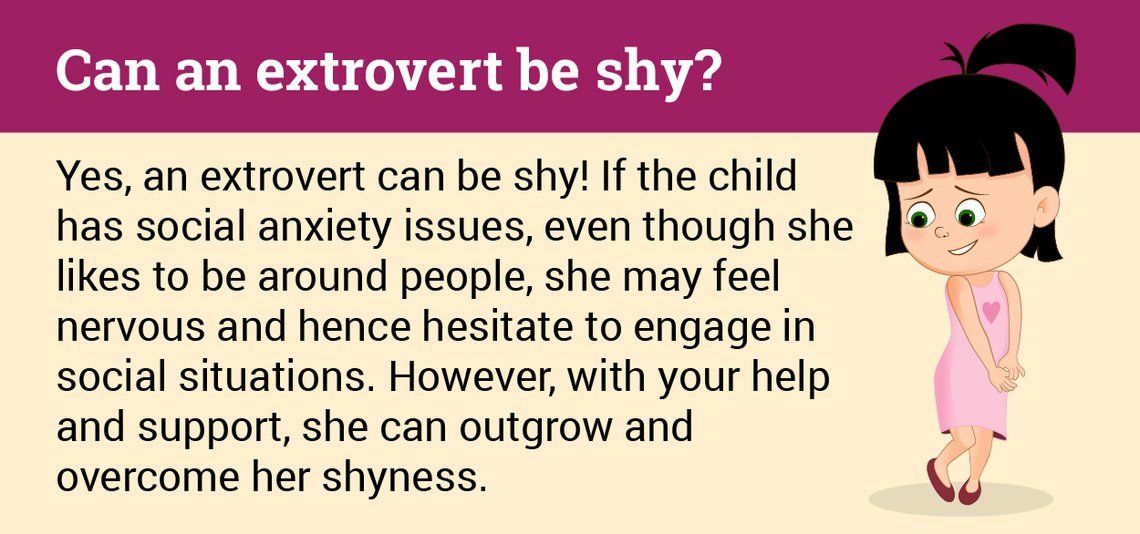
Now that you have some perspective on shyness and introversion, the first step is to understand whether your child's quiet or withdrawn behavior in social situations is because they are shy or because they are an introvert. Either way, you can do your bit to help them handle social situations more comfortably. Here are a few suggestions.
Helping your child around strangers
Your child becomes extremely reserved in the company of strangers. When they come face to face with people outside of their family, they display signs of discomfort. They don't talk or even answer questions. They may also be hesitant to meet people, often hiding behind you. What can you do?
Your child is probably not the only one who is hesitant when it comes to meeting strangers. Preschoolers and even infants have a very strong sense of distinguishing between the known and the unknown. For them, trusting a new person, a new place, or even a new thing isn't easy. This is why many children are very wary of strangers. However, some children can become extremely quiet, nervous, or anxious when strangers are around. You can do your part to help your child overcome any social anxiety and shyness and feel more comfortable in social situations.
WHAT YOU CAN DO
1. No labels, please!
If your child meets someone and they refuse to talk and instead hide behind your back, you and the people around you are probably quick to say, "Oh, he's just being shy!" or "Why are you being so shy?"
This kind of labeling will only add to your child's social awkwardness and anxiety. It will only make them more withdrawn and shy.
Instead, you could tell the person, "He likes to get to know you first before he feels comfortable talking to you."
This way, you're telling your child you understand how they are feeling and you're opening the door for them to start talking when they're ready to do so.
2. Prepare your child
When leaving home to meet new people, talk to your child about all the people they'll meet. If possible, show pictures of these people. Tell them a funny story or two about them. Giving your child details will prepare them in advance, and once they know what to expect, they'll be more comfortable handling the situation.
Your child may not know what to say when they meet someone. This may be a reason they appear shy. Before they have to meet someone, give them tips on what they could say or do- smile and say 'Hello,' tell them their name and what they like to do, ask them what their favorite color or animal is, show them their favorite toy, and so on.
3. Ease them in
When your child meets strangers, don't force them to say 'Hello!' or ask them to go greet everyone around them immediately. Instead, it's a good idea for you to start talking and making introductions. You could say, "Remember, I told you about my cousin who loved eating ice cream just like you? She's the one! Would you like to say 'Hello' or give her a big smile?"
Ease them into the introductions and pleasantries. Understand that they will need their time.
Helping your child thrive at school
You're excited to have your child enrolled in a preschool. You want them to quickly settle in, but they fuss, and their teachers tell you that they just don't talk. One day, your child didn't drink water all day because they were too shy to ask for their water bottle. You're worried about their well-being and progress at school.
In such situations, it's only natural for you to feel worried. However, beginning preschool can be a difficult phase for many parents and, of course, the children. This is because children always take time to cope with transitions. Some children take longer to settle in. They're quiet and are often labeled as being 'shy.' Parents of such children often worry about why their child doesn't talk or open up at school.
WHAT YOU CAN DO
1. Empathize with your child
Think about when you started a new job. How did you feel? When faced with a change, it's natural to feel nervous. Likewise, your child is coping by being reserved because everything is so new. You could let your child know you understand how they're feeling by saying, "I know this is all so new to you, and it can feel scary. See your teacher over there. Let's go and meet her. You can ask for anything you need. She will help you." This will reassure your child. Introduce them to the teacher, and let the teacher know your child may take some time to get comfortable in a new place with new people. Request the teacher's help in encouraging your child to talk.
2. Familiarize your child with school
Before school starts, it's a good idea to get your child to meet their teacher one-on-one, if possible, to get to know them. You could also get them to meet a couple of other children who will be in their class. This way, when they start school, they'll be comfortable with at least a few children.
After a few days or weeks, if you notice that your child is still not comfortable with others in their class, it's a good idea to arrange playdates with a few children in their class. Invite one friend at a time. This way, your child has a chance to get to know the other child one-on-one. Having many friends over at the same time can make them withdraw again. Once they're comfortable with a few children, they'll slowly start to open up in class.
3. Steer clear of comparisons
Preschool is probably the first time parents get to observe the behavior of other children. And parents begin to make comparisons. You may start to notice your child is especially quiet in front of children who are more outgoing and social, and you may say, "Look at Adarsh. See how friendly he is. You, too, should talk to everyone like he does." Such comparisons will only add to your child's shy behavior, rather than help them overcome it. Accept your child for who they are. They may not be great at show-and-tell, but they may be brilliant at listening to a story and comprehending it. Appreciate them for what they can do and never push them to do something because all the other children are doing it!
Helping your child make friends
Your child loves going to the park every evening and is always curious about what the other children are playing. You can see that they want to make friends and play with them, but something holds them back. As a result, the other children play together, and they play alone.
In this case, your child wants to make friends and interact with others. But they probably don't know how to, or they may be worried that the other children may not allow them to join. This fear of being judged or rejected can make your child avoid peer interactions.
WHAT YOU CAN DO
1. Making friends is not easy
Think about it, how easy is it for you to make new friends? Do you go to a park and strike up conversations with the people around you? Put yourself in your child's place. In the above scenario, you could ask your child if they would like to play with the other children. If they say 'Yes,' offer to go along with him to meet the other children and get to know their names. If they aren't ready to go just yet, give them time. Offer to do the same the next day.
2. Have a playdate at home
If your child seems interested in meeting other children, inviting a couple of them home may be a good idea. Your child will be more comfortable socializing within the familiar setting of their home. Make sure you're not around the children all the time, directing their play. Let your child know you're in your room if they need you. Give them time to connect with their peers.
3. Your child doesn't need a million friends
Your child doesn't have to be a social butterfly or the most popular one. Even if your child enjoys the company of one or two friends, that is enough! Communicate to your child that having lasting friendships is more important than having many friends.
In spite of all your efforts, if your child is having a hard time making friends or gets extremely anxious around people that which impacts all aspects of their life, you may want to seek professional help with a counselor or clinical psychologist.
Key takeaway
If your child doesn't want to interact with others, you may think it stands in the way of their enjoyment and happiness. But it may not be so. If your child is active, cheerful, and healthy, there's nothing to worry about. We all have different needs, and we express ourselves differently. Encourage your child to talk to others, but don't push them to do so when they don't feel the need to. Let your child be who they are rather than who you want them to be. The caterpillar that took time to break out of its cocoon still turns out to be a beautiful butterfly.
In a nutshell
- Shyness and introversion are two different things. Shyness is a behavioral trait and not a personality type like introversion.
- Before you begin to support your quiet child, evaluate whether it's because of shyness or introversion. A child can't grow out of introversion, but shyness can be worked through.
- Pushing your child to do something or say something will only add to their shyness. Allow them to gradually ease into new places, new situations, and new people.
What you can do right away
- Take time to understand your child's behavior and identify situations that make your child feel shy and uncomfortable. Hand-holding your child through these triggers will help them feel more secure and confident.
- Ditch all the labels. Labels are limiting, but shyness isn't. Remember to be careful with how you talk about your child, especially when they are around.
- Model the behavior you want to see. You want your child to make friends? You try making new ones! Invite family and friends over more often so that your child can familiarize themselves with them.
Also read:
The Dot social emotional learning program for kindergarten focuses on values such as respect, kindness, and empathy. The program focuses on building essential social skills for maintaining healthy relationships. Children also learn to manage their emotions and behaviours in different situations.


























Comments
Edit
Comment Flag
Cancel Update