
How To Detect Hearing Problem In Children
Monali Bordoloi
Do you know that children with hearing loss are excellent lip-readers? Many a times, detection of hearing loss gets delayed as those infants can coo, cry and babble just like a normal baby.
Perizaad's four-year-old son Zubeen has recently been diagnosed with a congenital hearing loss. Since her husband's family has a history of hearing problems, Perizaad keeps a tab on his developmental milestones closely. When she observes that Zubeen fails to respond to his name and does not react to any music being played, she takes him for check-ups where his hearing loss is confirmed. However, the good news is that there are many treatment options available for Zubeen now.
Dr BB Khatri, ENT specialist, Moolchand and Max hospital, Delhi says, "Hearing loss affects about one to three out of every 1,000 babies. Genetics plays a role to some extent, but most of the time, there is no definite cause of this common birth defect."
Hearing is one of the most important parts of a child's development. There are several tests which detect hearing loss.
Newborn screening
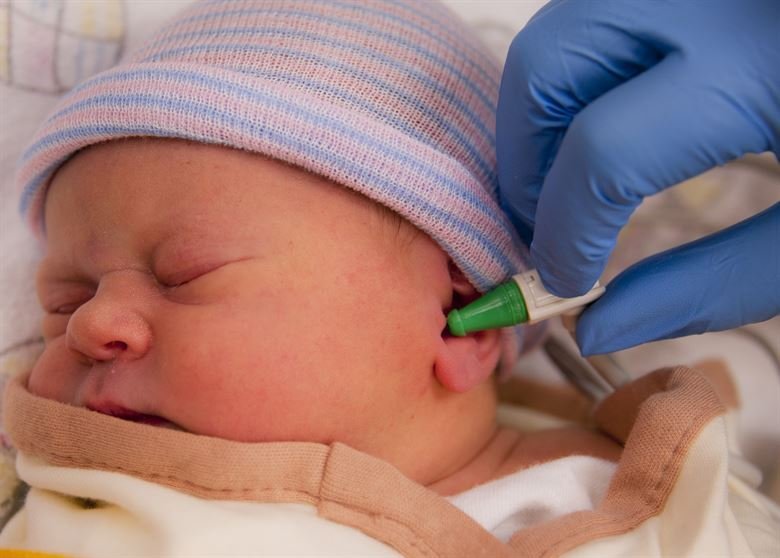
It is a common practice to screen the newborn for a hearing problem before they leave the hospital. If detected before three months of age, treatment options for the child increases and those kids tend to function at the level of their peers by the time they reach school-going age.
Hearing tests are painless and take only a few minutes to do. As speech and language development starts around six months of age, the treatment for hearing loss at birth should also start at this stage.
Some of the other screening tests for the newborns are:
Otoacoustic Emission test (OAE): This test is done to check if your baby's cochlea or inner ear works fine. While responding to a sound, the inner ear gives off certain sounds. These sounds are called otoacoustic emissions, or OAEs. The sounds are transmitted into the ear through a small microphone placed in the baby's ear. The hair cells in the inner ear respond to sound by vibrating. Hearing at certain frequencies can be determined by analysing the emissions. There will be no emission of sound if the baby has hearing loss.
Auditory Brainstem Response (ABR) test: It uses electrodes placed at several locations on the baby's head and ears. An analysis of the reaction of the brain when the acoustic stimulus is introduced shows the hearing capabilities of the baby.
Apart from these, audiometry tests are also done to check for hearing loss in babies.
For little grown up kids
Conditioned play audiometry (CPA): When a child is grown up enough to participate and answers questions, CPA test is done to check for hearing problem. This test needs the active participation of the kids and is made like a game so that kids participate. Here, the child is asked to do touch/bang a toy every time a sound is heard.
Test for an older child
Tympanometry: This test is done to check the functioning of the child's inner ear. Air pressure is transmitted into the ear making the eardrum move and then a special machine checks the mobility of the eardrum. It is good to detect changes in the pressure of the inner ear. This test can only be done in grown-up kids as it requires the child to sit very still.
If a child fails these tests, he is further investigated by an audiologist.
Another way of detecting a hearing problem in infants and child is by monitoring the speech and hearing milestones of the child.
The American Hearing Health Foundation (ASHA) has listed some guidelines for parents to help them detect a possible hearing loss in their children. Be vigilant and inform your doctor if you notice any of the following issues in your child.
- Your child seems to hear fine some of the time and then not respond at other times.
- Your child complains not hearing when the TV volume is on medium.
- Your child answers with 'What?' and 'Huh' when asked something.
- While talking over the phone, your child moves the phone from one ear to other. He will keep one side of his ears forward when listening.
- If your child is not doing well in school and their teacher informs you that they do not seem to hear or respond as well in the classroom.
- When your child says that they didn't hear you. Many parents ignore this; they assume that their children are not paying attention to what they are saying.
- Your child speaking more loudly than before.
- If your child looks at your face intensely when you speak to him, as if trying to read your lips, they may be depending on visual cues for interpreting speech.
There are several developmental milestones that parents can watch out for to identify a possible hearing loss.
Flip through this ClipBook to know about causes and treatment options of Hearing loss.
By three months:
- Your baby recognises your voice and tries to turn her head when called by her name.
- Any sudden and loud noises startle your baby.
By six months:
- Your baby recognises certain speech sounds and familiar noises.
- Some sound or noises make your baby turn their head in that direction.
- Your baby plays with his own voice and laughs.
- Your baby expresses pleasure and discomfort in their voice.
By 9 months:
- Your baby understands and responds to simple words like 'mommy' and 'daddy', 'no', 'ta ta', 'bye-bye.'
- They respond to their own name.
By 12 months:
- Your baby responds to music.
- Your toddler can speak one or more real, recognisable word.
By 18 months:
- By this time, your toddler understands simple phrases like 'come here' and 'go there.'
- They respond to command and speak between 20 to 50 words and short sentences.
- Your toddler learns new words each week.
By 24 months:
- By this time, your toddler's vocabulary should be around 200 to 300 words and she is speaking simple sentences which all can understand.
- A toddler at this age should show some interest in story reading sessions and sit and listen.
- Your toddler cannot respond to double commands such as "come here and eat this biscuit."
Some children may have born with perfect hearing but have developed hearing loss as they grow. It can happen due to factors like ear infections, trauma, perforation. Some drugs also damage auditory system.
Hearing is one of the most critical parts of a kids' social, emotional, and cognitive development, more so during the early stage of life as speech and language development takes place at this stage. Even a partial hearing loss too can affect a child's development.
With inputs from Dr B B Khatri, ENT specialist, Moolchand Hospital and Max hospital, Delhi.
Hope you liked this article. To get expert tips and read interesting articles on a wide variety of parenting topics, Subscribe Now to our magazine.















Comments
Edit
Comment Flag
Cancel Update