
Gopala And The Cowherd: A Soul Stirring Story Of Belief And Faith In Lord Krishna
Sindhu Sivalingam
author parentcircle author parentcircle author parentcircle author parentcircle author parentcircle author parentcircle
This Janmashtami delight your child with this charming story of a boy named Gopala and his friendship with the flute-playing Krishna
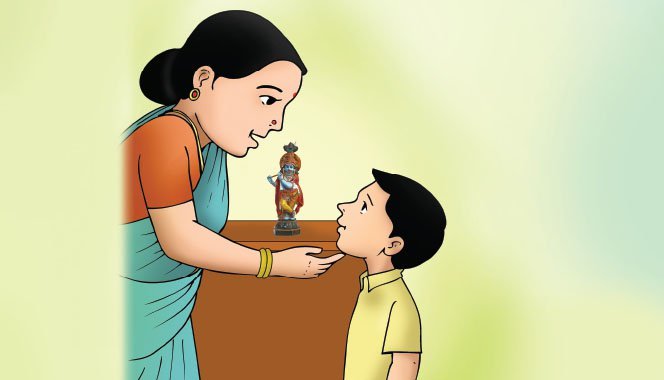
Gopala, a little boy, lived with his Amma in a small hut at the edge of a forest. Amma had a small vegetable garden and a cowshed. She worked hard to grow vegetables and milk the cows to support her son and herself.
When Gopala was old enough, Amma took him to the village school on the other side of the forest. Gopala was happy to go to school but the thought of crossing the forest every day all by himself scared the little boy. Amma caressed little Gopala and said, "I'll have to work. Amma won't be able to accompany you. But I know someone who can. In fact, he is out there always watching over you."
Gopalas eyes widened.
"Amma, who is he?"
"His name is also Gopala. He is your big brother and he can be your best friend. He herds his cows in the forest. So you will not be alone when you walk through the forest," Amma reassured him, as she smiled at the idol of Lord Krishna standing in front of her. "If you feel scared, call out to him. Say, 'Brother cowherd, come protect me.' You'll have no fear when he watches over you."
Feeling safe, Gopala was now all excited to meet the other Gopala and to go to school.
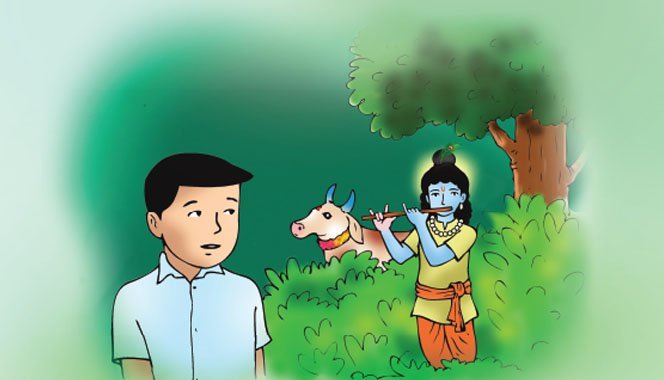
The next morning, well dressed and smelling fresh, Gopala set out into the forest. He started to sing, Gopala, Gopala, Gopala la la, Gopala.
He heard a rustle in the bushes and the jingle of anklets.
"Gopala?" He called out.
A beautiful melody echoed through the trees.
"O brother, my friend! You are here!" exclaimed Gopala excitedly.
From behind a tree, a dark-skinned boy with big bright eyes looked at Gopala, smiling. He was playing a flute. A cow was grazing a few feet away.
Gopala and the cowherd became instant friends. Both of them talked and laughed, as they walked. Every day, Gopala would carry extra food for his brother who loved to snack on butter, curd and poha. Gopala would talk to his brother about what he learned at school. The cowherd played songs for Gopala and even taught him a few.
Gopala would return home and narrate the day's adventures to Amma. She would listen with a smile on her face, as she churned the milk.
One day at school, the teacher announced that a feast would be held at his home the following day. The children were invited to the feast, along with their parents and other villagers.
The happy children gathered and discussed the gifts they would give the teacher—silver, silk, fruits, flowers, and even gold! Poor Gopala's face fell. He slithered out of the group. What could he offer? A potato? Maybe some milk?
That evening, Gopala met the cowherd on the way back home.
"What's wrong, Gopala?" asked the cowherd, noticing the boy's sad face.
"All my friends will bring valuable gifts to give my teacher at tomorrow's feast. I have nothing precious to give," Gopala sulked.
"Oh, come on! The curd you bring for me is the best in town. I'm sure a pot of curd would delight him!" the cowherd encouraged Gopala.
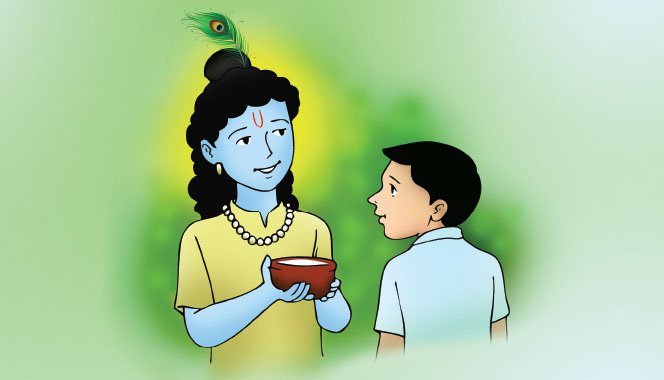
The next day, Gopala carried a small pot of fresh, creamy curd, covered with a muslin cloth. But he tripped over a stone. Crying out Gopala! he fell and the pot of curd went crashing down. The cowherd came running.
"Don't cry over this spilled curd. I have brought you a pot of curd. Wipe yourself and get going," the cowherd said.
When Gopala reached his teacher's house, he saw a big pandal and lots of guests and children. They all had brought huge baskets of gifts. His humble earthen pot looked quite small. Some of the guests looked at his pot with disdain.
The guests sat down to eat. The children helped serve food for the guests. Just when the guests were about to finish their meal with curd rice, the cook came running to the teacher.
"Some monkeys entered the kitchen and broke the pots of curd!" the cook said.
The teacher looked embarrassed. Gopala picked up his pot of curd and handed it to the teacher shyly.
"Thank you, Gopala!" the teacher said affectionately. But the pot was quite small. Did it contain enough curd to feed all the guests?
The teacher began to serve the curd to the guests. The moment he poured a ladle full of curd for one of the guests, the pot of curd was magically refilled to the brim!
Everyone knew something strange was going on.
"Who brought this pot of curd?" the elders enquired.
All eyes settled on Gopala.
"Who gave you this curd?" asked a middle-aged man in a gruff voice.
"My brother Gopala, the cowherd who lives in the forest!"Gopala replied confidently.
"Your'e bluffing! This must be some magic. Who is this cowherd? What does he look like?" asked a man in a silk shirt.
"He is a little older than me. He has big bright eyes and glowing dark skin. He adorns his hair with a peacock feather. He wears a pearl necklace and stone-studded earrings that sparkle under the sun. He wears a white cotton dhoti and plays the sweetest notes on his bamboo flute. He wears anklets that announce his arrival before he appears. He smells like fresh sandalwood and laughs like a child!" Gopala said with a fond smile.
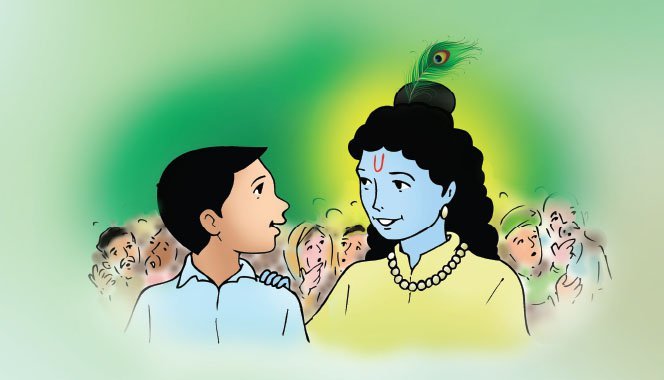
The crowd started to close in around Gopala. Some were sneering, some laughed.
But Gopala stood calmly.
"He comes and walks with me on my way home every day. It's almost time. If you don't believe me, come into the forest with me. You can see him for yourself."
The crowd followed him. Some were puzzled and some were angry at the boy, who they thought was clearly lying.
Gopala stepped into the forest and called out, "Brother Gopala!" There was no answer.
"O cowherd, my friend. Come quickly!"
A beautiful flute note drifted through the breeze. The air carried the smell of fresh sandalwood. The trees seemed to move to the music. Deers and peacocks appeared. Birds perched themselves on tree branches. No one could miss the rhythmic sound of the anklets approaching. The villagers got down on their knees. Arms outstretched, tears rolling down their cheeks, they looked in the direction of the sound with surprise, fear, and admiration. Inches ahead of them, the sounds stopped. The fragrance of sandalwood filled their nostrils. They heard a peal of divine laughter.
"O brother, these people did not believe me when I told them you would come," Gopala said to the cowherd.
Gopala then turned around, facing the kneeling crowd.
"See, I told you," he said.
"We can't see him! Lord Krishna, O Gopala! Why can't we see you?" the crowd cried out.
Surprised, Gopala turned toward the cowherd.
"He is right here. I can see you, Gopala. Why can't they?" he asked the cowherd.
"You can see me only if you BELIEVE in me," said the cowherd, smiling as his voice echoed around the forest.
"Let's go!" the cowherd whispered to Gopala, and they both started walking. The animals followed them. The cowherd, who was Lord Krishna himself, began to play his flute. The villagers, still on their knees, could only hear the fading flute and anklets. The gentle smell of sandalwood lingered in the breeze. On the ground, the villagers could see two sets of footprints—Gopala's and Krishna's, of course!
*This story is an adaptation of a well-known story of Lord Krishna.
Illustrations by Saravana Kumar




















Comments
Edit
Comment Flag
Cancel Update