
Dealing with LDs: Accepting that your child has a Learning Disability
Dr Meghna Singhal
As a parent, you may be distraught when you learn that your child has a learning disability. But by being patient with your child and by educating yourself on the disability, you can come to terms with your child’s learning issues and help them cope as well

This is the second of a series of four articles on learning disability in children and adolescents. Read the first article, “Does Your Child Have A Learning Disability?,” here.
According to a report published by the National Center for Learning Disabilities (US) in 2014, parents of children diagnosed with a learning disability (LD) fall into three categories:
- Those who struggle with the challenges that come with having a child with learning issues and who report being in most need of help (the “strugglers”)
- Those who are conflicted about their ability to manage the needs of their child with learning issues (the “conflicted”)
- Those who are optimistic about their family’s journey with LD issues but continue to require guidance and information (the “optimistic”)
Let us see how you, as a parent of a child with an LD, can turn from being one of the strugglers or conflicted to one of the optimistic.
Stages of Acceptance
Being told that your child has a learning disability can come as a shock to you. Receiving this diagnosis can leave you feeling angry, anxious, discouraged and hopeless. You may feel despair at the disparity between your desires for your child and the disability that impacts their learning, relationships and identity. You may feel grief, sadness or shame. You may even ask “Why me?” and conclude that you’re being “punished for some past sins.”
It’s normal for you to pass through four stages of adjustment when coping with your child’s diagnosis.
- The first stage is usually denial, wherein you may feel that an error has been made in the assessment. This may lead you to look for a cure or propose actions to change the reality.
- The second stage of adjustment is usually anger, which may be expressed in the form of rage or passively by feeling guilty.
- In the third stage, you may resign yourself to the fact that your child has an LD. Feelings of hopelessness, shame and anxiety—stemming from an overwhelming sense of responsibility—may ensue. Some parents may hide their child from social situations, which means they have begun to accept that their child has an LD.
- The last stage is acceptance, meaning that you’re able to understand and appreciate your child, and you want to obtain appropriate interventions and accommodations for them.
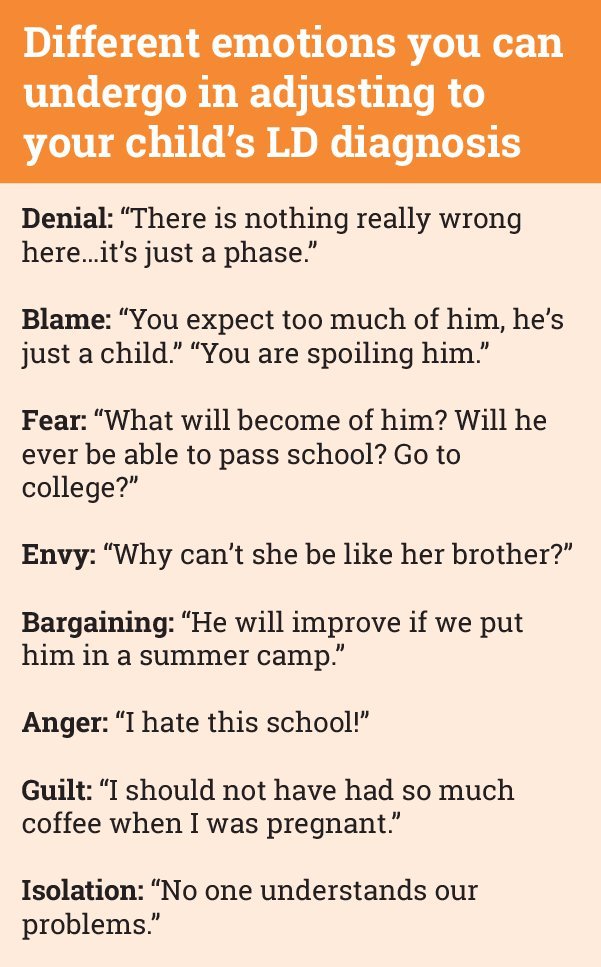
Usually the 'strugglers' take a longer time to accept their child's diagnosis. However, the situation becomes complicated when the father and mother are at different stages of adjustment, and experience conflicting emotions at the same time (e.g. blame versus denial; guilt versus anger). This often leads to a delay in their reaching out for help and in timely assessment and intervention.
Parent Speak
“Before I learned of my child’s dyslexia, I spent years waiting for some magic. I would wake up each morning hoping that my boy had magically transformed into a child who learned like all his classmates. My husband and I would argue daily about whether or not our child had dyslexia. My husband would keep saying, ‘If only he would focus, he could learn.’ But acceptance for him finally came a few years later when he said, ‘I think he has dyslexia. Learning might always be a struggle for him.’”
– Fathima, mother of a 10-year-old who was diagnosed with dyslexia
Even after parents find the resources and means to help their child deal with the disability, other challenges can lead to setbacks in their adjustment and acceptance. One of the main challenges that parents often struggle with is the lack of understanding and awareness of learning disabilities in India. This often leads to a negative attitude among friends and strangers or poorly informed educators. Encountering these negative attitudes can make parents regress to earlier stages of grief.
However, it’s important to grieve and express your anger and despair. If you don’t express how you feel, your feelings might get in the way of your helping your child. If you take care of your feelings, you’ll be able to help your struggling child more easily. It’s not that your child’s disability will stop bothering you. But dealing with your grief will free you from getting overwhelmed by your feelings, and you can focus on helping your child.
Parent Speak
“I remember a video of Sadhguru’s I watched on Facebook. He was talking about these conjoined twins—how when one twin fell, the other one would fall, too. So, a surgeon separated them. Now, if one twin falls, the other one can help pick her up. Sadhguru said that being a parent is like being conjoined with our children. We shouldn’t be so attached to our children that we feel like we have fallen when they fall. We must create a separation so that we can pick them up when they fall.”
– Priya Nayar, parent of a 14-year-old diagnosed with dyscalculia
Accepting your child's LD
In coming to terms with your child's LD, remember that your goal is to help him help themself. This cannot be achieved by desiring to 'cure' the disability but by arming yourself with information, resources and an optimistic attitude.
Here are some ways in which you can learn to accept your child's LD better:
- Keep things in perspective. Your attitude toward your child’s LD will go a long way in defining his attitude toward his disability. Your encouragement and support will ensure that your child gains the confidence and determination to keep going, despite the challenges. Your positivity and belief in hard work will help him view his LD as a speed bump, not a roadblock.
- Don’t get hung up on grades. School grades in India hardly test knowledge; most evaluation methods assess rote learning and writing speed. Allow your child with an LD to progress at her own pace. Emphasize comprehension of concepts and hard work (i.e., the process), instead of grades and performance in exams (i.e., the outcome).
- Arm yourself with information. Find out where you can get your child assessed and certified; what special services, methods of teaching, or assistive technologies your child may require; and where these services are available. Keep abreast of the latest research in LD programs, therapies and educational techniques. For example, the Dyslexia Association of India in Noida offers workshops and certificate courses for parents in understanding learning disabilities.
- Join a parent support group. Many groups on Facebook, such as “Smart Kids with Learning Disabilities,” draw parents with similar concerns together. In these groups, information, as well as emotional and practical support, is shared. Such mutual sharing is an extremely powerful tool to combat isolation, confusion and stress.
- Take care of your other child. If you have another child, she may feel that her sibling with an LD gets more attention or preferential treatment, which could lead to her feeling jealous or neglected. Reassure your child that she is loved and reconnect with her for some time every day, giving her your undivided attention (without any agenda or distractions). Also, involve her in any special routines for her sibling with an LD.
- Practice self-care. It’s easy to get overwhelmed by your child’s LD, given that you have to run your household and take care of the rest of your family. So, get enough sleep, eat, exercise and take a break from it all by pursuing activities you enjoy. Focus on your relationship with your partner and keep the lines of communication open. If nothing helps, seek counseling or therapy from a qualified mental health professional who can teach you ways to cope effectively.
Empowering your child
To empower your child with learning issues, try these strategies:
- Focus on strengths. Your child is not defined by her LD. Focusing on her strengths, such as the activities in which she excels, will go a long way in helping your child see herself as a person over and beyond her disability. Avoid making your child’s life and schedule revolve around her LD.
- Be realistic. Be honest with your child. Do not say everything is alright. No one knows better than him that something is wrong. Your child’s problems with literacy or numeracy skills are not due to laziness, disobedience or illness. Help your child understand that his difficulties are due to his brain processing information differently from his typically developing peers. That makes it harder for him to recognize, remember and use sequences of symbols. Understanding this will prevent your child from stigmatizing himself.
- Don’t encourage a victim mentality. Help your child see what she can do despite the challenges she faces. Help her assume a greater degree of responsibility by, for example, involving her in household chores in an age-appropriate manner. Not encouraging your child to contribute to chores may send the message that she’s not capable of helping.
- Build self-esteem. Show your child unconditional love and acknowledge his good choices. Don’t jump in and take over tasks (such as chores or homework) that your child finds difficult. When you allow him to work through something without your help, you confirm your belief in his capabilities.
- Bullyproof your child. Although no child is immune to bullying, children with disabilities are particularly vulnerable. Let your child develop healthy friendships; even one friend can go a long way in bullyproofing your child. Help her to be assertive so that if the situation arises, she can defend herself by talking assertively, using a respectful but firm and confident tone.
- Help your child take charge of his life. Neither you nor your child can cure the disability, but you can do things that make him feel his best. He can consider taking up a sport, doing yoga or learning martial arts. He can also hone his skills in an activity like art, music, baking, drama or anything that makes him feel good. Encourage him to join a school club to feel good about himself.
Expert Speak
Positive Things to Say to Your Child
“When dealing with your child’s LD, it’s vital that you take a positive approach. Let your child know that you’re on their side. Here are some things said by parents that children told me made all the difference to them:
- ‘You can learn even though you have a learning difficulty. I know you can because you’re bright.’
- ‘We’ll read together every day for fun.’
- ‘We’ll do some spellings every day, but not too many.’
- ‘Remember, I’m with you in this, and I believe you can do well.’”
– Dr Geetika Agarwal, assistant teaching professor, Ball State University (US), and associate director, Stepping Stone Centre (Bengaluru)
Sucess attributes
A 20-year longitudinal study, conducted by researchers from the Frostig Center (California), followed children with learning issues into adulthood and identified the following six success attributes possessed by successful children with learning disabilities:
- Self-awareness: Self-awareness includes knowledge about one’s strengths, weaknesses, and talents or special abilities. Talk to your child about your strengths and weaknesses, and encourage them to talk about theirs. Encourage activities and passions within your child’s capabilities—this will help build competency and enable your child to experience success.
- Proactivity: Proactivity entails self-advocacy (e.g., asking for help when the child doesn’t understand a lesson) and willingness to take responsibility for their choices. Help your child understand that they have the “power to control their destiny and affect the outcome of their lives.” Encourage your child to make their own decisions.
- Perseverance: Perseverance involves keeping at a task or situation despite challenges and failures. Share success stories of famous personalities (or your own) who kept going despite obstacles. Discuss the rewards that only hard work can bring and the opportunities missed by giving up. When your child fails despite working hard, keep up the optimism and discuss ways of moving forward.
- Goal-setting: Setting realistic goals is an important life skill. So is the ability to adapt and adjust goals according to limitations. Help your child identify short- and long-term goals, along with the steps required to achieve them. Discuss what they can do when they encounter obstacles. Celebrate when they achieve a goal.
- Support systems: Children with learning issues require strong support systems. Help your child learn interpersonal skills that will help them develop supportive relationships. Role-play situations in which they’re required to ask for help from others and have them practice social skills.
- Emotional coping strategies: Help your child express their anger, frustration or feelings of discouragement. Give them the space to talk about their feelings. Also, empathize with your child rather than jumping in to solve their problems.
- Helping your child connect to their feelings and showing them how to calm themselves will help them regulate their emotions. Encourage your child to identify and get involved in activities that reduce stress, such as music, sports or baking. Empowering your child to deal with unpleasant feelings or stress will make them better equipped to surmount challenges.
In a Nutshell
|
What you can do right away
- Use a positive approach when discussing learning with your child. Let him know that you are on his side
- Reassure your child that she is loved and reconnect with her for some time every day, giving her your undivided attention
Discover The Dot Learning Circle’s language and communication program for pre-primary, designed to nurture early literacy skills and social interaction skills.






























Comments
Edit
Comment Flag
Cancel Update