
Dealing With LDs: Does Your Child Have A Learning Disability?
Dr Meghna Singhal
Here’s a ready reckoner on learning disabilities—causes, types, signs, diagnosis, and myths and facts. Learning about the disorders may help you identify your child’s learning challenges and seek out support and educational services for your child.

This is the first of a series of four articles on children with learning disabilities. Read the next article in this series, “Accepting that your child has a Learning Disability,” here.
Rukmini, an otherwise cheerful 5th grader, dreaded going to school. She particularly hated the English class, where sometimes the teacher would ask students to take turns to read aloud from the textbook. When Rukmini read aloud, she stumbled and made mistakes. She felt anxious. Her heart would pound.
To make her life easier, Rukmini would count the students ahead of her and figure out which paragraph she would have to read. Then she would try to memorize it. She always hoped for a short paragraph. Sometimes she would even plan toilet breaks so she could avoid her turn altogether.
Rukmini’s parents had no idea what she was going through. It was only when she reached Grade 11 that she was diagnosed with dyslexia, a type of learning disability.
What is a Learning Disability?
Learning disability (LD), or specific learning disability (SLD), is a disorder that interferes with a child’s ability to read, write, listen, think, spell, speak, or do mathematical calculations. Thus, LD refers to ongoing problems in three areas—reading, writing, and math—which are the foundations of learning.
| LD is fairly common in our country. According to an article published in the Indian Journal of Psychiatry in 2019, 5–17% of children in India have learning disorders. |
LD is frequently taken to mean dyslexia, but dyslexia is only one type of LD. Learning disability is an umbrella term that is used to describe many different types of learning disorders. Three of the most common LDs are:
1. Dyslexia
A specific disability in reading is called dyslexia, which includes difficulty in noticing, thinking about, and working with individual sounds in words; difficulty in detecting and discriminating between different speech sounds (e.g., “d” may sound like “g” to a dyslexic child); and difficulties with reading, rhyming, spelling, vocabulary, and comprehension.
Dyslexia is the most prevalent and well-recognized learning disability, accounting for an estimated 80% of the cases of LD. The popular Bollywood movie Taare Zameen Par showcases the struggles of a child with dyslexia.
2. Dyscalculia
Dyscalculia is a specific learning disability in math. It includes difficulties with counting, learning number facts, and doing math calculations; difficulties with measurement, telling time, counting money, and estimating number quantities; and trouble with mental math and solving math problems.
3. Dysgraphia
Dysgraphia is a specific learning disability that affects a child’s writing skills. Children with dysgraphia find the physical act of writing difficult and have trouble expressing their ideas in writing. Dysgraphia is expressed through a tight, awkward pencil grip and body position; tiring quickly while writing; trouble forming letter shapes; and inconsistent spacing between letters or words. It could also include grammar difficulties and trouble in organizing ideas logically.
A child may have one or a combination of these learning disabilities.
According to the American Psychiatric Association, learning disorders can vary in severity:
- Mild – Indicates some difficulties in learning in one or two academic areas, and can be compensated with adequate support.
- Moderate – Indicates significant difficulties with learning, requiring special education and accommodations.
- Severe – Indicates severe difficulties in learning, impacting most academic areas and requiring intensive specialized instruction.
LD terminology decoded
Although the terms “learning disorders,” “specific learning disability,” “learning difficulties” and “slow learner” are often used interchangeably, they differ in many ways.
- Learning disorders is a medical term used by mental health professionals the world over.
- The term specific learning disability is mentioned in the Rights of Persons with Disabilities Act (RPWD Act), which was enforced by the Government of India in 2016.
- According to the Dyslexia-SPELD Foundation, an Australian NGO, children with learning difficulties underachieve academically for various reasons, such as “severe behavioral, psychological and emotional issues; English as a second language; ineffective instruction; high absenteeism; or inadequate curricula.” These children have the “potential to achieve at age-appropriate levels” once they are provided support.
- Slow learner is a term used to refer to a child who can achieve a moderate degree of academic success, but at a slower rate compared with the average child. Slow learning is not to be confused with “mental retardation.”
Causes of learning disabilities in children
Research has identified several possible risk factors for LDs:
- Genetic: LDs tend to run in families. Children who have a parent with an LD are more likely to develop an LD themselves.
- Biological: LDs arise from neurological differences in brain structure and function, which affect the brain’s ability to receive and process information.
- Pre- or peri-natal: Factors that affect a developing fetus in the womb, such as alcohol or drug use, maternal malnutrition, and significant maternal illness or injury, can put a child at higher risk for an LD. Lack of oxygen to the brain during birth, premature or prolonged labor, and low birth weight have also been associated with LDs.
- Environmental: There is a high incidence of LDs among people living in poverty, perhaps due to poor nutrition and ingested and environmental toxins (such as lead, tobacco, and alcohol) during early and critical stages of development.
LDs are not caused by intellectual disabilities, emotional disturbance, inadequate instruction, or limited English proficiency.
Early recognition
Learning disabilities become evident when a child starts formal schooling, because that is when challenges with reading, writing or doing mathematical calculations become apparent. However, many individuals do not receive a diagnosis until late adolescence (when they reach high school or college) or until adulthood (when they join the workforce). Others with LDs may never receive an evaluation—they go through life never knowing why they have difficulties in academics, or why they have problems in their jobs or relationships.
There are many factors that hinder the detection of LDs, some of which include lack of awareness, dearth of trained teachers in school, myths regarding LDs, and confusion with other conditions like learning difficulty or slow learning.
Research shows that early detection of a learning disability, along with appropriate support, can increase a child’s chances of success in school and in life.
Signs of learning disabilities in children
The child may have difficulty in:
- understanding instructions
- spelling words or similar words
- performing well on written tests
- writing and reading letters
- recognizing letters
- remembering numbers
- hand-to-eye coordination
- copying accurately from a model
- completing schoolwork
- organizing tasks
- understanding abstract concepts
- discriminating size, shape, color
- understanding temporal (time) concepts
- remembering information and instructions
- adjusting to environmental changes
- concentrating on certain tasks
- making decisions
Other signs include impulsive behavior, low tolerance for frustration, and having developmental delays (e.g., motor skill or speech delay).
Learning disability diagnosis
SPOTTING THE SIGNS
Does your child have a learning disability?
1. Has your child been having difficulties in one of the following areas for at least six months?
- Difficulty reading/understanding the meaning of what is being read
- Difficulty with spellings
- Writing difficulties (problems with grammar, punctuation, or organization)
- Difficulty understanding number concepts, number facts, or calculations
- Difficulty with mathematical concepts
2. Are your child’s academic skills significantly lower than what is expected for their age?
3. Does your child’s difficulties in learning cause problems in their school, work, or everyday activities?
If you answered “Yes” to all the questions above, it’s a good idea to get your child evaluated by a mental health professional, such as a clinical psychologist.
Diagnosing a learning disability
Diagnosis of LDs can only be made by a mental health professional, such as a clinical psychologist, child psychiatrist, occupational therapist, or pediatric neuropsychologist. The diagnosis is made through a combination of interviews, tests, observations, family history, and school reports. It includes intelligence testing, academic skill assessment, LD testing, and evaluation of classroom performance.
Busting common myths about LD
Learning disabilities: 6 Myths and Facts
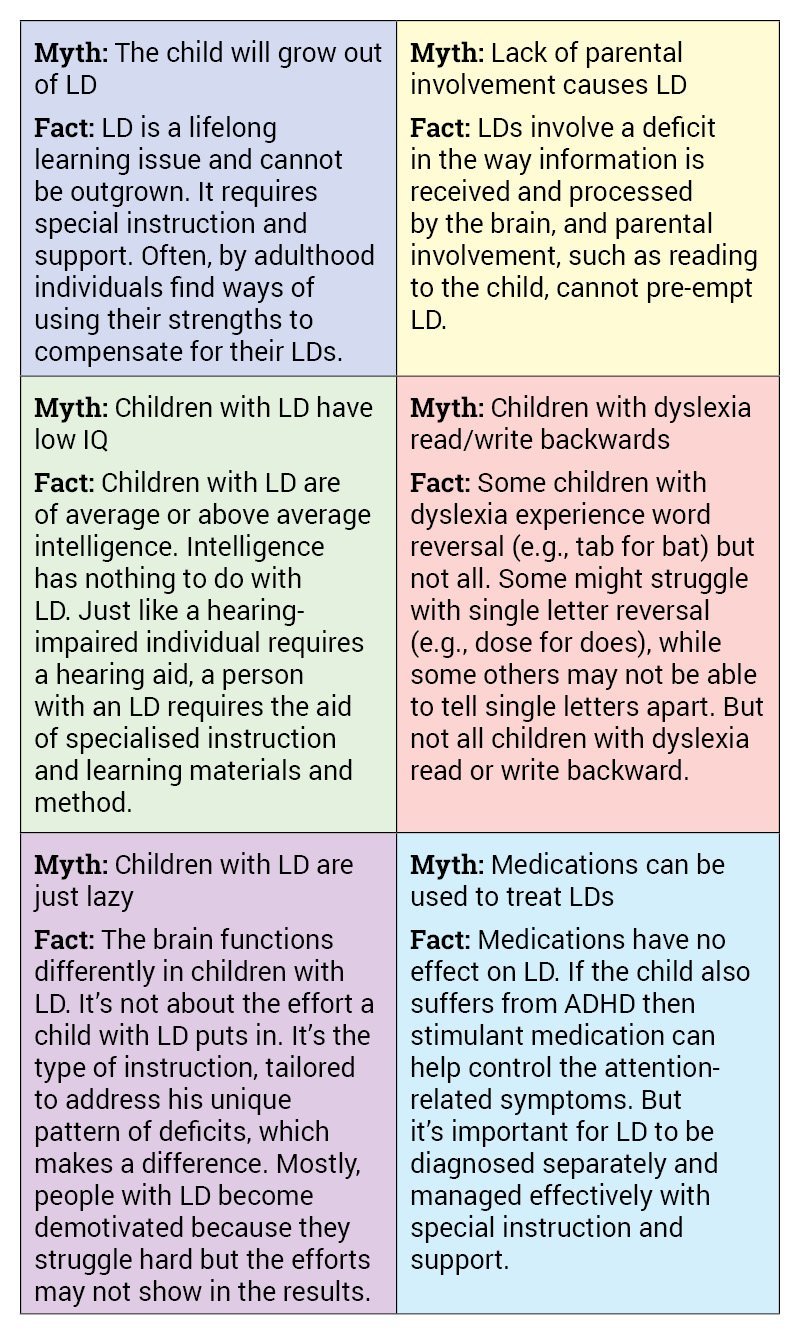
Behavioral and social challenges faced by children with LDs
Living with a learning disability is not easy. LDs impact not just learning and schoolwork, but every important aspect of the affected person’s life, including work, family, relationships, and even the sense of self.
1. Problems with self
- Low self-esteem: An all-too-common companion of LDs, low self-esteem could show itself in the child putting herself down, thinking that she is stupid, and not even trying.
- Attitude toward failure: Failure is a constant theme in the life of a child with an LD through no fault of his own. When failure becomes recurrent, children with LDs are much more likely to give up trying at school. They begin to assume that no matter how hard they try, failure will be the outcome.
2. Problems with social relationships
- Social relationships: Children with LDs often struggle with social acceptance among their peers. Some may even be bullied by their classmates. Sometimes they may even bully others to relieve themselves of their inner turmoil.
- Social interactions: A child with an LD may have difficulty comprehending new information or situations, organizing the information to give the desired response, and retrieving the language to express that response.
Expert Speak
“Children with LDs often end up wondering whether they are intelligent because their intelligence does not reflect in their academic functioning. This can contribute to their feeling low about themselves, which is expressed differently by different children. Some children may withdraw and be unable to take any initiative, some may be extra sensitive to feedback, and others may be intrusive in wanting to show their competence. These patterns also strain their interactions with teachers, peers, and family.”
– Dr Nithya Poornima, assistant professor of clinical psychology, NIMHANS (Bengaluru)
3. Problems with behavior
- Hyperactivity: Attention deficit hyperactivity disorder (ADHD) is a developmental disorder that often co-occurs with LDs.
- Acting up: Sometimes children would rather be the “bad” than the “dumb” kid. So, they act up or misbehave to get attention away from their academic struggles or display an “I don’t care” attitude as a way of saving face.
Barriers to success
1. Being made to repeat a grade
Children with LDs don’t often receive early or effective interventions. A third of students with LDs in the US have been held back a year, which increases the risk of their dropping out of school.
2. Coming under strict school discipline
According to the US-based National Center for Learning Disabilities (NCLD), students with LDs are “twice as likely to be suspended as those without disabilities,” and the loss of instructional time increases the risk of failure and aversion to school.
In a Nutshell
- Learning disability (LD) is a disorder that interferes with a child’s ability to read, write, listen, think, spell, speak or do mathematical calculations. It also impacts their organizational skills, ability to focus, and social and motor skills.
- Many causes for LD have been identified, including genetic, biological, pre- or peri-natal, and environmental issues.
- LDs do not become evident till the child starts formal schooling.
- LDs impact not just learning and schoolwork, but every important aspect of the person’s life, including work, family, relationships, and even the sense of self.
- Children with LDs need to be identified early, diagnosed accurately, provided appropriate assistive technologies, and given the right targeted interventions to help them become the best learners they can be.
What you can do right away
- If you suspect that your child has a learning disability, take them to a qualified mental health professional such as a clinical psychologist for a thorough assessment.
- Don’t stigmatize your child if they have learning difficulties. Don’t blame them; it’s not their fault. Instead, look for ways to support your child’s learning.
Discover The Dot Learning Circle’s language and communication program for pre-primary, designed to nurture early literacy skills and social interaction skills.
























Comments
Edit
Comment Flag
Cancel Update