
How The 'Waldorf Curriculum' Helps In Developing Your Child's Imagination And Creativity
Sindhu Shivalingam
In the second of our curriculum series, we look at the Waldorf way of integrated, holistic education. Here, the focus is on developing every child's unique gifts through imagination and creativity.
As I walk into Indradhanu, a Waldorf-inspired school in Chennai, I see children in brightly colored dresses hopping out of school and waving goodbye to their teachers. Most of them are not wearing their shoes. To my left is a sandpit with a customized climbing frame near it. The climbing frame has been put together using wooden poles, tightropes, safety nets, and planks. There is no particular shape to it, but it sure looks like great fun! As I continue my walk, I hear the sound of a flute. I catch glimpses of several rooms that resemble rooms in our homes and I see some teachers sitting inside, knitting. I also walk past a large, neat kitchen on my way to the principal's room. As I enter her room, I am amazed looking at the walls, which are completely painted in the colors of the rainbow! Mud sculptures and handicrafts made out of wool and twigs decorate the shelves in the room. I sit down on a wooden chair, eager to learn all about this magic of Waldorf education.
"Accept the children with reverence, educate them with love, send them forth in freedom." - Rudolf Steiner, Austrian philosopher and founder of the Waldorf schools
What makes Waldorf education unique
Waldorf education was founded by Steiner in the early 20th century. The system aims to educate the whole child, 'head, heart, and hands'. "Waldorf is a health-giving curriculum in a holistic sense - mental, physical, and emotional. The curriculum includes academics, art, music, physical and practical activities, as also, plenty of enjoyable nature observation. Waldorf helps children see how their hands can create useful things," says John Miller, Director, Indradhanu school. Children experience their connection to art right from kindergarten. They learn to paint, sculpt, knit, cook, sew and stitch. This creates within them, internal motivation and a love for learning. So, there is no need for marks or tests to get children to learn.
The Waldorf Environment
"Waldorf schools try to make their environment feel like home. The child has to like where she goes every day," smiles John Miller. The same home-like feeling is what I got when I visited Tatva, another Waldorf-inspired school in Velachery, Chennai. At both schools, the spaces radiated beauty in an inexpensive and subtle way with no fancy arrangements - walls decorated with the artwork of children; curtains that look like 'amma's beautiful old dupattas', soothing colors and green plants, and most importantly, teachers who spoke warmly and patiently from the heart. Not to forget the laughter of the children!
"A lot of emphases is given to appreciating beauty in Waldorf. When children see beauty in little things, they see it in themselves. If a child begins to love himself and understands his potential and capability, our job is done, isn't it?" asks John Miller. I couldn't agree more. "Every Waldorf school is warm and cozy. Zero to seven-year-old children need to experience beauty and love. Waldorf education is natural education, that allows the learning intention to come from children's will. So, every arrangement revolves around that theme," says Vidyalakshmi Rajagopalan, Director, Tatva School, Chennai.
When children see beauty in little things, they see it in themselves
Play as education
The curriculum is based on the developmental needs and stages of children in each grade. "Children learn better when they are ready," says Vidyalakshmi. For instance, little children explore the world and learn social connections through peer interaction and play. The indoor and outdoor play areas are creatively designed with natural objects, toys, and age-appropriate challenges that kindle creativity, imagination, and peer interaction.
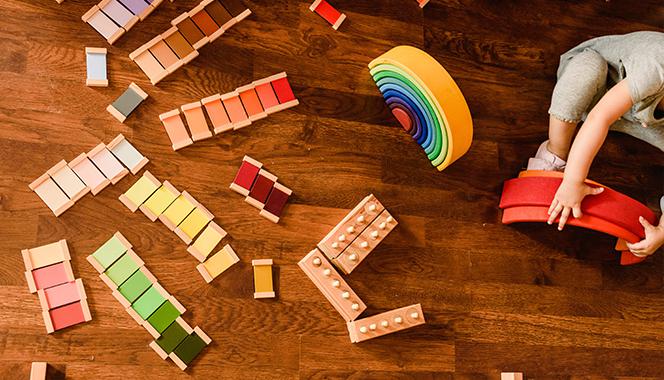
The toys are all open-ended. Even the dolls have minimal or no facial features. This allows the child to imagine the doll's emotion according to his play. Children are encouraged to play in the sand and are taken on plenty of nature observation walks. The art and craft sessions develop their fine motor skills. Waldorf is against the use of electronic gadgets as it believes the gadgets interfere with a child's natural tendency to learn.
Teaching method
Children learn by observing and experiencing; also they are naturally curious. Here are some examples:
- Alphabet: For the early years, most teaching is indirect. For instance, a child may learn the sound of the letter 'M' as the teacher tells him a story of a benevolent mountain emphasizing the letter 'M'. She then shows the letter 'M' and moves like an M as the children copy her. They write 'M' in the air, on each other's backs, and later on paper, but that comes much later.
- Science: Science is taught by means of observing phenomena and hands-on experiments. In the younger grades, everything is through artistic experience and observation - observe the plants, draw, sing. "For higher grades, we follow different steps - tell them stories about a concept, and offer an artistic experience. Then we leave the idea to sleep. Later, we come back to work with the concept. Waldorf lets it come gradually but surely," says Shama, a sixth-grade Science teacher at Indradhanu. "For example, we make waves on the terrace. As the children feel the water under their feet and let the buckets float, they feel energy transfer and experience what waves can do. Nothing is put in words. We let the children experience it and we deliberately let the idea go to sleep with them. We don't speak anything about it that day. Then the next day, we recall it. We ask the children to express it artistically, through drawings or poems. And then comes the concept briefing. By then, the child has already internalized it," says Shama.
- Math: "We teach numbers by quantity. We start with '1' and speak of it till the children get what 1 means. They raise one hand, clap once, swirl once, bring one apple, and so on. We do not introduce number 2 at this stage. Even if a child clapped twice, we don't tell her, 'that's 2'. We go one number at a time, gradually," says Kavitha Mahesh, coordinator, Tatva school. "For Grade 2, multiplication is introduced by allowing the children to observe body movements, rhythm, and songs. Then we play with bean bags and sing songs like 'Row, row, row a boat', till we say 9, 12, 18, 21 and so on, with hand movements. Then, we derive the tables through activities. Only later do we introduce the written tables," says Shama.
Lessons are taught through artistic experience and observation
Textbooks, notebooks, and practice sessions
Most Waldorf schools do not have textbooks until Grade 5. The children express what they've understood using art, poems, and writings.
Academics
The whole academic year is split into ten months. Every month, one subject is taught deeply, during a two-hour main lesson block every day. This period is structured with movement, stories, songs (for lower grades), and interesting activities (for higher grades) so the strain isn't felt. The rest of the day is divided into activities and practice sessions, where children review what they've already learned in other subjects. Waldorf aims to show children how all subjects and lessons are interdisciplinary. So, the subject or topic learned in the main lesson block will be woven into the concepts the children learn in other subjects through activities they'll be doing throughout the day (some may include worksheets). This way, their understanding deepens. So, when they learn math as their main lesson, children see the arithmetic functions at play while they learn to play the guitar or when they learn music notes or dance, or as they cook. If they study plants (Science) as the main lesson, during their language practice session they have poetry, comprehension, and stories on plants. They'll be drawing and painting flowers in the art class.
Assessments
Waldorf schools do conduct assessments, but children do not get marks, as such. The goal is not to grade your child based on what he scores in a test, but to assess his understanding of what's being taught and for the teacher to design her teaching program effectively.
Raising disciplined, happy, empathetic children
The Waldorf system builds sensitivity, sensibility, and respect as innate qualities. Children naturally respect other people. This is because the teachers respect children. The teachers always remember that a child is not bad. Any action is a reaction to some stimulus, an observation, or an action taken by another person. This allows teachers to be more understanding and accepting. Sometimes intervention may be needed. For instance, when a child starts throwing blocks, the teacher simply sits next to her and arranges the blocks to show there is a different, more peaceful way of playing with them.
Culture and festivals
"Our culture has a lot to offer. Starting with body sense and exercising vocals, our cultural expression makes a child understand perception. Waldorf urges its schools to connect to our cultural roots. The children love and enjoy celebrating our local festivals. For snacks, we serve ragi porridge for our children. And, our school is sugar-free. Our children have started preferring natural and traditional food," says Ms Saradha, co-founder and Principal, Indhradhanu school.
Developmentally-appropriate curriculum
Although the curriculum consciously avoids direct reading and writing until the age of 6.5 to 7 years, many other skills (necessary for perception, processing, and storing of information) are being developed and sharpened through a variety of uniquely designed activities. These include music, rhythmic movements, bee-wax molding, wet-on-wet paintings, healing stories, etc. Having acquired the pre-requisite skills for reading and writing early on, Waldorf school children are already at an advantage when starting formal school at the appropriate age of 6.5 to 7 years. - Neelu Dhungana, founder, Neev Montessori school, a Special Educator and IRA Waldorf teacher trainee based in Chennai.
Expert speak: Pooja Marshall, a trained Waldorf educator, and director, InBloom, Bangalore, answers some important questions from parents
Will the child be able to withstand intense education and discipline if shifted to a mainstream school? Will she able to sit for competitive exams?
It is a misconception that Waldorf children play freely all day. We are proud to say that play is an important aspect of our education. But in middle school, education is intensive. The children, however, don't feel the pressure because of how our curriculum is designed. They do not have written exams but do answer questions, and it comes from the heart. We introduce concepts at the right age so our children easily grasp them. They are confident with their language, Science, and Math (or any other subject). Their handwriting is beautiful. School is not a threat to them; children love coming to school and dread holidays! They work, write, learn Science, Geography, and Astronomy beautifully and at a comfortable pace. So you will understand that this child can confidently adapt anywhere. Any shift will take time. As a parent, you must tell the school, 'Let's give my child some time to catch up'. Let us first change our expectations - let him first start enjoying going to the new school.
How do I decide?
Educate yourself. Attend seminars and workshops, read about Waldorf. When you are convinced, inform others. Visit schools, ask them to add you to their mailing list. Waldorf is very much like our Vedic system - it is very scientific. An old method in a Western package, like Yoga, is today. You will find a lot of similarities starting from how the curriculum is attuned to the developmental need of the child.
Choosing the right school
I asked Vidya whether it is possible to find out if a school is Waldorf in its true spirit. She thought deeply before answering: "That's a tough question considering how much freedom Waldorf schools have in making it their own. One key pointer is that a real Waldorf school will have a lot of respect for the child. The way a teacher speaks, tells stories, and conducts her class will tell you that the school has love and reverence for children. If you don't see art and movement, it's not Waldorf."
"We strive to provide the education that will make a child jump with joy to go to school. We are confident of nurturing children who will walk out as humble human beings, who are creative, who know to respect others, who are responsible and also, have confidence and love for self and the environment around," concludes John.
Waldorf education is an ocean. We've given you just a quick peek. If you are ready to introduce your child to this magic, do your research. Enter the world of Waldorf and be patient. Your child is not going to sing A, B, C or write her name when she is four. But, she will grow up to become a wholesome child. And right now, the world needs more of such children.

























Comments
Edit
Comment Flag
Cancel Update