
Benefits Of Sand Play For Children: How It Supports Development, Learning, And Creativity
Sahana Charan
Wondering whether sand play is safe for your child? Discover the many benefits of sand play for kids, from strengthening motor skills and boosting creativity to supporting emotional well-being, concentration, social development, and immunity. Learn why this simple outdoor activity is an important part of healthy childhood development, along with practical safety tips for parents
- 49.8K
- 2
- 1
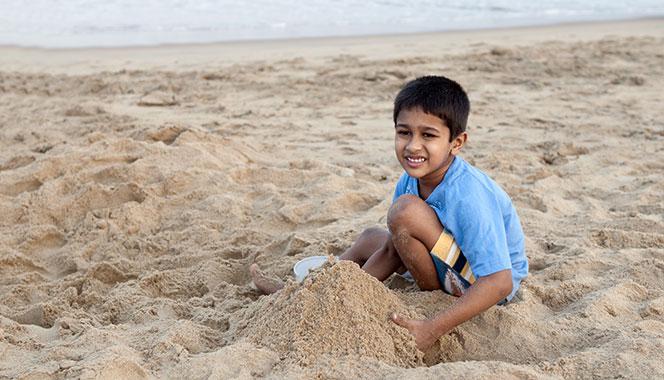
Do you remember the last time your child played in the sand and you worried about dirty clothes or skin infections?
While these concerns are understandable, research shows that sensory play such as digging, scooping, pouring, building, and drawing in sand supports children's physical, cognitive, social, and emotional development. Sand play provides children rich learning opportunities.
Benefits of sand play for children's development
1. Aids in physical development
There are various ways your toddler can indulge in sand play. When they use buckets and scoops, the effort of pouring it from one bucket to another and lifting the sand into a toy truck helps develop their gross motor skills. It also strengthens their muscles.
2. Encourages sensory development
Sand play offers children a rich sensory experience. They enjoy feeling wet and dry sand, letting it run through their fingers, making patterns, and exploring its textures.
3. Expands the imagination
Building a sandcastle on the beach or creating bridges in the sand builds your child's imagination and encourages creativity and problem-solving.
Simple toys such as cars, animals, buckets, shells, and other props can inspire imaginative play. "Sand is a toy, and the less a toy does, the more a child will learn. There are hours of fun and learning to be explored with sand as it promotes and encourages creativity and imaginative play, sensory and language skills. - Dr Vikas Satwik, Consultant Pediatrician, Motherhood Hospitals
What your child learns while playing in sand
When your child... | They're developing... |
| Digs and shovels sand | Gross motor skills and muscle strength |
| Scoops and pours sand | Fine motor skills and hand-eye coordination |
| Builds sandcastles | Creativity, planning and problem-solving |
| Shares buckets and toys | Cooperation |
| Draws lines and shapes | Pre-writing and early literacy skills |
| Fills and empties containers | Early maths concepts such as volume and quantity |
| Explores different textures | Sensory awareness and curiosity |
4. Helps children express emotions
Playing freely with sand allows children to explore and express themselves in a relaxed environment.
According to Pramila Balasundaram, Founder-Director of Samadhan, an NGO that works with intellectually different children, sand play can help children express emotions without always having to verbalise their thoughts. "It is a valuable tool for personal and emotional development. Playing with free-flowing sand poses no restrictions, as they can do whatever they want with it. This way, children get an opportunity to communicate non-verbally. Sand play also relaxes and calms down children who are angry, disturbed, or traumatized."
Trained mental health professionals use structured sand tray therapy.
5. Promotes social interaction
Since sand play is most often outdoor play, children often get to interact with other children where they learn to:
- Share toys and buckets
- Wait for their turn
- Cooperate with others
- Solve simple conflicts
- Communicate and negotiate during play
Family trips to the beach provide an opportunity for children and adults to interact meaningfully while playing together.
6. Builds attention and concentration
One of the biggest problems parents and teachers face is helping children sustain attention.
Sand play keeps children engaged as they experiment, create, and solve small problems."We increasingly see even small kids hooked on electronic gadgets such as smartphones and tablets while parents are busy. This, in turn, greatly affects their attention span as they are easily distracted. Sand play involves touching the soft sand, feeling its texture, piling up, and making buildings. This gives children an opportunity to do different things with it. Such an activity helps them focus on the task at hand and improves concentration." - Anupama Ramesh, a preschool teacher
7. Improves cognitive development
Many children find it easier to draw letters, shapes,s and patterns in sand than on paper because it feels less restrictive and more playful.
Sand play also introduces children to early concepts such as cause and effect, measuring, comparing, estimating, and experimenting, all of which contribute to cognitive development.
8. Supports healthy outdoor play
Researchers suggest that regular outdoor play in the sand or grass, and with twigs and other natural materials, contributes to children's learning and well-being.
Playing outdoors encourages physical activity, curiosity, exploration, and connection with nature.
Safety tips for sand play
To ensure your child enjoys sand play safely:
- Make sure the sand in the pit is clean and free of animal excreta.
- When taking your child to the beach, choose a clean area and supervise them.
- Check the sand for broken toys, glass, shells or other sharp objects that could cause injury.
- Make sure very young children do not put sand into their mouths.
- Change out of wet clothes on returning home and rinse off the sand.
- Apply sunscreen and ensure your child stays well hydrated during outdoor play.
A simple activity with lasting benefits
The simplest childhood activities offer the richest learning opportunities while having fun.
So the next time your little one heads for the sandpit or the beach, you may find yourself joining in rather than worrying about getting a little sandy.
Parent checklist
- Encourage regular sand play in a clean, safe environment.
- Let your child explore freely without directing them.
- Provide simple toys such as buckets, scoops, and moulds.
- Join your child occasionally to encourage conversation and imaginative play.
- Supervise young children throughout sand play.
- Wash hands after play and follow basic hygiene precautions.
Trusted sources:
- Center on the Developing Child, Harvard University (play and early childhood development)
- American Academy of Pediatrics (importance of play and outdoor activity)
- UNICEF (Learning through Play)
- Indian Academy of Pediatrics
- National Institute of Public Cooperation and Child Development (NIPCCD)
Updated: July 02, 2026

























Comments
Malini Jul 6, 2017
Edit
Comment Flag
Cancel Update