
Simple 20-Minute After-Work Routine For Working Parents To Reconnect With Children
 Anjali Sharma 8 Mins Read
Anjali Sharma
Parentcircle Author .................................
The transition from work to family time isn't always easy. Discover how a simple 20-minute routine can support work-life balance for parents, help them mentally switch off, reconnect with their children, and make quality time for kids more meaningful
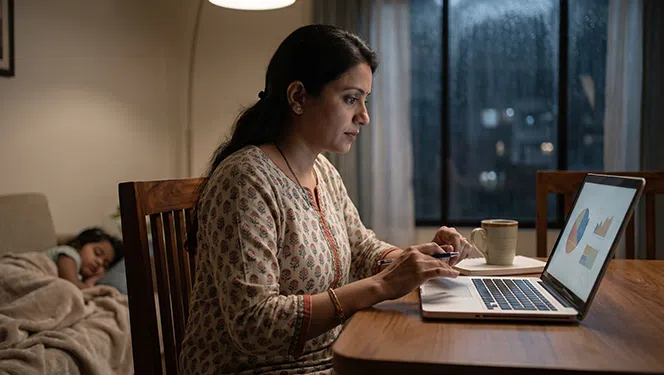
You do not have to become a better parent tonight. You only have to arrive as one.
There’s a small, slightly silly thing that many working parents do that nobody talks about.
You reach your own door. The key is already in the lock. And you stand there one second longer than you need to. Or, if you're like me and work from home, you stay at your desk for just a little longer after closing your laptop.
It isn't because you don't want to be with your child. Sometimes, you need a moment to shift from work mode to parent mode.
You stand there because you know that the moment the door opens, you will be needed immediately, and some part of you is still sitting in the 6 pm meeting that did not go well.
That gap, between the person who worked today and the person your child is waiting for, is where the challenge lies. It is also where a small change can begin.
The reunion is not automatic
Researchers at UCLA once did something unusual. They placed cameras inside the homes of 30 dual-earner couples and observed how families interacted after work and school.
The reunions were not always what we picture. In the recorded parent-child reunions, children showed positive behavior (such as greetings, affection, or moving towards the returning parent) in 59% of mother-child observations and 44% of father-child observations. Distraction was also common.
I share this not to make anyone feel guilty. Thirty families in Los Angeles cannot tell you anything about your house.
But it offers an interesting reminder: reconnecting after work does not always happen automatically. Sometimes, you have to make it happen.
It isn't always about finding more hours. It's also about being emotionally present in the time you already share.
What a transition ritual actually is
Researchers studying work and family roles have examined how people move between roles during the day. Familiar routines can make these transitions easier.
The uniform that comes off. One particular song in the car. Washing your face.
They may sound trivial. That is exactly why they can help. Your mind may not switch off simply because the workday has ended. But familiar actions can signal that it is time to shift your attention.
Research by Dr Sabine Sonnentag, a work and organizational Psychologist, shows that people who mentally disengage from work during their leisure hours tend to report greater life satisfaction and fewer symptoms of psychological strain. Importantly, switching off from work does not mean becoming less engaged or effective at work.
Switching off is not disloyalty. It is maintenance.
When you work from home
If you work from home, the twenty minutes are harder, not easier.
There is no commute to do the forgetting for you. The laptop sits on the same dining table where children will do their homework in an hour. Work from home does not end. It thins out. One more email at 8 pm feels harmless, because you never left.
Your child can see you, but cannot reach you
To a small child, a parent behind a laptop ten feet away is more confusing than a parent in an office across the city. Your child hears your calls through a door that is only sometimes closed. You are right there. Why are you not coming?
Every interruption costs you twice
You lose the workflow. Then you feel guilty for being irritated with your child. Both feelings follow you into the evening.
Everyone assumes you are free
“You are at home only, no?” So, the courier, the plumber, the relatives dropping in, and the question of what to cook for dinner all find you between two calls.
None of this means working from home is a mistake. It means the boundary an office builds for you, you now have to build for yourself.
Here is what helps.
Give your workday a visible signal
A closed door, a particular lamp, a pair of headphones. Tell your child plainly: when the lamp is on, I am working. When it goes off, I am all yours. A clear, consistent rule can help children understand when you are working and when you are available.
Put the laptop out of sight
Closing it is not enough if it stays on the dining table, glowing with unread messages. Put it in a bag, a drawer, a cupboard. What you cannot see, you are less likely to check.
Plan small, predictable check-ins
A five-minute predictable chai break with your child is worth more than an entire afternoon of “Wait, beta, one minute.” When children know you will come, they wait more patiently.
Younger children may need a visual cue or a simple explanation; older children may be able to agree on specific times to connect.
Say your working hours out loud
Tell your family your hours the way you would if you left for an office every morning. It feels awkward the first time. It saves you a hundred small negotiations later.
Being home is not the same as being available. Being available is not the same as being present. This is where a deliberate end-of-work routine can help.
The twenty minutes, broken up
Nobody has a spare twenty minutes. So this is not extra time. It is time you already spend, spent differently. The 20 minutes are simply a suggested framework, not a fixed or scientifically prescribed duration. You can adapt the time and steps to suit your workday, your child's needs, and your family's routine.
1. Five minutes: Close the day, not the laptop
Before you leave your desk, write down the three things waiting for you tomorrow. Unfinished work does not stay at the office. It travels home in your head and speaks in your voice at the dinner table.
Writing these tasks down can help you organise unfinished work and signal to your brain that it is safe to stop.
2. Five minutes: The in-between
The auto-rickshaw ride, the last stretch of the walk from the bus stop, one lap around the building, one song. Whatever it is, guard it. This is not the time to clear your inbox.
If you work from home, this matters more, not less. Step outside for a short walk, stretch, run errands, or move away from your workspace for a few minutes. Your body can benefit from a change of setting even when your commute is only a few steps.
Ten minutes outside, between closing the laptop and opening your arms, does what the auto ride does for everyone else.
3. Two minutes: The threshold
Change out of your work clothes. Wash your face. Put your phone away or switch off non-essential notifications.
Do the same two things in the same order whenever possible. The repetition is the point—that is what turns it from a nice idea into a ritual.
4. Eight minutes: Arrive at your child, not at the house
Sit down. Get to their eye level. Do not ask "How was school?" which every child on earth answers with "fine."
Ask nothing at first. Let them show you something.
Eight minutes of undivided attention can help your child feel seen and heard. It may not transform the rest of the evening, but it gives you a chance to reconnect before the day's demands take over. Ten minutes of half-attention buys you nothing, and you feel it.
The 20 minutes are a starting point, not a prescription. Adjust the routine to your work schedule, family circumstances, and your child's needs.
Start with one
Do not attempt all four tomorrow. You will manage it for three days and then give up and feel worse than when you began.
Pick one. Most parents find the threshold step easiest because it costs two minutes and no negotiation.
And please, no villains here. If your partner walks in scrolling, this can be explored together. Many of us have never consciously thought about the transition between work and family life.
Your own parents had no vocabulary for transitions; they had a 'hisaab' of school fees, rent, and getting everyone fed. You can build something they did not have without holding it against them.
Some evenings the ritual will not happen. A deadline, a fever, a train that does not come. That is not failure. A ritual survives being missed. That is what makes it different from a rule.
Tomorrow
Before you open your door tomorrow, put your phone inside your bag and zip it shut.
Then open the door.
It may seem like a small thing to everyone else. Or nobody in the house will notice.
You will notice the difference.
Anjali Sharma is founder and editor of ‘The Balanced Working Mom,' a site for Indian women navigating marriage, motherhood, work, and the version of themselves that tends to go missing in between. Her writing rests on one idea: you can build a beautiful life without disappearing inside it. She works as an SEO consultant for a Lisbon-based company, serving global clients from a remote village in Punjab.
Need more information? Trusted sources:
1. Campos, B. et al. (2009). Opportunity for Interaction? A Naturalistic Observation Study of Dual-Earner Families After Work and School.
2. Sonnentag, S. (2012). Psychological Detachment From Work During Leisure Time: The Benefits of Mentally Disengaging From Work.
3. Ashforth, B. E., Kreiner, G. E., & Fugate, M. (2000). All in a Day's Work: Boundaries and Micro Role Transitions.
Published on: November 19, 2026




























Comments
Edit
Comment Flag
Cancel Update