
Check Out These Activities To Make Learning Science A Fun Experience For Your Child
Hannah S Mathew
Studying Science doesn't just add to your child's knowledge bank, it impacts the way they think. Even so, the subject can be boring. We tell how to bring the fun element into learning Science
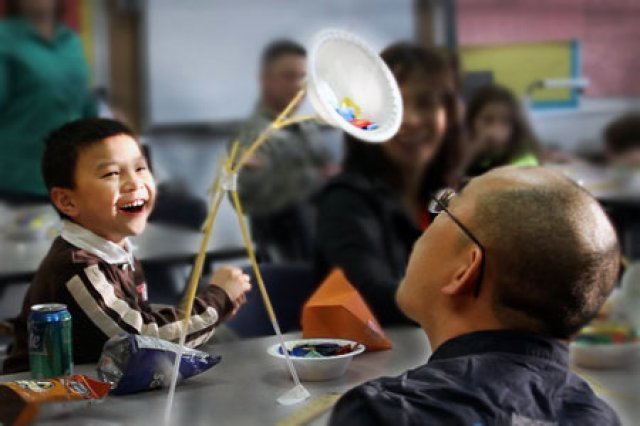
Having fun is an important component of learning and development. And, when it comes to Science, being attuned to the scientific temperament of your child will help you make the learning of the subject interesting for children. Also, making Science fun will help children learn better. But, first of all, let us see the significance of learning Science.
Through Science, your child can learn a few very important things.
Learning Science -
- Reveals the workings behind the wonders of nature around them
- Keeps them well-informed and, thereby, makes them an interesting communicator
- Urges them to search for proof about issues that cancel false beliefs
- Helps them care for the world around them
- Prepares them for a career in Science in the future
Now, how do you get your child interested in Science? The key word is 'relevance'. Children will always pay attention when the topic is of relevance to them. Weave your everyday conversations with them around Science. Whenever possible, introduce them to scientific tools like a magnifying lens, an hourglass, a pair of binoculars, or a periscope.
As you embark on this voyage of making your child learn to love and enjoy the surprises that Science holds for them, focus on getting the basics correct right from the start.
Listed below are some sample activities to make Science fun for your child depending on his age:
Primary schoolers (Ages: 6 to 9)
1. Citizen Science:
This includes extremely simple scientific surveys that your child can conduct. Here's one example - Kitty and Sarvesh, two children living in an apartment complex in Mogappair, Chennai conducted a study to find out the average number of times a person cracked the knuckles. Their sample consisted of 50 people on their campus who were between the ages of 30 and 45. Your child can go in for similar simple and interesting surveys.
2. Seeds to Saplings:
This activity is mainly about observation. Get your child to try and observe the best depth at which to plant a seed or the rates at which different seeds grow. They could use a window planter and plant several seeds in a row. Depending on the experiment, your child needs to bury the same kind of seed at different depths or different seeds at the same depth. Place little flags near each planted seed to note the placement, type, or depth of each seed. Now, they can watch the saplings as they grow and record their observations in a journal. They can note down the difference in growth rate, color, texture, and so on.
Preteens (Age: 10-12)
1. Building a composter:
This is always an interesting subject for children. If your child is the kind who doesn't mind getting messy, then they can start the process by finding a lot of information on the different types of composting. Select a few videos for them to watch and figure out how they want to go about the construction. Your child might need monitoring if they are handling worms or chemicals. Make sure you use the 'black gold' that develops in your garden soil.
2. Using magnetic slime:
This isn't just great to play with, it's also fun to make. Some metal filings, homemade slime, and a few magnets can help your child understand magnetic fields, different powers of magnets, properties of fluids, viscosity, and so on. Children would especially love it if you taped a video of their experiment and posted it online!
Teens (Age: 13+)
1. Garden in a bottle:
This involves the use of a chemical solution and various chemical compounds to create what will eventually look like an underwater garden. The compounds, when dropped in the solution, take on different colors and shapes. A few tries will make your child an expert at dropping the compounds at well-spaced intervals. Teach them to record their observations of these chemical reactions.
2. Pisciculture (fish farming):
This is an exciting way to learn about reproduction and growth in fish. All it takes is a little space and a few large containers. Again, there is a lot of information available online on which kind of fish thrive best, what fish food to administer, ideal temperatures, how to separate the smaller fish so that the bigger ones don't eat them, and so on. Your child can maintain a very creative journal with diagrams of observations and personal thoughts. More importantly, they can track the life cycle of the fish from the time they hatch till they are fully grown.
Note that adding steps to each activity or lesson can make it more interesting. Use a combination of reading material, videos, and journaling to add a twist to every task. Ensure that you help your child do the groundwork first. This will help them think more about what they are accomplishing.
Career Options in Science
Besides the obvious career choices like Medicine and Engineering, there are numerous other professions that your child can pursue. Some interesting choices are Astronomy, Chemical Engineering, Marine Engineering, Animal Science, Biochemistry, Forensic Science, Environmental Technology, and Hydrology.
Some inspirational leaders in the field of Science
- Amil Kumar Das was lauded worldwide for his accomplishment in Astronomy when he was the first person to make observations of quakes on the sun from his solar tunnel telescope in Kodaikanal's Solar Observatory.
- NASA-acknowledged inventor, Uddhab Bharali, has 118 inventions patented to his name. The recipient of many national and international awards, his inventions focus on making life better for the illiterate and the physically impaired.
Remember that developing an interest in Science is a gradual process and it requires patience. Guide your child through the stages of learning patiently, try to kindle their curiosity, and do not force-feed any information. Rest assured, exploring the field of Science will be the beginning of a life-changing journey for her.
Enhance your child's cognitive skills and scientific thinking skills with The Dot Me and My World program for kindergarten. It provides a solid foundation in science through sensory explorations and engaging experiments.




























Comments
Edit
Comment Flag
Cancel Update