
Is Acid Reflux Causing Your Infant’s Fussiness And Throwing Up?
Subhechha Chatterjee
Worried your infant is fussy during feeds? Wondering what's causing them to frequently throw up after feeds? Acid reflux could well be the culprit. Find out more about this condition.
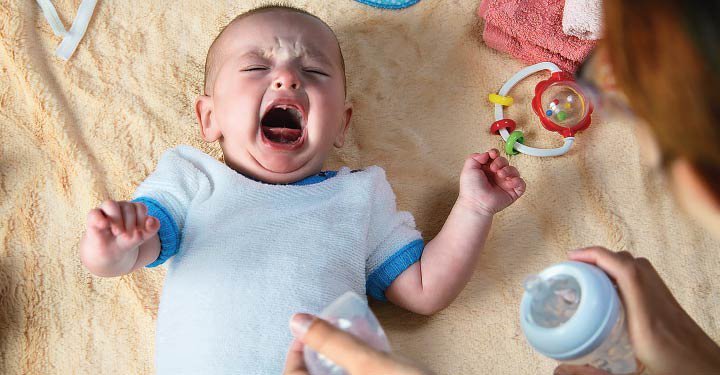
When my niece, Riya, was about five months old, she would often spit out what was fed to her and remain irritable throughout the day. Due to this, she almost stopped gaining weight. Her parents were worried and clueless about what was going wrong with her. Finally, a thorough check-up by a pediatrician showed that my niece was suffering from acid reflux, often termed gastroesophageal reflux (GER). She has since overcome that condition and is now almost two years old with no signs of acid reflux.
Riya's parents acted early and rightly so. Acid reflux is very common among babies, more than two-thirds of infants experience symptoms of GER. To overcome the condition, all it requires is simple lifestyle changes and some simple home remedies. But first, let's try to understand what causes acid reflux in infants.
Common causes
When the contents of the stomach take the reverse route and go back up into the esophagus (food pipe) or mouth instead of proceeding further down for digestion, it is termed acid reflux.
This is a common problem in infants primarily because of an immature lower oesophageal sphincter, which is a bundle of muscles at the junction of the food pipe and stomach. When your baby swallows, the sphincter relaxes and lets the food pass. The muscle is then supposed to stay closed so that the stomach contents do not flow back to the mouth. However, in some babies, since the sphincter is not fully developed and is partially or fully open, the food flows back into the mouth.
Other common causes of acid reflux
- Dependency on a liquid diet
- Premature birth
- Spending a lot of time lying on the back
- Excessive/frequent feeding
- A narrow esophagus
- Not burping the baby after feeds
Signs of acid reflux
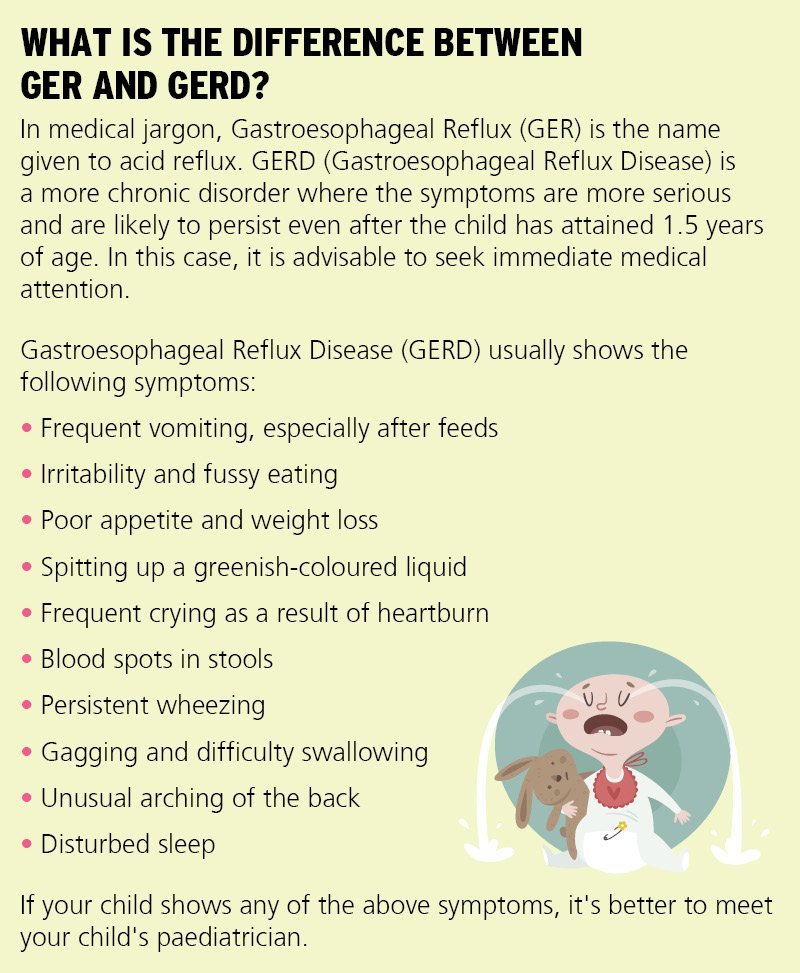
The primary sign of acid reflux in infants is the tendency to spit out liquid feed. It is sometimes accompanied by hiccups, a sour breath, and irritability.
Acid reflux or GER is quite common among babies till about 18 months of age. As the infant's digestive system gradually firms up and becomes well-developed, the signs of acid reflux tend to wane, leading to better digestive abilities in the child.
Diagnosis of acid reflux
Generally, doctors easily conclude that a baby is suffering from acid reflux based on the symptoms. However, they could suggest a more conclusive diagnostic test to be doubly sure of the cause. A few such diagnostic tests to ascertain acid reflux include:
- Ultrasound: This is done to check for blockages in the upper abdomen using high-frequency sound waves.
- Barium Swallow Test: The baby is made to ingest chalky-white barium liquid which forms a coating in the gastrointestinal tract, thus helping identify if there is any obstruction in the GI tract.
- Blood Test: This is done to ascertain that the symptoms are not a result of any underlying infection or disorder.
- pH Probe Test: A slightly invasive process where a pH probe is passed through the baby's mouth to the stomach, to check the acidity of the baby's stomach. This is not a very common test and will be required only in specific conditions.
- Endoscopy: An endoscope is inserted through the baby's mouth to help the doctor get a clear picture of the gastrointestinal tract. Again, this is not a very common test for infants and will be required only in specific conditions.
Treating acid reflux
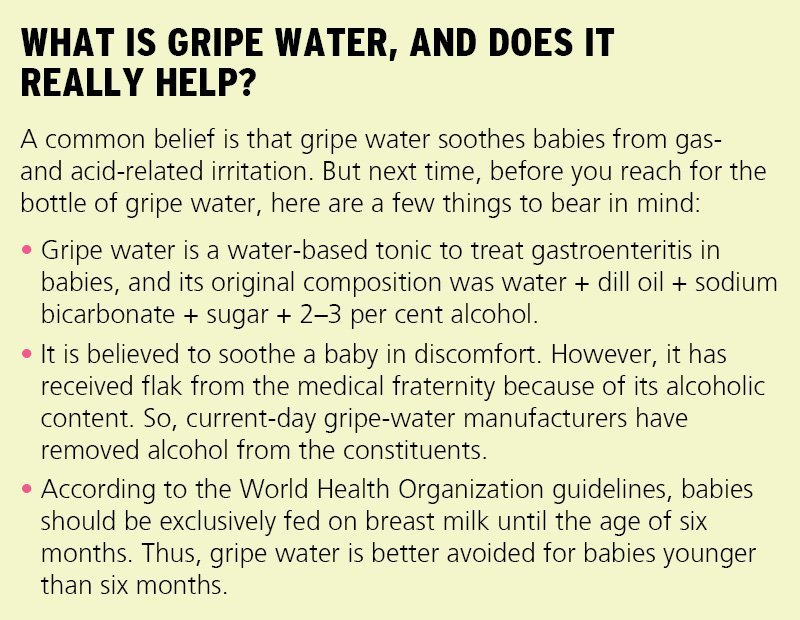
Acid reflux can be easily treated at home with certain lifestyle changes. Here are some simple steps that can help:
- Give smaller feeds at regular intervals instead of large feeds after prolonged gaps.
- Ensure that you keep your baby upright and in a sitting posture during the feed. "My daughter was about 4 months old and one day, she suddenly spat up right after what I felt was a good feed. I was worried and visited my child's pediatrician. The doctor suggested that I adjust my baby's position while feeding and keep her upright for about 15 to 20 minutes after a feed. The problem considerably reduced after that," shares Geetha, a mom of a 1-year-old.
- Burp your baby after every feed so that the trapped gas can escape.
- Avoid bouncing your baby, as any upward or back-and-forth movement may lead to regurgitation and vomiting.
- Make sure your baby wears comfortable, loose-fitting clothes, as tight babywear or diapers can trigger a reflux.
- If you are a breastfeeding mother, avoid consuming vegetables like cauliflower and cabbage, or other food items that tend to induce gas. "Initially, when my baby would spit up, I used to get very disturbed. But I began to keep a check on my diet and I realized it helps," shares Malini, a mom of an eight-month-old.
- Ensure that your baby latches on to your nipples correctly during breastfeeding. If the latch is incorrect, your baby may swallow excess air along with the milk, thereby triggering them to spit out the feed.
- Bottle feeding increases the chances of swallowing air and regurgitation due to overfeeding. If you are bottle-feeding your baby, use the right bottles so that air-swallowing can be kept to the minimum. The use of appropriate nipples is also important.
- If your baby is older than 6 months, a slightly thicker feed can help reduce the occurrence of acid reflux.
Despite these simple remedies, if the signs of acid reflux persist, your child may be advised to take a mild antacid. This will be purely based on the doctor's advice after a thorough assessment of your baby's condition.
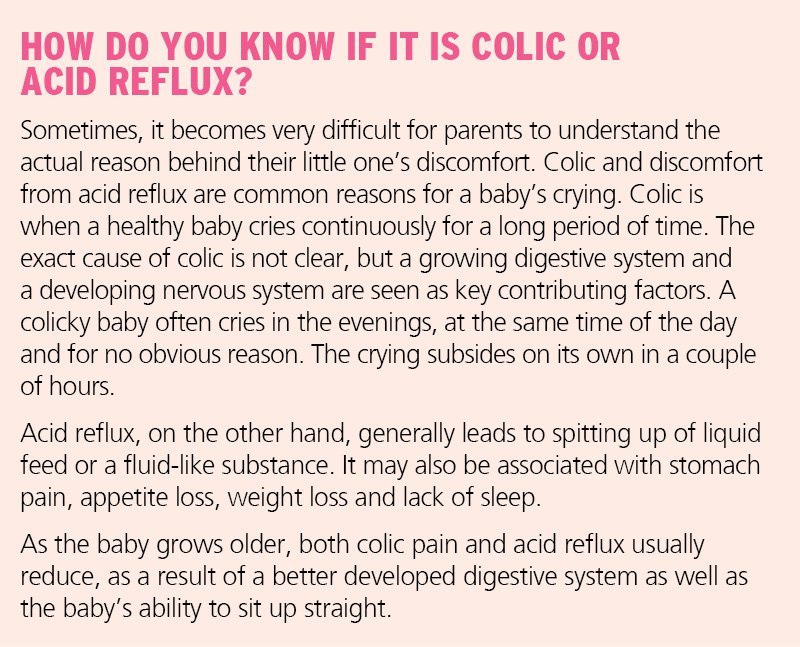
Most cases of acid reflux are not serious. By the time your child turns a year and a half, their digestive functions will improve, and the signs of acid reflux will reduce. Try out the home remedies and keep a check on any signs of improvement. If you feel that the condition is deteriorating despite the suggested remedies, consult your pediatrician for the next course of treatment.
This article has been reviewed by Dr Satish Laddad, a paediatrician, and founder and director of Docterz, Mumbai.
























Comments
Edit
Comment Flag
Cancel Update